
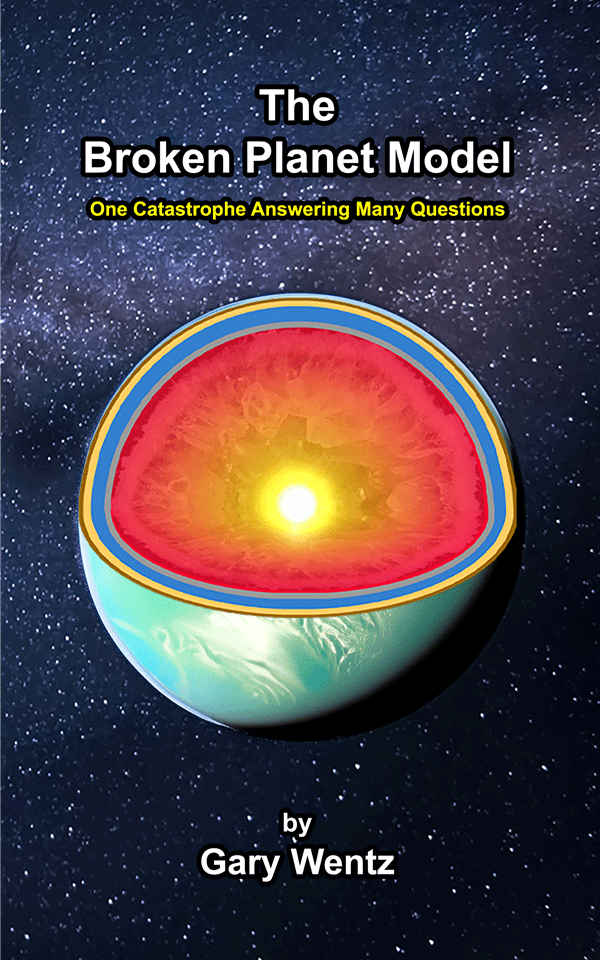
Contents:
Section I — INTRODUCTION & FOUNDATION
Section II — PRE-FLOOD STRUCTURE OF THE EARTH
Section III — CATASTROPHE – THE BROKEN PLANET
Section IV — SCIENTIFIC RAMIFICATIONS OF THE MODEL
Section V — SCIENTIFIC PREDICTIONS & FUTURE RESEARCH
Appendix A: Effects of the BPM Across All Disciplines
Appendix B: BPM Summary and Scientific Impact
Appendix C: Scientific Predictions of the Broken Planet Model (BPM)
Appendix B: BPM Summary and Scientific Impact
The Broken Planet Model (BPM) is not a correction of mainstream thought—it is a total systemic replacement. It resets our understanding of Earth’s structure, history, and observed features by demonstrating that a single global catastrophe shattered the original creation and reshaped the Earth in days, not years. Every major field of science is affected, and each apparent anomaly in secular models finds resolution under this singular, one-time, inimitable event.
Geology
In geology, the BPM reveals that Earth was once structured in concentric, organized layers—Atmosphere, Soil, Bedrock, Water Layer, Mantle, Outer Core, and Inner Core. The crust was not a patchwork of drifting plates but a continuous shell composed of uniform Bedrock with soil on top. The Lithosphere was not an amalgamation of several elements combined in a chaotic manner. Above the firm Bedrock Layer, a thin Soil Layer supported vegetation and life; below it, a 15–18 mile-deep Water Layer acted as a hydrothermal heat stabilizer, which the Bedrock radiated to the Soil Layer. Beneath that sat an intact Mantle.
The event of global restructuring began with a celestial impact—centered at what is now Iceland—that punctured the Bedrock and penetrated the Mantle, triggering global collapse when the encased Water Layer met air from above and lava from below. “Mohorovičić Discontinuity” (Moho) is the modern name for the collapsed chamber made of Bedrock above and Mantle below, in some areas, or simply plate on plate in others. The Moho chamber (housing the Water Layer) collapsed entirely, as the Bedrock cracked into the segments we now term Tectonic Plates. Some fragments remained at the surface of the Mantle, others subducted into the Mantle, or stacked upon each other. Pressurized lava burst upward through these fractures, forming volcanoes, plateaus, islands, and other formations, such as the foundations of the continents. Lava that did not escape to the top of the plates remained trapped under them and became what we now call the asthenosphere—a soft layer of magma and lava that keeps the plates above in a dynamic, tectonic condition.
When the lava escaped, contacting the Water Layer above, much of the water was sucked into the void that the extruded lava produced. It is estimated that as much as 7/8ths of the Water Layer went into the Mantle and Outer Core. This had a negative impact on the magnetosphere that the Outer Core produces. Other debris, such as Bedrock and Mantle shell fragments added to the Outer Core and Mantle’s contamination. This left only a fraction of the water above the Bedrock plates to become deep oceans.
As lava erupted, it formed new landmasses and islands above the shattered plates along with the former Soil Layer, now turned to mud. As the mud partially hardened by the lava’s presence, and large mats of mud were moved around, collisions of moving mats became mountains, and cracks in them became canyons. These giant mats of mud, suspended in water, were piled up into what we now recognize as continents and islands. Inland seas, lakes, and rivers formed when water became trapped in natural depressions upon these lifted and dried rock mats. Stratification of sediments occurred rapidly by particle size and density as layers of mud settled in waves, explaining the structured layers seen today in sedimentary rock (the current term for what became of the original Soil Layer through extreme pressure and heat after liquification).
Paleontology
In paleontology, the BPM shows that fossils formed through violent, sudden burial, not gradual sedimentation. Entire biomes, filled with flora and fauna, were entombed mid-motion, as they were captured globally. Polystrate fossils, bent strata, marine fossils at elevation, and the rapid petrification of wood all point to swift processes under heat and pressure. Fossilization occurred under stacked, water-deposited mud layers that were quickly compressed by subsequent flows. Heat was generated by nearby lava to accomplish the fossilization process. The fossil record is not a sequence of eras, but a geologic pileup of a one-time, inimitable event.
Meteorology
In meteorology, the Flood destroyed the serene and stable balance of the pre-Flood world. Originally, the Atmosphere was stable, uniform, and rich in oxygen, supporting human longevity and the megafauna and flora now extinct. Rain did not fall heavily in torrents; instead, it fell gently and regularly but in small measure—more like a mist than moderate rain. There were dual water cycles: the same water cycle we now have in our atmosphere, and another lost cycle under the earth. The lost water cycle was between the Water Table and the Water Layer (through the Bedrock). The Water Table acted as a pre-filter and sealant, preventing surficial elements from contaminating the Water Layer, while ensuring the anaerobic seal of it. The Bedrock further sealed and filtered out harmful elements while keeping the Water Layer in a state of super-heated stability.
When this well designed system was demolished, pressure, heat, and water escaped, as the world’s Crust fell. Gases vented. The Atmosphere lost uniformity and became super-saturated with water particles. Wind, storms, and rain began on a level previously and since unimaginable. Hypercanes covered the surface of Earth, entirely. The Ice Age sprang up, mid-Flood, caused by the super-saturated atmosphere, fueled by hot oceans, volcanic particulates, and sudden surface cooling from the solid global overcast. This one-time, inimitable event left lingering glacial remnants on and near the poles but is no longer repeatable due to post-Flood desertification at the poles. Jet streams, monsoons, and polar vortices emerged only after terrain and rotation stabilized.
Oceanography
In oceanography, the oceans as we know them did not exist before the Flood. Pre-Flood seas were shallow, fresh, and likely no more than 1,000 to 1,500 feet deep—plenty of depth for giant marine life, like whales, megalodons, colossalsquid, and plesiosaurs. These waters were also captured, surrounded and eventually incorporated into the escaped waters during the Flood. But at least one sea must have remained cohesive long enough for marine life to endure the process. The ocean floors are plates of the Bedrock that did not have the lava and mud mats form continents upon them. Oceanic salinity is a result of mineral leaching from magma and lava contamination. “Seafloor spreading” (a misnomer) is the result of residual mantle pressure venting and carrying some lava onto the ocean floor—not ongoing plate drift.
Biology
In biology, the pre-Flood world supported larger and longer-living life forms due to ideal pressure, oxygen concentration, and the absence of ionizing radiation. The Atmosphere shielded the surface from solar and cosmic radiation, while the totality of geo radiation was contained within the Mantle. This pristine condition was shattered during the Flood. A massive radiation event—a one-time, inimitable release of stored mantle radiation—swept over the globe as lava erupted and layers broke apart. This sudden exposure caused genetic degradation to all lifeforms, shortening lifespans, causing defects, and creating a new, hostile environment. Gigantism disappeared. Disease and mutation were introduced. Biodiversity was reduced. Life became fragile and frail, susceptible to disease.
Physics
In physics, the conservation of angular momentum accounts for Earth’s shift from a 360-day year to a 365.25-day year. As Earth’s radius shrank by ~47.3 km during the collapse, its rotation rate increased. This shift is mathematically predictable and provides physical confirmation of the global structural loss. Magnetic phenomena are also explained under BPM. The Bedrock Layer, struck and tilted during the initial impact, preserved its magnetic alignment even after the crust collapse. This tilt (23.4°) explains the divergence between True North and Magnetic North and the alignment of volcanic anomalies in Iceland. What are called “magnetic reversals” are better explained as magnetic layers being flipped, warped, or relocated during crustal chaos. The pre-Flood magnetosphere would have been stronger and more uniform, but the post-Flood Earth is a jumbled magnetic mess.
In radiology and dating science, BPM invalidates uniformitarian assumptions. Radiometric dating depends on steady decay rates and a constant radiation environment—neither of which are aligned with the Flood. The radiation accumulation we measure today is a tiny trickle compared to the single, global burst released during the event. That one-time, inimitable radiation dump is responsible for nearly all measurable isotope shifts. Any dating method relying on current decay patterns without acknowledging this singular disruption will always misinterpret Earth’s age. The Flood is not only a historical reset—it is a radiological one. The singular, massive flood of radioactive ions is the culprit, not a trickle over many eons. This is why radiometry is a failed clock for determining time lapse.
Astrophysics
The BPM presents a unique and testable celestial framework by explaining Earth’s axial tilt (23.44°), orbital plane shift (7.25°), and lunar misalignment as direct consequences of a massive impact near Iceland. The Moon’s current orbital inclination and eccentricity, along with Earth’s path relative to the Sun, are shown to be permanent alterations to a previously synchronized Earth-Moon-Sun system. Unlike other Flood models, BPM is the only one that directly addresses orbital mechanics, predicting a southward displacement of Earth, a damaged magnetosphere, and long-term orbital instability as residual effects of a literal collision. These astrophysical markers are presented as indicators of divine judgment—locked into the sky as lasting evidence of the event.
Anthropology
In anthropology, archaeology, and mythology, the broken world left cultural scars. Every major civilization retains legends of a global flood, advanced pre-flood peoples, and sudden destruction, since their founders were all cousins in the family of Noah and his three sons. From Sumerian kings to Chinese emperors, from Native American flood myths to Norse giants, echoes of the same catastrophe resound like in a decades-long game of telephone. The division of family members at the Tower of Babel, the forced dispersion of humanity, with early ziggurat-building aspirations, are not allegories—they are historical memories. Ancient ruins and megalithic structures testify to early post-Flood genius followed by decline. BPM bridges the mythic and the factual, revealing how memory and geology are part of the same record. Devolution is evident in all cultures, clans, and conventions of man—from the DNA building blocks in our bodies to the bricks in our streets.
Geomagnetics and Planetary Alignment
In magnetism and planetary alignment, the BPM provides resolution where secular models look the wrong way. Magnetic North and True North are misaligned not because of wandering molten cores, but because the original Bedrock crust was canted at impact and preserved that tilt upon collapse. Iceland’s magnetic declination and volcanic pattern reflect that frozen orientation. What mainstream science reads as “magnetic striping” on ocean floors is actually the result of flow orientation during rapid lava deposition. The alignment is not global, not periodic, and not reversed over time—it is chaotic residue.
Worldview
In worldview and theology, the Broken Planet Model affirms the biblical narrative. It restores Genesis as literal history. The Flood was real, global, and catastrophic—an extermination level event. Earth was once perfect, then broken. Every discipline will confirm it when unshackled from failed and frantic uniformitarian bias. The Scriptures told us what happened. The Earth’s condition agrees. We can demonstrate the age of Earth now with more precision than ever before. We can see how the Bible was right all along and the Enlightenment crowd was not. But they’ve had their time in the spotlight. Now it’s time for God to make an appearance on the stage of your heart. Let Him have His time in your spotlight and see what He tells you. See what love He has for you that no human can match. But know through this study that His grace has a limit. He will only take our abuse for so long before He acts again. And if you will turn to the Bible’s pages of prophecy, which are just as accurate as its pages of history, you will see that it can be trusted as truth for our future. Read my book, End Times Made Easy, for a clear teaching from the Word of God on what to expect in our near future.