
Contents:
Section I — INTRODUCTION & FOUNDATION
Section II — PRE-FLOOD STRUCTURE OF THE EARTH
Section III — CATASTROPHE – THE BROKEN PLANET
Section IV — SCIENTIFIC RAMIFICATIONS OF THE MODEL
Section V — SCIENTIFIC PREDICTIONS & FUTURE RESEARCH
Appendix A: Effects of the BPM Across All Disciplines
Appendix B: BPM Summary and Scientific Impact
Appendix C: Scientific Predictions of the Broken Planet Model (BPM)
SECTION III: CATASTROPHE – THE BROKEN PLANET
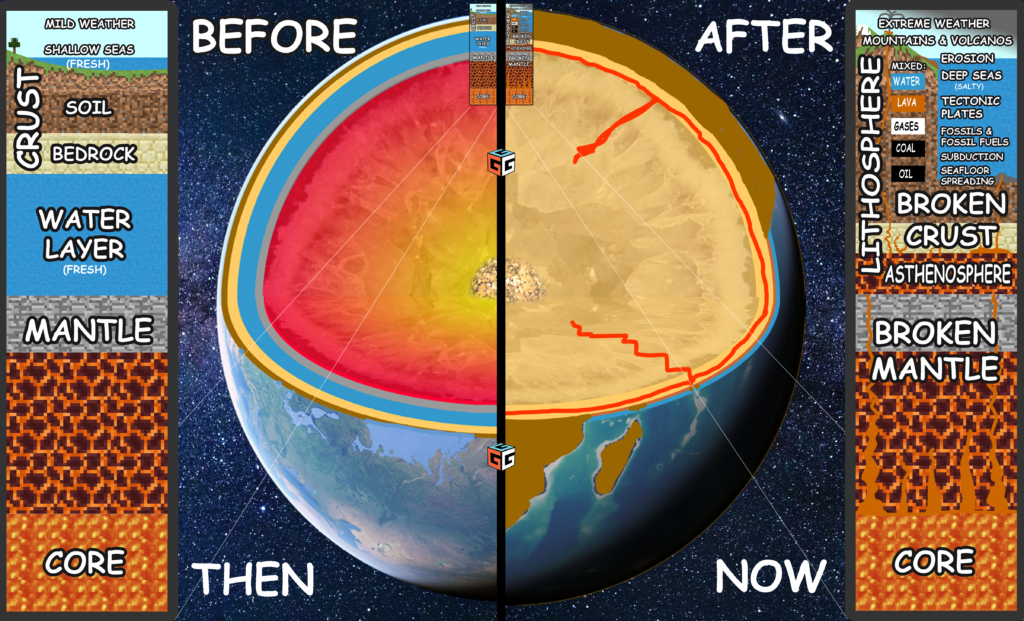
Flood Introduction
The Flood began not with rain, but with explosive destruction and torrential rage that only the Living God could unleash. In mere moments, Earth’s impeccably arranged and beautifully adorned layers were dashed by a celestial bullet sent by the Maker’s own hand. This was the defining moment—the beginning of global judgment and catastrophe.
When the meteorite struck, the immediate result was a rapid transfer of debris flung into the heavens, with waves of destruction rippling through the Earth’s delicate structure. The force of the impact did not merely puncture the layers—it set off a chain reaction from deep within, both outward and inward, that peeled back its skin and crushed its heart. Forever wounded. Forever broken. Forever scarred. This Broken Planet would never be the same.
The catastrophic sequence began the moment of impact, piercing through the thin crust of the Pre-Flood Earth. The impact site—now called Iceland—became the focal point of a world-shattering chain reaction. The Bedrock soon began to crumble. The Water Layer—sealed for 1,656 years—was violently exposed to open air for the first time. The Mantle released much of its precious lifeblood—lava—under immense pressure. What followed was not just a flood, but a global-scale explosion of unimaginable power—the extermination of almost all life.
Impact
It abruptly came from the depths of outer space, a meteorite moving with the speed of a cosmic bullet. Unlike smaller meteorites that burn up in the atmosphere, this object was far too large, dense, and swift for any atmospheric resistance to slow it down. It was judgment, sent by the Creator in the form of a celestial gavel, punishing the rebellious planet for its sins.
When it first hit the mesosphere, it began to blaze. In the stratosphere, bits of it began to peel off in fire and smoke, trailing like a dragon’s tail tugged through delicate air. In the troposphere, the fury only magnified as it lit up the sky with its impending doom. The atmosphere, Earth’s first line of defense, barely got its attention as it careened too fast for its sound to keep up. A lesser object would have been consumed quickly in these layers of gaseous friction, but not this ball of rock and wrath. It was not even fazed by Earth’s shield of protection. The resistance of the air only ignited its flaming wrath. This was pure kinetic energy about to explode and wreak havoc upon a surface thousands of times its size.
The impact site—what is now Iceland—received a direct hit, and in mere minutes the planet was violently, eternally, and decisively transformed.
The moment of impact was brief but certain. Until these few seconds, nothing on Earth had yet changed for its millennium-and-a-half existence. Except for that one spot and moment, the Pre-Flood world was just as it had always been: lush, vibrant, perfectly balanced to support all forms of life that the Creator had lovingly placed upon this once utopian orb. But now the love had turned to judgment, and His immense ire was released.
The Icelandic Plume
Unlike other volcanic regions on Earth, Iceland sits directly atop a major rift—a scar from the primary rupture. Besides its raised elevation, the single reason Iceland stands out as the impact site is the vast shaft punched beneath it. The Icelandic Plume, as it’s called, is an anomaly in global geology that lies beneath the Mid-Atlantic Ridge. It extends deep into the Earth’s interior and exhibits properties that differ from all other Mantle regions. This plume is best understood not as a simple upwelling of magma but as the path of destruction left by a meteorite as it plowed into the Mantle. The sheer depth, width, and thermal activity of the plume all suggest a one-time catastrophic event rather than a slow-forming geological process. It is the deep wound of a celestial bullet, filled with Earth’s lifeblood—lava. It is forensic proof of what we can call Ground Zero.
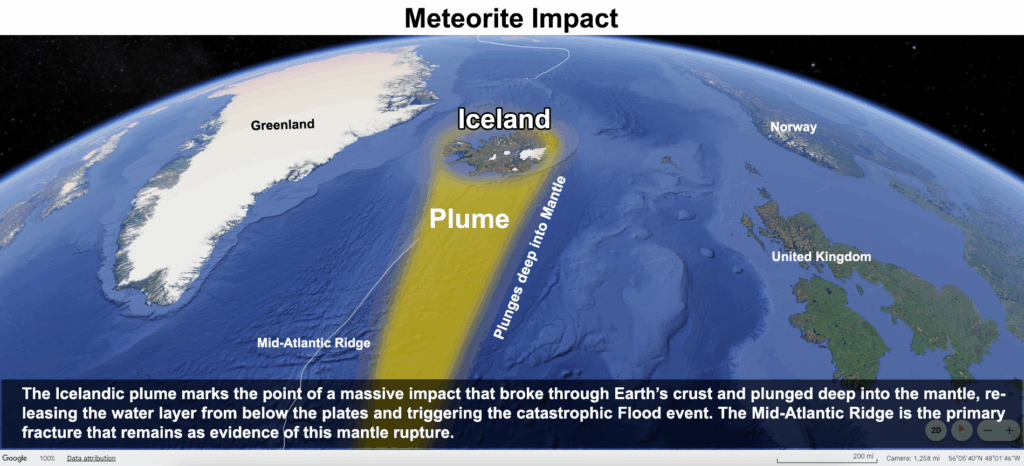
The meteorite’s exact size and density are uncertain, but the presence of the deep Icelandic Plume suggests a large, high-velocity object with significant force. Further study is needed to estimate its properties.
Image: The Iceland Plume is a shaft that plunges deep into the Mantle under Iceland.
This scab on the planet, now known as Iceland, covers a deep wound that portrays what can only be the remnant of the impact site. But why is it not a crater like other surficial impact sites? It is due to the original composition of this broken planet. You see, the Earth had a much different Crust then than what we see today. When this meteorite hit, it punched through a relatively thin layer of soil on rock. And those two layers sat upon a thick layer of water. And that Water Layer is the reason why this does not look like any other impact site known to mankind. That Water Layer made an impact crater an impossibility. Craters happen when they hit solid ground. This Bedrock, placed on water, allowed the cosmic rock to punch right through.
| Key Points:The Flood began with fire, force, and fury, not just rain.A massive meteorite impact triggered a global catastrophe.The impact site (now Iceland) became the epicenter of destruction.The force of the impact pierced the thin Pre-Flood Crust, exposing the sealed Water Layer for the first time in 1,656 years.The Mantle released immense lava pressure, fueling further devastation.The meteorite struck with incomparable velocity, burning through atmospheric layers and hitting with pure kinetic wrath.The Icelandic Plume is a geological scar, evidence of the catastrophic rupture.Unlike other impact sites, Iceland is not a typical crater because it struck a Crust resting on a Water Layer, allowing it to punch through instead of leaving a traditional depression. |
Explosions
Hitting something is not the same as having that impact create an explosion. It’s like the difference between shooting a metal plate versus shooting a metal canister full of propane. In this case, the first impact was upon a surface of dirt, with underlying rock being struck immediately after. But as you are about to see, there was more to this meteoric impact than what is normal, due to what was beneath the surface.
Soil Layer
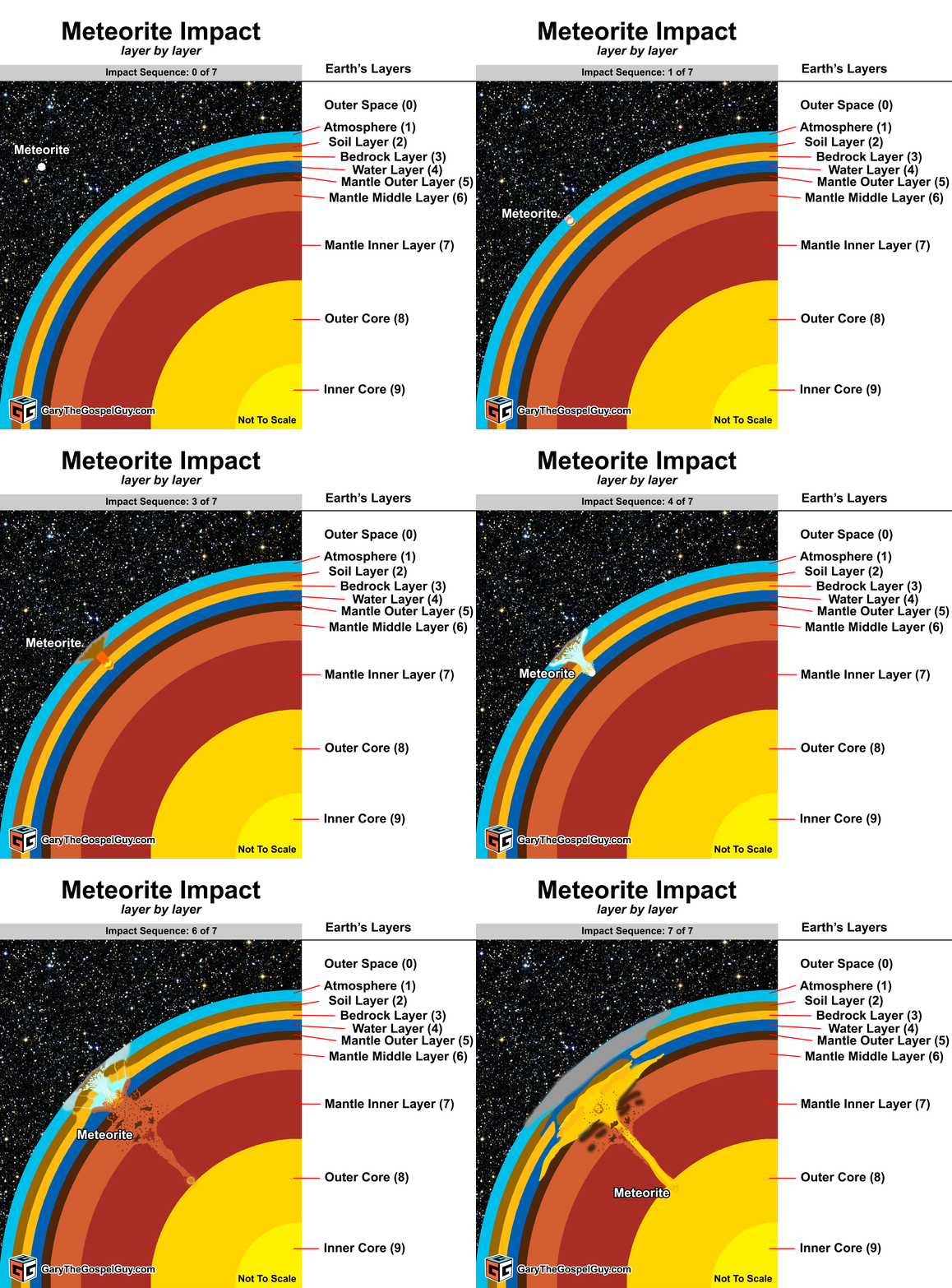
The first layer to be impacted, I call the Soil Layer. The meteorite struck with such force that it did not merely displace soil—it vaporized it on impact. A fireball erupted at the point of impact, instantly turning the uppermost contact point into an expanding plume of superheated debris. Shockwaves radiated outward, compressing then flinging the surrounding soil into an explosive dash through the troubled air. A towering debris cloud was launched skyward, carrying with it chunks of earth, vegetation, and rock, obliterating everything within the impact zone on the Earth’s soiled face. The sudden compression of matter beneath the impact created an underground shockwave, sending ripples of force downward into the layers below. This was only the meteorite punching right through the Soil Layer, but the true destruction was just beginning. The impact’s energy now reached the unsuspecting Bedrock Layer.
Bedrock Layer
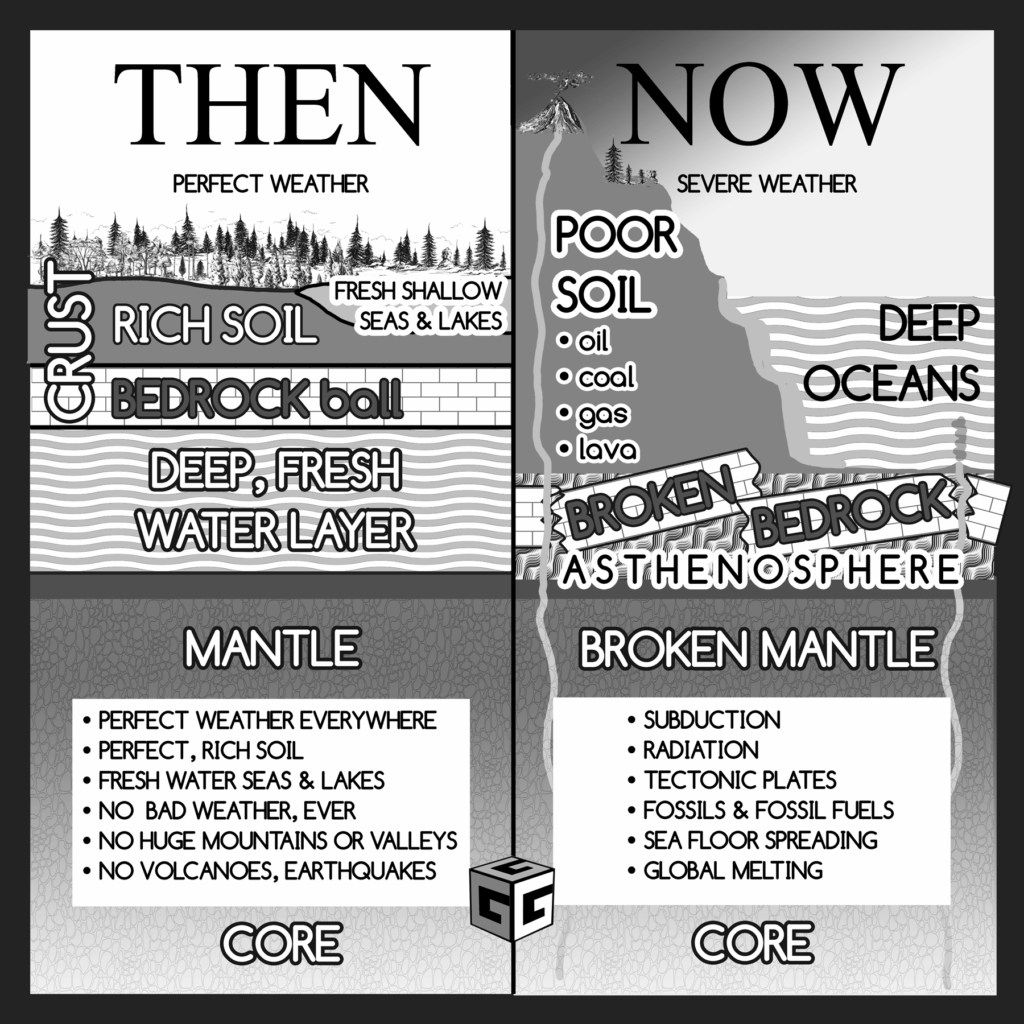
Unlike our Crust today, the Bedrock Layer was not resting on solid ground—it sat atop the vast subterranean Water Layer that had been sealed beneath it for over 1,600 years. Because of this unique configuration, the impact did not create a typical crater, as if on solid ground. Instead, the force of the impact had a radically different effect: it punched through the miles-thick Bedrock Layer like a bullet through a thin sheet of metal, leaving a hole in it as it pushed on through the Water Layer below. The water couldn’t stop it either. Its target was the heart of the Earth, deep within the Mantle.
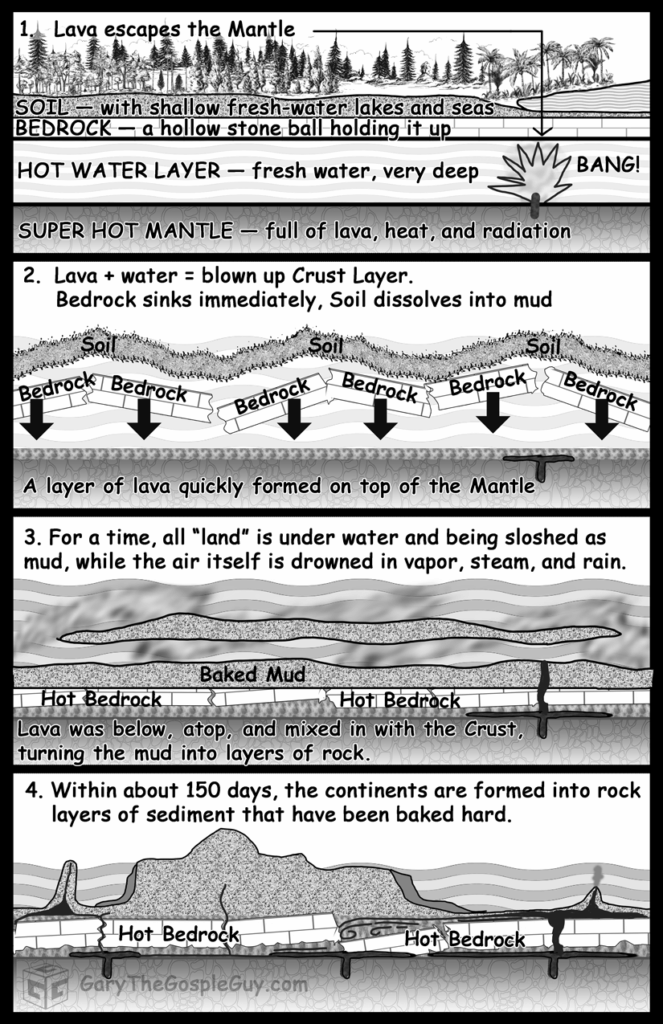
This initial impact did not completely destroy the Crust’s Bedrock; it only punched a hole in it. But because that water under it was super hot (hundreds of degrees, Fahrenheit) and had not ever been exposed to air before this moment, the water instantly and violently expanded into steam. This first expansion, along with the kinetic energy of the impact upon the water, sent water and steam up through the new hole with much force. This means that an observer of the event so far would have seen a cloud of dirt and debris flung high into the sky, followed by a plume of steam and water. He would have heard something like, BOOM, FLOOSH! With a SPATTER, SPATTER, SPATTER, as rocks came back to the surface.
Technically speaking, the hidden Water Layer touched air for the first time, bringing its super-heated particles to the point of expansion into a form it had not known before—steam. The anaerobic bubble had been burst. The pressurized air gave the water a new height to soar to. A new expression of itself that it had only dreamt of before this moment. But we know that this was an explosion, a very big and powerful explosion, from the first second of contact, below the bottom of the rocky Crust into the watery depths.
But wait, there’s more. That was just the first expansion of water turning to steam. And keep in mind that this Water Layer was encased in a rock shell. Even with its new hole, it was still able to hold back the coming larger explosions enough to allow a massive pressure buildup within.
Water Layer
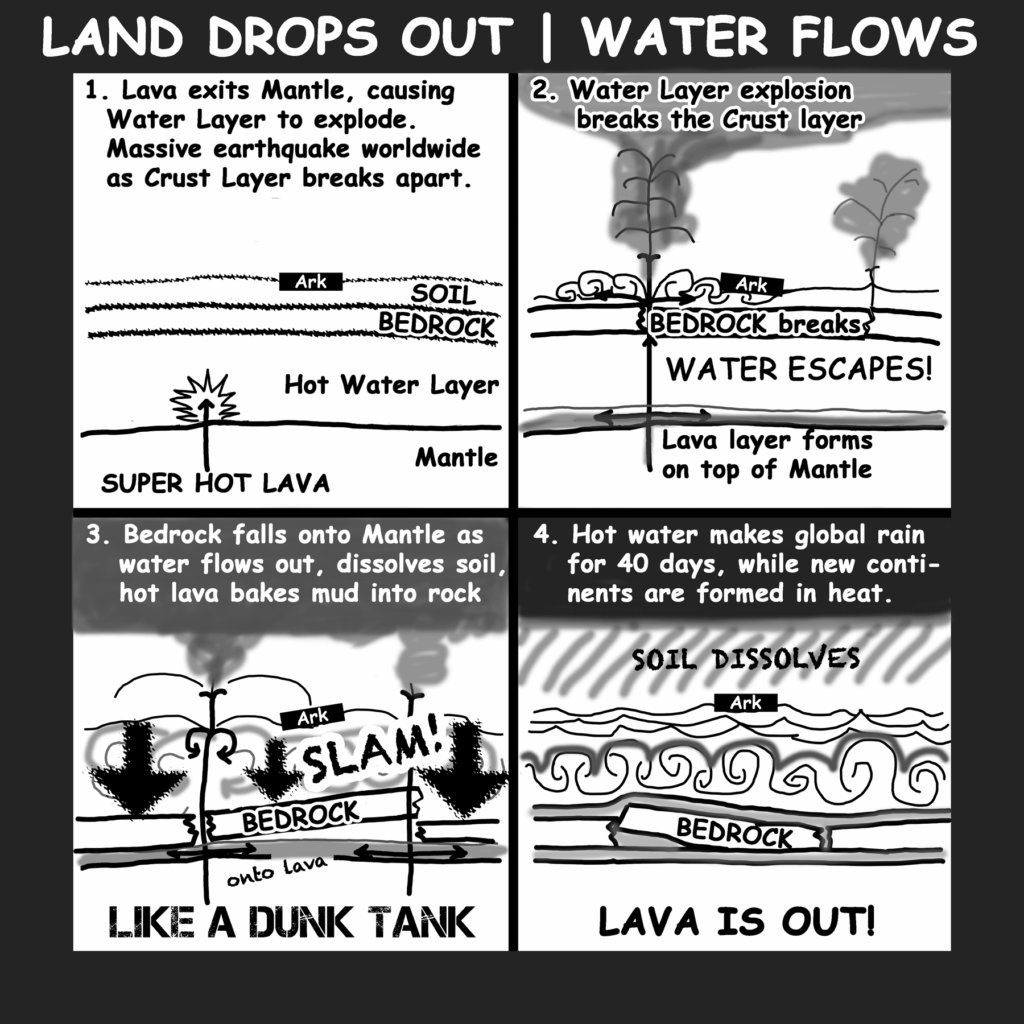
As you know by now, the Water Layer was heated to hundreds of degrees, Fahrenheit. And as you just saw, the conflux of super-heated water and tepid air was very powerful and explosive. But this is not the end of the impact event.
Under the Water Layer was a Mantle with a hard rock surface that kept the water away from the lava deep in the bowels of Earth. But that will soon be dashed, as the cosmic rock crushes the protective skin of the Mantle and dives deep into it.
When the Mantle skin was ruptured, immense pressure was released into the Water Layer from below. And I’m about to describe this second explosion that started at the bottom of the Water Layer, wreaking true destruction on a whole other scale.
The plume of earth upon impact, the surge of escaping water and steam, and the flying rocks racing with the water that flew out of the wound on the surface were nothing compared to the massive reaction now being unleashed. As the heavenly bullet sank deep into the flesh of the Mantle, finally coming to rest, it met up with the reservoir of Earth’s blood—the Outer Core—a well of radioactive lava and heat that had been storing up energy for just this moment. It showed the lava the way out of its confines through the path it had just tunneled through Earth’s layers.
The lava took the opportunity and rushed toward the surface, finally escaping the pull of gravity that had kept it confined for so long. But it soon met with something it had not known was there—its arch-nemesis, its exact opposite—a thick layer of water.
When these two elements met for the first time it was pure chaos in a cacophony of power, sound, and expansion, as the Water Layer leapt into its expanded form, a transformation previously unknown to this hidden reservoir. Just as the air meeting with the super-heated water caused an explosive expansion of water into steam on the topside of the layer, so this meeting of even hotter lava with the cooler water was far more extreme on the bottom side of the layer. But now there was great pressure added to the mix, throwing a whole new layer of power into the event. The poor Bedrock was not built for this kind of pressure and force.
This lower explosion lifted the Bedrock enclosing it far beyond its capacity for expansion. It quickly lifted up to the breaking point, then ripped apart into mere fragments of its former unified self. But it could not escape the clutches of gravity that called it back down to the depths below. When it failed, the ignited force of fury below sprang from the confines of the now fractured rock ball. Steam, water, rock, lava, ash, and all manner of pyroclastic debris leapt into the sky through the newly formed cracks, trying to flee to the very heavens above. But all this cloud of destruction could do was linger high in the air, choking off the light from Madam Sun. Yes, the rocks and drops of searing rain fell, the flying mud came back to the surface, but the vapor remained, high in the stratosphere. It decided to linger in its moment of liberation from the confines of the caverns of its birth, not realizing the effect it would have on the air in which it levitated.
And so, to our observer on the surface, after that initial BOOM, FLOOSH, SPATTER, SPATTER, SPATTER, he saw an even larger FLOOSH of a wall of water shooting up before him as high as could be seen and spreading out in two directions laterally, followed by the very ground he was standing on quickly rising higher and higher with a great cacophony of a thunderous BOOM deep below, even greater than the first. In no more than a couple of seconds, our observer is lost to the depths as his foundation is dropped out from under him into scalding, furious torrents of water, both rising high into the sky and quickly rushing up from below to replace the sinking land.
Mantle
Just as the Bedrock above was sent in an upward direction from the blast, so too the Mantle was sent in the opposite direction—in on itself, inward. This implosion into the Mantle was extremely catastrophic for the planet. For the Mantle was the heart of it that kept everything held together. But now it was undergoing a series of blasts that continued in a chain reaction all through its structure within and its surface above. It was now being ruptured and destroyed—reduced to a ball of hyperthermal mush. Since the Water Layer encompassed the Mantle all around, there was no other way for this progression of destruction to go. The interaction between lava and water relentlessly continued unabated until the reaction had run its course and the force was exhausted.
The Bedrock Layer was quickly lost, as Tectonic Plates were born from its ruin. In less than an hour, globally, it fell in pieces—now called plates— through the scalding watery depths and found its way to the Mantle that had just suffered its own demise in the same explosions. You see, when the chain reaction of blasts burst forth, they went in all directions—as most explosions do—multiplying themselves all around the planet’s inner spaces. Not only was the Bedrock container blown apart, but the Mantle was blown inward upon itself. This shattered the Mantle’s once perfect surface into a cracked ball, exuding the bloody lava onto its once smooth and hard face. It was a fractured mess of mush and falling fragments, sinking deep into the fiery depths of its heart and soul. Lava was going wild. The Water Layer was no more. The Bedrock and Mantle together were decimated beyond hope. As the explosions continued, the entire structure of the Pre-Flood Earth was lost forever.
It is nearly impossible for those who study the Mantle to see how it was once in a unified, unbroken whole. This is because the chain explosions turned it nearly inside-out, with its shell being sent inward to the Core. And not only this, but parts of the Bedrock were sent to its depths, along with copious amounts of water. I fault no one for not being able to piece this wreck of a sphere back into its former glorious self. One needs this backstory to see how it once was. But it is a verifiable fact that huge debris fields are dotted throughout its broken structure today. It is also known that many sectors of the hottest parts of the underworld have much cooler material in them. This allows anomalies of the (insufficient) old paradigm to become logical (sufficient) evidence of the new paradigm.
| Key Points The meteorite impact did not simply displace material—it set off a catastrophic sequence of explosions.The Soil Layer was vaporized at the impact site, sending a massive fireball and shockwaves in all directions.The impact punctured the Bedrock Layer, exposing the sealed Water Layer beneath for the first time.Superheated water violently expanded into steam, triggering the first in a series of immense explosions.The Mantle was ruptured, allowing lava from the Outer Core to rise and react explosively with the Water Layer.The secondary explosion from lava and water interaction was even more devastating than the initial impact.Steam, water, lava, ash, and debris were ejected high into the sky, choking off sunlight and altering the atmosphere.The Mantle’s destruction caused a global chain reaction, forming Tectonic Plates from the shattered Bedrock.The Pre-Flood Earth’s structure was permanently lost as the world was remade in violent upheaval. |
Weather
As the atmosphere reached saturation, another chain reaction was triggered: the formation of hypercanes—super-hurricanes of unparalleled magnitude. These storms formed rapidly due to the extreme water heat and moisture content of the air, developing simultaneously across the globe in a self-replicating, continuous, contiguous, conjoined pattern.
Unlike modern hurricanes, which require warm water to sustain their rotation, hypercanes in the Flood were fueled by the immense heat released from both the Water Layer and the volcanic eruptions occurring worldwide. The planet’s atmosphere, now thick with water vapor, became a perpetual storm system, feeding and intensifying these massive hurricanes.
- These storms were global in scale, covering vast regions without interruption.
- The storms were sustained for the entire 40-day period due to the continuous input of energy from the escaping waters.
Hypercanes
As the Bedrock pieces—now called Tectonic Plates—fell to the crushed Mantle, some sank into the Mantle and some did not. Since the pre-Flood surface of Earth was slightly larger (maybe 29 miles) than now, it is only natural that some of these pieces had to overlap each other when collapsed. Since those who came up with the theory of subduction did not have this backstory, the true origin of the phenomenon was not known before now. The same can be said of Tectonic Plates. But now we can see how things actually came about and fit together.
As the plates fell, the water rose. Within minutes—perhaps under an hour, globally—what had been a stable, perfect world was turned into a violent scene of exploding water, churning lava, and a collapsing crust. The scalding floodwaters, surging with mud, consumed everything. Entire biomes, from lush forests to vast plains, were ripped apart and buried in layers of sediment. Humans and animals alike were instantly scalded, and either torn apart by the surging currents, or buried in deep mudflows that preserved their remains as fossils.
As soon as the Flood began, the Earth was plunged into a unique and extreme meteorological event unlike anything seen before or since. The rupture of the Mantle and the collapse of the Bedrock Layer released the superheated Water Layer, which had been held under immense pressure for 1,656 years. As soon as the containment failed, massive amounts of water surged skyward, meeting the atmosphere for the first time. This immediate and extreme temperature differential resulted in a global-scale super-saturation of the atmosphere, blocking out the Sun.
With vast quantities of steam, ash and debris ejected into the sky, the planet’s atmosphere became completely opaque. The world entered a period of complete darkness, with thick clouds and storm systems covering the entire planet like a thick blanket—gray below and puffy white above. This is what turned the world from a Green Planet into a White Planet—a churning, chaotic storm-covered globe where sunlight could no longer penetrate.
The heat from the water itself, combined with additional heat from escaping lava, created a self-sustaining hydrological cycle, leading to 40 days and 40 nights of continuous, torrential rainfall. It was a global “Hypercane”. These storms formed rapidly due to the extreme heat and moisture content of the air, developing simultaneously across the globe in a self-replicating, continuous, contiguous, conjoined pattern. As a result, the world became a relentless storm-wracked planet, where the combination of intense winds, extreme rainfall, and airborne debris would have rendered the planet completely unrecognizable. Wind speeds would have far exceeded anything seen today, possibly reaching over 250 mph in some areas. Maybe more?
This was not a slow, gradual weather shift—it was immediate and overwhelming. The release of energy, both thermal and kinetic, ensured that the saturation of the atmosphere happened almost instantly. Within hours, the world was engulfed in a catastrophic meteorological event. The hypercanes were not localized but worked together in a global system, perpetuating the obscuration that kept the Earth from receiving any sunlight for those fateful six weeks.
The Ice Age
The Ice Age was not a slow process spanning thousands of years, as mainstream models suggest—it was an immediate consequence of the Flood. With the atmosphere completely obscured by water vapor and volcanic debris, sunlight was effectively blocked from reaching the Earth. Without direct solar input, temperatures began to rapidly plummet.
The extreme moisture in the air ensured that precipitation from the poles down to about the 40th parallels fell as snow and ice. This freezing process was incredibly rapid, happening during the Flood’s rain. Within days, massive snowstorms would have buried entire regions, and within weeks, glaciers began forming at the lowest latitudes. The rapid accumulation of snow, hail, freezing rain, and ice was made possible by the heavy precipitation and the inability of the Sun’s heat to reach these areas. Antarctica and the Artic Circle are Earth’s two largest deserts, respectively. That is why this precipitation was a one-time, inimitable event for the poles. There just hasn’t been the moisture required for such snow and ice coverage since Noah’s Flood. This is testable.
This is why the Ice Age was a one-time event—it occurred as a direct response to the Flood’s atmospheric effects. As long as precipitation continued and the skies remained obscured, ice continued to accumulate. However, once the precipitation ceased and the skies cleared, the poles transitioned into their current state as cold, dry deserts. Today, the poles no longer receive significant snowfall because the atmospheric conditions have stabilized, making it clear that the Ice Age was a direct product of the Flood’s aftermath.
This means that the Flood was not just a geological catastrophe—it was also the most extreme meteorological event in Earth’s history. The White Planet phase, the global hypercanes, the instantaneous Ice Age, and the mighty winds all played crucial roles in reshaping the world into the form we recognize today. When the clouds subsided enough to see the surface, it was all brown for a while there, a Brown Planet, with pockets of livable water for the surviving marine life. Just because the storms receded some, did not mean that the destruction and resurfacing was over. The storms were just the first 40 days, but the terraforming continued for about half of that year of reformation.
Using this model, we can show how the best explanation for the single Ice Age is the Flood. At no other time could there have been so much water content in the atmosphere at one time. Especially, knowing that the poles are desert regions. This explanation completely denies the common misconception of many ice ages occurring over many millennia. It makes the Ice Age a one-time, inimitable event. Just like the rest of the Flood elements.
| Key Points:The rapid collapse of the Bedrock Layer and the rise of floodwaters transformed the Earth’s surface within minutes.Tectonic Plates were born from the falling Bedrock, explaining the true origin of subduction and plate movement.The Flood caused a super-saturation of the atmosphere, leading to total solar obscuration and global darkness.The immediate atmospheric changes triggered worldwide Hypercane systems, generating relentless, storm-wracked conditions.For 40 days and 40 nights, the Earth experienced continuous torrential rainfall, fueled by thermal energy from escaping lava and superheated water.The White Planet phase was caused by thick cloud cover, turning the world into an opaque storm-filled wasteland.The Ice Age was an immediate and direct consequence of the Flood, occurring due to atmospheric cooling and extreme precipitation.The poles received a one-time, massive deposit of snow and ice, forming glaciers rapidly—explaining why polar regions are now dry deserts.As the Floodwaters receded, the Brown Planet phase emerged, with a barren, reshaped world waiting to be repopulated.The world remained in turmoil long after the initial 40-day storm—terraforming continued for much of the year. |
Lava, Mud & Water
The Flood was not a simple rise of water; it was a global catastrophe of immense hydraulic power. Water erupted from the depths with violent force, creating massive surges, shaping continents, and drastically altering Earth’s topography. This process did not take millions of years but occurred within days and weeks (if not hours or minutes), leaving behind unmistakable scars that can still be observed today.
Escaping water surged across the land, stripping the Bedrock of its fine soil blanket. That once fertile dirt quickly becomes gigantic globs of mud, suffocating and seizing all that once was alive upon it. All life on Earth is sucked into the vortices of scalding water and mud, being carried down to the searing depths of the dying planet as the Bedrock sinks. Heat is everywhere. Water, rock, mud and lava are being churned like salsa in a fiery kiln-like blender. All life is now gone but for the few lucky ones on the Ark and in the few seas that retained their cohesion in pockets of survivability. The immense biomes of life that were, are now being blended into something new: oil, coal, gas, and fossils. This array of mingled life is what those who never knew what really happened call a “Geologic Column”. It was all life being sucked into layers of mud that was baked into something that only resembles life in some form or another, either retaining its energy or retaining is form—but not both together. If only the continental shelves were still useable soil.
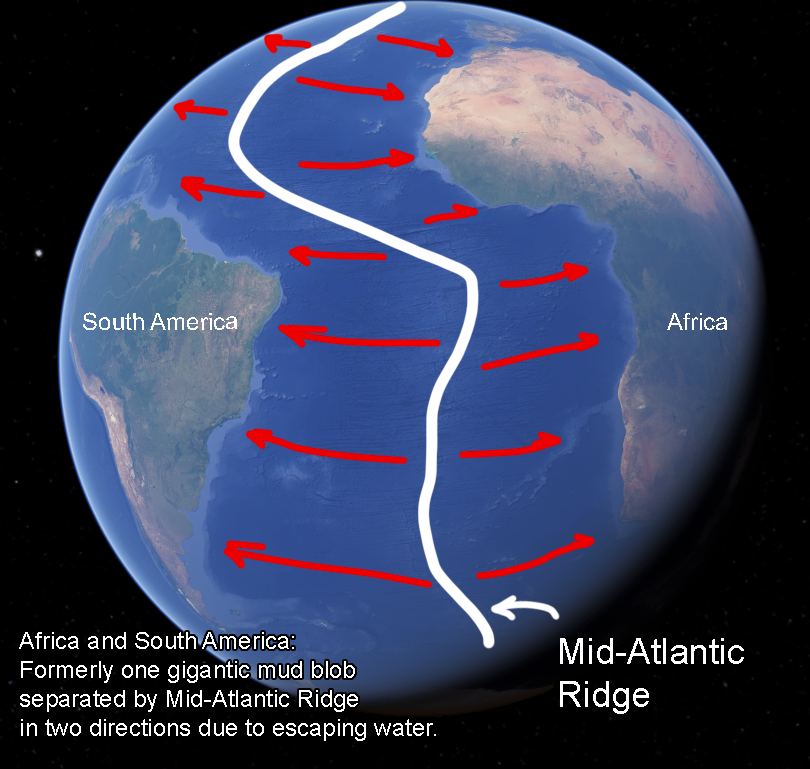
The escaping lava did not merely disperse; it went everywhere: under the falling Bedrock plates it became the Asthenosphere; atop the plates (now called “Tectonic”) it was volcanic, and formed huge beds for the mud to lie upon and rise like bread in an oven to become Continents. Their random shapes are but the result of chaotic forces pushing the huge swaths of mud and lava in many directions. Look how Africa and South America were pushed in different directions by the same escaping surge of water, midway between, given its force by the collapsing Bedrock plates. But because the lava was thicker and heavier, it formed the base, while the soft mud clung to it and formed into hardened rock—“Sedimentary” it is called. The tremendous surges of water pushed vast amounts of dislodged soil containing remnants of life, turning and churning those layers of mud into rapidly forming land masses. Over a few months’ time, this mud hardened into sedimentary rock, encapsulating remnants of the old world that were not reduced to oil or coal into fossilized remains.
Though the primary explosions subsided, lava continued to exude through the newly formed cracks—it’s still doing it today in places. What geologists today call “seafloor spreading” is merely the ongoing leakage of residual lava escaping from the disaster that reshaped the world. Call the Mid-Atlantic Ridge an oozing wound.
Huge tsunamis continued to move gigantic mud globs across the world for 150 days straight. Massive amounts of lava continued to exude and remain both above the broken plates and below them. Volcanism continued unabated for at least eight to ten months, continuing to reshape the planet. In fact, we still have volcanoes on the surface and they will continue for many more years. This Broken Planet is still reeling from this explosive and destructive event called a “Flood”.
Understanding these meteorological effects allows us to see the Flood not as a slow, regional event but as a rapid, globe-altering catastrophe that fundamentally changed Earth’s climate, geography, and atmospheric conditions forever in just one single year. It was far more than just 40 days and nights of heavy rain. It was an extinction-level event that destroyed what was once perfect, leaving no trace of what was. But even in its ruined state it is very beautiful. After all, God is still a God of love, peace, joy, and beauty, even if He is forced to judge us for our wickedness that we brought and bring upon ourselves.
Escaping Water Creates Devastating Forces
1. Mega Surges (Tsunamis) – As the water burst forth from the fractured Bedrock, it unleashed massive waves, hundreds of feet high, which raced across the land, reshaping everything in their path. Entire regions were drowned, and vast amounts of sediment and debris were transported across the planet.
2. Separation of Mega Mud Globs into Continent Shapes – The force of the water propelled massive chunks of mud and lava across the planet, rapidly forming the foundational structures of the post-Flood continents. The continents and islands formed as lava provided a hardened foundation for the mud layers to settle on top of. All islands and continents were formed in situ—no spreading tectonics as widely assumed. Just soft mud riding on soft, hot lava. Being pushed around by water jets from below.
- Africa and South America Formation – These landmasses appear to have been split and pushed apart at equal velocity.
- India’s Separation from Antarctica – The surging forces carried what is now India from Antarctica, slamming it into the southern edge of Asia, creating the Himalayan mountain range.
- American Cordillera Formation – The western mountains of North and South America (including the Rockies and Andes) were formed as mega mud globs were pushed eastward into the newly forming landmasses, rapidly crumpling and uplifting the terrain.
- Mountain Ranges Formed by Massive Surges – Entire mountain chains were either uplifted or carved out by the Flood’s surges. The Grand Canyon, for instance, may have formed as the semi-hardened landscape cracked apart due to extreme hydraulic pressures and sudden uplift. It had nothing to do with water erosion and everything to do with forming rock slabs cracking under pressure of motion and cooling.
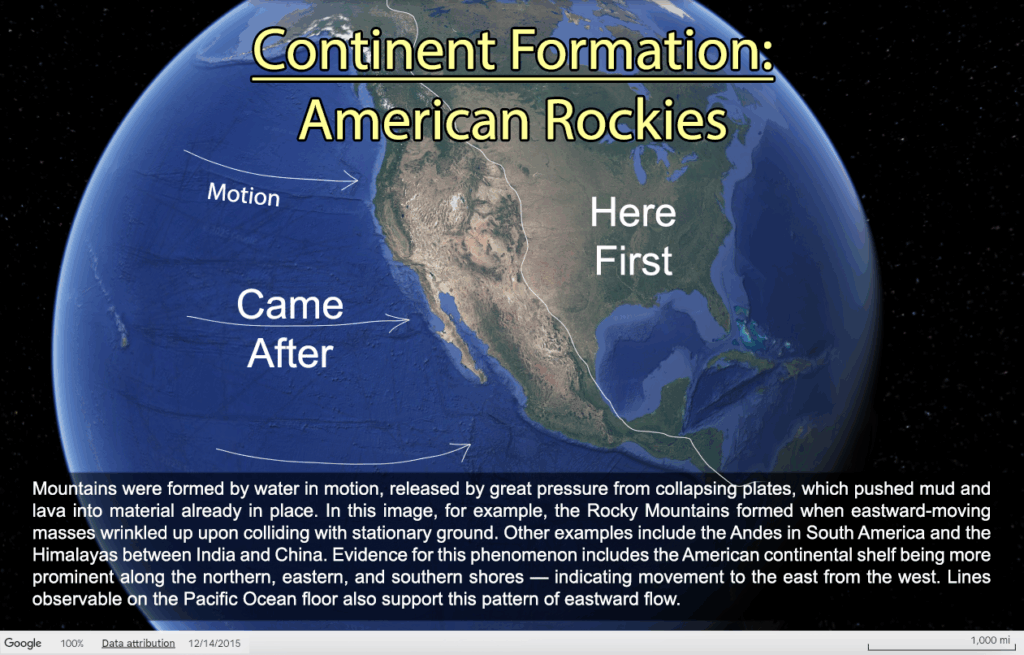
Water is Released
As we have just explored, the surging waters from the deep reservoir that I call the Water Layer very quickly came out of their deep abode and replaced the good land that was. This event was so violent that it continued to surge for weeks on end. Giant tsunamis sent enormous mud globs in all directions for these fateful weeks. The mud was mixed with lava. The heavier lava remained below the mud for the earliest phases of the transformation of the Crust, sometimes pushed up and out through the mud.
Because of the force of the escaping water from under the plates, formations such as Africa and South America seem to have been fit together at one time. But this is just the result of huge swaths of lava and mud being pushed in two directions from a central point—the Mid-Atlantic Ridge. And since they went in opposite directions in equal distances, the illusion was set. This was soft material in motion, not tectonic activity.
All across the surface, we see this same phenomenon pushing mud and lava in the same manner. Tsunamis are the reason why we have mud layers stacked into continents today. And the force that pushed those tsunamis was from the falling plates. It’s just that simple. No long periods of continental drift. No Pangaea that broke apart from tectonic activity. Just mud and lava pushed along the tops of the plates by the water escaping from under those same plates.
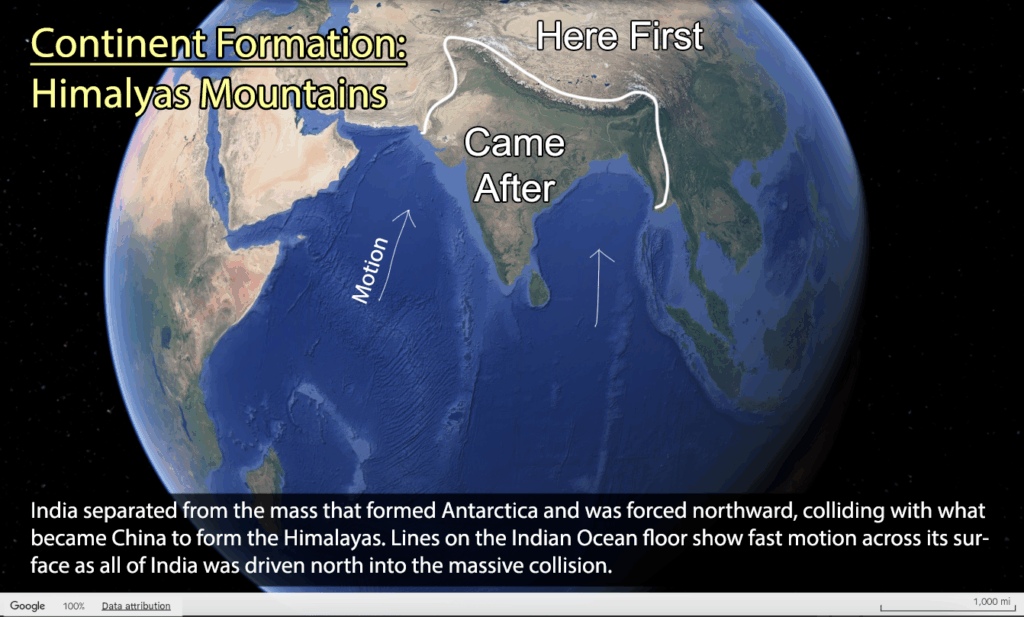
Mud is Formed
Of course, this means that the perfect soil of the Pre-Flood world quickly became those huge mats of mud. And that means that the mud captured the biomes that were sitting on the soil, since it all went down together. The tremendous surges of water mixed with vast amounts of dislodged soil, creating layers of mud that rapidly covered the new landforms.
This is a key aspect to the mud mats (globs or blobs): They became what is now called “sedimentary rock”. This is because as mud sits on super-heated lava, there is time for it to bake while the lava cools into igneous rock. And since we can find a plethora of combinations of igneous and sedimentary rocks, we get all kinds of other rocks from this combination.
Lava is Released
So now you can see how the escaping lava made its way to being both above and below the falling plates—taking on different forms as a result. If on top of the plates, it cooled into rock; if trapped under the plates, it remained as lava or magma. This lower entrapment is what is called the Asthenosphere. The upper formations are called volcanoes, igneous rock, or foundations for the continents (my term). Had the lava not made its way above the plates, then the planet would not have any continents. It would just be a water world upon a thick layer of mud. This is because the lava stuck to the plates better than the mud could and then held onto the mud too, turning it to rock as well.
Though the primary explosions subsided, lava continued to exude through the newly formed cracks. What geologists today call “seafloor spreading” is merely the ongoing leakage of residual lava escaping from the disaster that reshaped the world.
Land Rises & Seas Fall
All around the world this process took shape. The lava stayed low against the tops of the new plates and acted as a magnet or sticky glue for the mud globs. As the mud globs continued to shift and settle, they were baked on top of other layers that were caught and baked below them. As the mud baked, it started to rise a bit. And with layer upon layer upon layer getting caught and rising into hardened rock, the continents quickly began to form up. Up and up they rose, with layer upon layer of stone of various types becoming the new landforms.
The Bible tells us that after about 150 days of this process the continents began to peek out from under the waves, and as they did so the water began to recede from them. Since the land was forming in parts and segments, there were huge swaths of area that did not have any of this rising rock and mud. Today, only about 19% of the Earth has land. The rest is where the process did not take shape. And thank God for that! The Bible also tells us that God established the boundaries between sea and land. And now we know how.
As the Floodwaters began to recede while the lands rose, the Earth entered its final phase of transformation. The Bible explicitly mentions that God caused mighty winds to blow across the Earth, signaling the mechanism that would remove water from the new landmasses. These winds were not normal breezes but immense, planet-altering forces that sculpted the post-Flood world.
The winds would have been caused by the sudden shift in atmospheric pressure as the obscuration began to clear and the hydrological cycle found its new normal. The sheer force of these winds contributed to:
- Draining the Floodwaters – As the new continents formed, these winds helped channel the remaining waters into the new ocean basins—pushing rocks into other rocks, leaving many scars thought to be from glacial movement. But it wasn’t glacial formation and recession that scarred the rocks; it was rocks being carried in the final downhill run to the new oceans.
- Creating the Continental Shelves – Every continent today has a continental shelf, a feature that was formed as the final surges of water were pushed off the landmasses by the massive winds. Each shelf was formed in the same month as the others.
- Shaping Landscapes – The extreme winds likely stripped loose sediment, carved valleys, and contributed to the erosion patterns we observe today.
These winds were the final act in reshaping the world, ensuring that the newly formed continents and islands were exposed while the oceans took their new place on the planet. This is around the time that Noah poked his head out from the Ark to surveil the damage.
The Flood was not just a geological catastrophe—it was also the most extreme meteorological event in Earth’s history. In the White Planet phase, the global hypercanes, the instantaneous Ice Age, and the mighty winds all played crucial roles in reshaping the world into the form we recognize today.
Understanding these meteorological effects allows us to see the Flood not as a slow, regional event but as a rapid, globe-altering catastrophe that fundamentally changed Earth’s climate, geography, and atmospheric conditions forever.
This was far more than a simple rising of rainwater. The Flood was a violent, catastrophic event that reshaped the planet’s surface within a short period. The “mountains” under the Flood were not the modern peaks we see today but newly formed mud masses and lava beds, which were soon buried under layers of sediment. At its peak, the water level was not 22 feet above Mount Everest—it was 22 feet above the highest point of the shifting mud masses at that time.
The final surging of water across the continents left behind immense flood scars, often mistaken today for glacial evidence. These features were cut into the forming landscape as the last remnants of water rushed off the new landmasses, marking the end of the most catastrophic event in Earth’s history.
Conclusion: A Unique, One-Time Event
The entire impact sequence—from penetration to outward explosion, to Mantle collapse, and finally to global fracture propagation—was a uniquely catastrophic event. Unlike mainstream geological theories, which propose slow, incremental changes over millions of years, this model presents a scenario where the world as it was created ended in a matter of moments.
This impact was not just another cosmic collision. It was the defining event of Earth’s geological history, initiating the Flood and permanently altering the structure of the planet.
And this is how the continents were formed: escaping lava flows onto the new Tectonic Plates as the mud stays on the lava to become sedimentary rock, through a baking process. Many layers of mud found their way on top of the lava beds to be stacked up enough to “peak” out from under the water. As the mud hardened into rock it rose in height.
The Flood was not merely rain covering mountains, but a violent restructuring of the planet. Water did not gently rise; it was forced through surging torrents, explosions, and immense geological upheaval. This event permanently reshaped Earth’s surface, leaving behind flood scars, mountain chains, deep ocean basins, and continents formed in situ. It also initiated the lasting effects of the Ice Age and changed atmospheric and hydrological conditions permanently. The forces at work were global, rapid, and catastrophic—unlike anything seen before or since.
Sea Life Endures
One of the most intriguing questions regarding the Flood is how marine life survived amidst the catastrophic destruction. One has to ask, “What happened to the sea creatures? How did they survive the heat and mud?” The answer is not completely known, but we can surmise.
While a collection of terrestrial creatures were preserved on the Ark in breeding pairs, aquatic life faced its own set of challenges, including superheated water, mud contamination, and violent surging forces. The answer may lie in a combination of natural physics and divine preservation, similar to the Ark itself.
Apparently, there were seas of great enough area to remain largely intact as pockets of livable water during this transformation. In order to remain unified and intact, the size of a surviving Pre-Flood sea must have been quite large to begin with. And not just in area, but in depth as well. So this is my guess as to how we still have oceanic life today. Whatever sea or seas survived the collapse, did so when the Bedrock fell out from under them. It or they were large enough for the mud to remain distant, unincorporated.
And since the cooling of the hot Flood water was rapid, the animals only had to hang on long enough for the Flood water to reach a livable temperature before the two waters blended. At the same time, the mud mats had to be mostly held together as well, with those pockets not being contaminated with the former soil.
Were there many pockets of marine life? Was there only one very large one with all the variety needed to replenish the seas? Only God can answer those questions. But apparently enough aquatic animals made it through. I would assume that the Creator was directly involved in assuring that the animals He wanted to survive, did pull through. Was it a miracle? Maybe.
Perhaps the rapidity with which this all happened was a factor as well.
While the Bible is silent on exactly how marine creatures survived, this explanation provides a plausible mechanism that fits within the framework of the Broken Planet Model. It allows for a combination of physics, geology, and divine orchestration to explain how Earth’s oceans remained populated after the Flood.
Marine Survival: The Pockets of Life
- Survival Pockets – Some large Pre-Flood seas may have remained largely intact while others were destroyed or buried in mud. Whether there were multiple pockets or a single large one, the right species survived in conditions that allowed for life to continue. Since very large seas could have been farther from the primary impact zones, they could have experienced less direct mud contamination, giving marine life a chance to survive.
- Physical Conditions – As the Bedrock fell and the surging waters engulfed the world, the surviving seas fell with it, largely remaining together rather than mixing with superheated, contaminated water. This would have kept the temperature stable in key regions and prevented total annihilation of aquatic species.
- Gradual Salinization – The pre-Flood water layer was likely freshwater. Salinity as we see it today was not an initial condition but rather a product of leaching over time from the newly formed continents and magma. As mineral-rich landmasses interacted with the waters, salts gradually dissolved, creating modern saline ocean conditions.
- Divine Preservation – Just as God ensured the right terrestrial animals were preserved on the Ark, He may have also sustained the right marine life within these pockets, ensuring biodiversity continued. Even with physical conditions allowing for survival, divine intervention likely played a role in maintaining the balance of life.
| Key Points:The Flood reshaped the planet not just with water but through immense lava flows and mud movement.Volcanism continued for months after the impact, and volcanic activity persists to this day.The Water Layer’s release drove the movement of lava and mud, reshaping the Crust and creating the illusion of continental drift.Tsunamis propelled massive mud globs across the surface, leading to the formation of sedimentary rock as mud was baked atop lava.The Mid-Atlantic Ridge and other major fault lines are scars of this violent process, not signs of slow plate tectonics.The Asthenosphere formed as a lower reservoir of trapped lava beneath the Tectonic Plates.Land rose as mud and lava bonded to the plates, forming continents through rapid stratification and rock hardening.Oceans formed where the rising land did not take shape, establishing the boundaries between sea and land.Sea life endured through pockets of surviving Pre-Flood seas, protected from mud and excessive heat.The survival of marine life may have been divinely guided, ensuring enough diversity to replenish the oceans. |
Radiation
One of the most overlooked yet most impactful aspects of the Flood was the release of massive amounts of radiation. Prior to the catastrophe, radioactive materials were contained within the Mantle, shielded from the surface by the impenetrable shell of the Mantle. The rupture of the Mantle and the exposure of the radioactive Outer Core led to an unprecedented irradiation event that permanently altered Earth’s surface conditions and biological life.
When the cosmic bullet (the meteorite) came for Earth, it wanted blood. And blood it got, in the form of lava. The catastrophic release of lava from the Mantle did not just result in geological devastation; it also had profound effects on Earth’s electromagnetic field. The Outer Core—a vast sea of molten lava that functioned as Earth’s electromagnetic dynamo—suffered major disruptions. These effects were due to both the loss of mass and the introduction of foreign debris into the system.
Understanding Radiation: A Primer for the BPM Thesis
Radiation is everywhere—yet most people don’t know what it actually is, how it’s measured, or why it matters. This page aims to demystify radiation in simple but accurate terms to serve as an educational primer within the context of the Broken Planet Model (BPM). We learn as we go.
What is a Sievert?
A sievert (Sv) measures the biological impact of radiation on living tissue. It doesn’t describe how much radiation is present (that’s measured in becquerels), but rather how damaging that radiation is to a person or animal. One sievert equals one joule of radiation energy absorbed per kilogram of body mass.
Radiation damage begins to become significant around 0.1 Sv (100 mSv), and a dose of 4–5 Sv can be lethal without medical intervention.
Does It Weigh Anything?
No. Radiation is energy, not matter—it has no mass. However, it transfers energy to tissue at the atomic level, damaging cells and DNA. One sievert equals one joule per kilogram. For example, a 70 kg person absorbing one sievert of radiation would absorb 70 joules of energy.
What is a Becquerel?
The becquerel (Bq) measures radioactive activity: how many atomic decays occur per second. One Bq equals one decay per second. A banana contains about 15 Bq due to its potassium-40 content. The Earth’s crust emits over 10²⁴ Bq (a septillion decays) every second globally. However, Bq only tells us how many decays are happening—not how harmful they are.
What About Joules?
Joules are the basic unit of energy. Radiation transfers energy to cells in the form of joules, but not all joules are equally damaging. The sievert adjusts for biological harm—giving weight to the kind of radiation and how it affects different tissues.
Solar vs. Cosmic Radiation
Solar radiation originates from the Sun and is mostly low-energy protons and electrons. Cosmic radiation comes from outside the solar system—supernovae, black holes, and galactic sources. Cosmic rays are more energetic and penetrating. Earth’s magnetosphere shields us from most solar radiation, but cosmic rays constantly bombard the atmosphere, producing secondary radiation like muons and neutrons.
How Radiation Affects Life
Radiation ionizes atoms—stripping electrons and breaking molecular bonds. This causes mutations, cellular damage, and cancer. In animals, it targets fast-dividing cells such as bone marrow and gut lining. In plants, it disrupts seed development and photosynthesis. While background radiation is generally harmless, large doses are catastrophic. But it keeps us from living over 900 years of age. All life lives much less now than before the Flood. Shorter, sicklier lives are ours.
Summary for the BPM Thesis
Earth experiences over 10²⁴ atomic decays per second—equating to trillions of sieverts of potential exposure over time. Natural background radiation delivers an average of 2.4 mSv per person annually, totaling roughly 20 million sieverts to the global population each year. This constant presence of radiation is a reminder: something happened in the past to seed our environment with radioactive decay. The Broken Planet Model proposes that the mantle eruption during the global Flood event was a one-time, high-energy radiation release that permanently altered the surface environment. Meaning, almost all of our current radiation was delivered in a single dose. That happened a little over 4,300 years ago. The Flood was a flood of radiation, lava, mud, and scalding water.
Extrusion of Radioactive Lava
- A One-Time, Global Radiation Event – The release of lava from the Mantle led to a massive surge of radiation exposure, an event unlike anything else in Earth’s history.
- Irradiation of Surface and Atmosphere – As radioactive lava was expelled into the environment, it contaminated land, water, and air.
- A Single-Year Event with Residual Effects – While the peak radiation event occurred over a single year, residual radioactivity persisted for centuries (and now), contributing to changes in atmospheric chemistry and long-term biological effects.
Impact on Atomic Structure and Dating Methods
The irradiation event fundamentally altered the composition of many minerals, leading to element transformations that modern science misinterprets as evidence of deep time.
- Elemental Transmutations – Radiation exposure caused atoms to change state, leading to the formation of elements that are now misused in dating methods:
- Potassium → Argon
- Uranium → Lead
- Rubidium → Strontium
These changes, rather than representing vast timescales, are simply the aftereffects of the global radiation exposure caused by the Flood.
The Ongoing Growth of the Asthenosphere
The aftereffects of the Flood are still visible today:
- Asthenosphere Expansion – The layer of molten rock beneath the tectonic plates continues to expand as minerals melt and shift.
- Lingering Radioactivity – While much of the radiation has dissipated, its residual effects still impact geological formations and contribute to modern misconceptions about Earth’s age.
This catastrophic radiation release was a pivotal moment in Earth’s history, reshaping its composition, altering its electromagnetic field, and permanently changing biological life expectancy and health. It was the final and most devastating aspect of the Flood’s consequences, bringing an end to the pre-Flood world and sealing the planet’s fate as This Broken Planet.
Lava
What is lava? Lava is more than just molten rock—it is the lifeblood of the Earth, a superheated, dynamic fluid that originated deep within the planet, not from shallow magma chambers, but from the Outer Core itself. Unlike the conventional view that lava is merely melted crust or upper mantle material, its true nature is far more fundamental and powerful.
At its core (pun intended), lava is composed of liquid metals, silicates, and radioactive elements that sustain the Earth’s internal heat. These include:
- Iron (Fe) & Nickel (Ni): The primary metallic components, critical for Earth’s magnetic field and the dynamo effect.
- Silicon (Si) & Oxygen (O): Forming molten silicate compounds that influence viscosity and fluidity.
- Radioactive Elements: Uranium (U), Thorium (Th), and Potassium-40 (K-40) are crucial. These isotopes undergo radioactive decay, producing the heat necessary for maintaining Earth’s inner nuclear fusion, much like the sustained reactions in the Sun.
This radioactive nature of lava is not incidental—it was designed to support Earth’s internal heat balance, just as fusion sustains the Sun’s energy output. Without the radioactive elements, the heat would not be self-sustaining and perpetual. Deep within the Outer Core, immense pressure maintained this nuclear reaction in a controlled environment. As long as this radioactive energy was contained within its proper domain, it fueled the planet’s self-sustaining dynamo, keeping Earth’s magnetic shield strong and its internal structure stable.
But when this powerful, radioactive substance was forced out of its domain, it became destructive. Unlike the Sun, which contains its fusion reactions in a perfectly balanced sphere, Earth’s system was never meant to have its nuclear heart exposed. Once the violent chain reaction of the Flood broke through the Mantle, lava—now freed from its controlled environment—erupted with catastrophic force. What was once a stabilizing element of Earth’s design now became an agent of worldwide devastation. When the lava escaped its captivity, entropy was born.
Entropy & Irradiation
Entropy is the measure of disorder in a system, the inevitable unraveling of order into chaos. Before the Flood, Earth operated in a perfectly balanced system, where radioactive decay existed in harmony, contained within the depths of the planet. But when the catastrophic eruptions of radioactive lava, steam, and energy burst through the Mantle, they unleashed an event unlike anything before or since. This was not a slow, measured process—it was a single, overwhelming moment of irradiation, rewriting the atomic structures of minerals, the very fabric of DNA, and even the composition of Earth’s atmosphere and oceans.
Radiometric dating assumes slow, predictable decay of isotopes over millions or billions of years. But this method fails to account for the one-time, inimitable event that drastically altered isotope ratios in an instant.
The three main isotope pairs used in radiometric dating (six total elements) are:
- Uranium-238 → Lead-206 (Half-life: 4.5 billion years)
- Uranium-235 → Lead-207 (Half-life: 704 million years)
- Potassium-40 → Argon-40 (Half-life: 1.25 billion years)
Each of these decay chains relies on the assumption that their “parent” isotopes have been decaying at a consistent rate over deep time. But what if a cataclysmic radiation event flooded the system with high-energy particles, transmuting isotopes and accelerating decay rates in ways never before considered?
The massive, concentrated surge of radiation during the Flood was far beyond the gradual exposure from cosmic rays or solar radiation. This means that the apparent age of rocks and minerals today could be the result of a one-time hyper-irradiation event, not an ancient, slow process.
Daughter isotopes (like Lead-206 and Argon-40) could have formed instantly in ways unaccounted for by conventional dating models.
Radiohalos, microscopic discolorations within minerals caused by radioactive decay, could be forensic evidence of this event—a “snapshot” of the moment when entropy was introduced in full force.
This means that radiometric dating, which assumes a steady, undisturbed history, is blind to the reality of this event. The geologic clock was reset, and deep-time assumptions collapse in the wake of this realization.
Just as minerals absorbed this sudden burst of radiation, so too did every living thing on the planet. The radiation from the Flood didn’t just kill—it rewrote the very code of life. The human genome, once perfect and uncorrupted, began its slow descent into genetic entropy. DNA damage from radiation introduced errors, degradation, and susceptibility to disease.
Lifespans, once stretching over 900 years, began to plummet in the generations following the Flood. But the fact that people died at all before the Flood is evidence of the curse that God placed on living creatures, including man. But this influx of radiation took things to a new low. Increased genetic mutations led to birth defects, cancers, and hereditary disorders that continue to this day (becoming more pronounced as time advances). The explosion of radiation fundamentally altered the biological world, making death and decay more prominent and faster-acting.
The oceans and atmosphere were infused with radioactive isotopes. The air people breathed, the water they drank—everything was altered at the atomic level. Heavy metals and radioactive elements mixed into the Floodwaters, making long-lasting contamination a reality—the new normal. Ionized particles also filled the sky, changing the chemical composition of the air. Did this have any effect on contributing to changes in climate and weather patterns post-Flood? The Flood was the event that brought death and decay to Earth on a universal scale. The perfect system was shattered, and everything that came after bore the mark of that event.
| Key Points:Lava is not just molten rock but a superheated, radioactive fluid originating from the Outer Core, not shallow magma chambers.The primary components of lava include Iron (Fe), Nickel (Ni), Silicon (Si), Oxygen (O), and radioactive isotopes (Uranium, Thorium, Potassium-40).The radioactive nature of lava was essential for sustaining Earth’s internal nuclear fusion, just as fusion sustains the Sun.The Flood broke the containment of this nuclear process, unleashing catastrophic radiation and introducing entropy into Earth’s system.Radiometric dating assumes a slow, steady decay of isotopes, but the Flood’s irradiation event disrupted these processes, invalidating deep-time assumptions.The massive, one-time radiation surge accelerated decay rates and could have instantly formed daughter isotopes, skewing dating methods.Radiohalos within minerals serve as forensic evidence of this hyper-irradiation event.The human genome suffered radiation damage, leading to genetic entropy, shorter lifespans, and increased mutations post-Flood.The oceans and atmosphere absorbed radioactive isotopes, permanently altering Earth’s air, water, and biological systems.The Flood was the moment when death and decay intensified, marking the irreversible break from the pre-Flood world. |
Electromagnetic Effects
And speaking of bearing marks, we now turn to the effects the Flood had on the electromagnetic elements of this broken planet.
The greatest lava release in Earth’s history did not merely alter the surface—it reached deep into the planet’s very structure. As the massive upheaval disrupted the Outer Core, the Earth’s internal dynamo suffered drastic changes, leading to weakened magnetic field strength, shifting poles, and disrupted magnetic signatures in rock formations.
The Dynamo Dims
The Earth’s pre-Flood dynamo was a formidable force, sustained by the rapid motion of molten metals within the Outer Core. But with the catastrophic expulsion of lava, this system was permanently disrupted.
The Dynamo’s Volume Reduced
The Outer Core, once teeming with a vast volume of conductive molten metals, lost a significant portion of its contents. Lava, once contained deep within the planet’s fiery heart, was forced upward and expelled through volcanic fissures across the world or became a new layer beneath the new plates. This massive loss of molten material diminished the Core’s ability to maintain the strong, stable electromagnetic field it had once produced.
The Dynamo’s Velocity Reduced
With the expulsion of so much molten fluid, the circulation of the remaining material slowed. Just as a whirlpool weakens when water is drained from a basin, the Outer Core’s internal currents lost some of its momentum. The swirling motion responsible for generating Earth’s magnetic field became sluggish, leading to a noticeable weakening of the planet’s electromagnetic shield.
The Dynamo’s Flow Interrupted
Compounding the problem, debris from the shattered Mantle and Bedrock, along with quantities of trapped water, was drawn into the depths. These foreign materials disrupted the once-fluid, uniform motion of the Outer Core’s molten currents. The smooth, uninterrupted flow that had governed Earth’s magnetism was now riddled with obstructions, further hindering the dynamo’s function.
The Electromagnetic Field Shifts
Where is North?
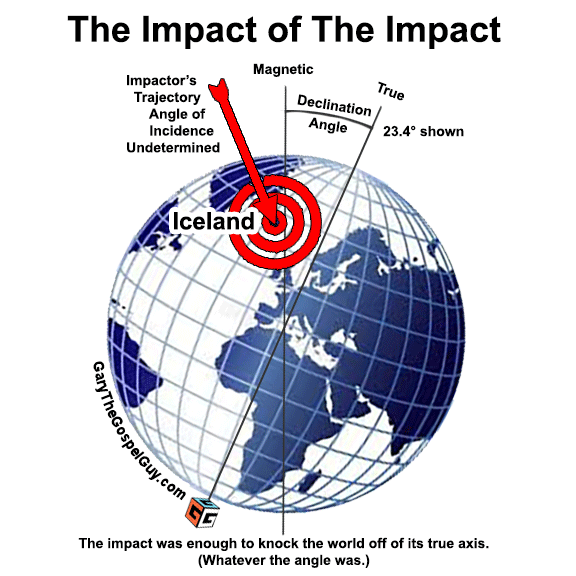
The Flood did not just break the land; it moved it. When impacted, the Crust canted slightly from the inertia, since it was riding on a thick layer of water. Then when the Bedrock fell, this new angle was fixed forever. This violent redistribution of mass affected the delicate balance between true north—the fixed axis of Earth’s rotation—and magnetic north, which is determined by the flow of molten metals deep within the Core.
Before the Flood, the alignment between these two reference points was likely very stable, with zero difference. But after the catastrophe, as the Core’s movements became erratic and the Crust settled into a new equilibrium, magnetic north found itself in a state of flux. Even today, the Earth’s magnetic field continues to shift—an echo of the massive disruptions set in motion by the Flood. In fact, the Flood caused a drastic shift in Earth’s magnetic orientation, fundamentally altering the planet’s geomagnetic properties. The interplay between the meteor impact, the global explosions, and the movement of massive amounts of molten material contributed to a permanent geomagnetic shift. How much that shift was initially may never be known.
With the electromagnetic dynamo compromised, the magnetic field itself underwent drastic changes:
- Shifts – The Earth’s magnetic poles likely shifted as the electromagnetic flow within the Outer Core was disrupted.
- Fluctuations – The weakening dynamo caused erratic changes in the field’s intensity and direction.
- Permanent Degradation – The magnetic field never fully recovered from these changes and has been steadily weakening over time.
Long-Term Consequences
As conditions continued to degrade, the Earth’s magnetic field has remained unstable. The effects of this catastrophic event are still observable today in the form of:
- Geomagnetic anomalies – Variations in Earth’s magnetic field strength and direction.
- Weakening of the field – Scientists have observed an ongoing decrease in the strength of the geomagnetic field, which can be traced back to the destabilization event caused by the Flood.
Signatures Imbedded
As lava cooled in the wake of the catastrophe, it recorded the prevailing (yet dynamic) magnetic field of the time, locking in a permanent snapshot of the Earth’s electromagnetic state. But what should have been a consistent and orderly record of geomagnetic orientation is, instead, chaotic and disjointed.
Why? Because the mud and rock that received these magnetic signatures had not yet fully hardened. Hydrological forces continued to churn the soft, newly deposited material, dragging it through shifting currents and turbulent waters. The result was a set of magnetic imprints that were frozen mid-motion, distorted and scattered.
This explains the irregularities we see in magnetic rock formations across the globe. These variations are not evidence of slow, meandering changes over countless ages but rather the scars of a world still reeling from catastrophe.
Conclusion: A World Permanently Altered
The Flood did more than reshape the land and sea; it disrupted the very forces that govern Earth’s stability. The once-powerful magnetic field weakened. The planet’s internal dynamo, though still functioning, lost much of its former strength. The very alignment of the poles shifted, and the electromagnetic signatures etched into rock became chaotic and fragmented.
The scars remain, imprinted into the Earth itself, silent witnesses to the greatest upheaval in history. If we could determine the amount of shift initially, then we would have an angle of incidence of the meteoric impactor. My knowledge in this area is not sufficient to make an educated guess with much specificity. But I can show an illustration that explains the basic idea.
| Key Points:The Flood’s massive lava release did not just alter the surface—it permanently disrupted Earth’s electromagnetic system.The Outer Core lost a significant volume of molten material, reducing its ability to sustain a strong electromagnetic field.The circulation of molten metals slowed, weakening Earth’s magnetic field, much like a whirlpool losing momentum as water drains.Foreign debris from the Mantle, Bedrock, and trapped water was drawn into the Outer Core, disrupting the smooth flow required for an efficient dynamo.The Flood displaced entire landmasses, throwing the balance between true north and magnetic north into chaos, contributing to ongoing magnetic field shifts.As lava cooled, it recorded the magnetic field at the time, but due to hydrological forces, these magnetic signatures were distorted and scattered rather than uniform.The irregular magnetic signatures across the globe are not evidence of slow geological change, but rather the frozen scars of a cataclysmic event.The Earth’s magnetic field remains in a weakened state, an echo of the Flood’s upheaval still lingering in the present.The Flood was not just a surface event—it permanently altered Earth’s core processes, leaving behind geological and electromagnetic evidence of its impact. |
Astrophysics—Orbits of Earth and Moon
Introduction
This document presents a technical but simplified look at what might have happened to the orbits of Earth and Moon during Noah’s Flood. It’s based on the idea that a massive object struck Earth—right about where modern-day Iceland is now (around 64°N, 18°W). That Extinction Level Event, I believe, was powerful enough to affect how Earth spins, tilts, and moves around the Sun. It also affected how the Moon orbits the Earth. I will use scientific terms here, but will also try to break them down so anyone can follow along.
Where the Impact Hit
The strike zone is believed to be Iceland—in the Northern Hemisphere. A nearly perpendicular hit there would drive its inertia mostly downward (south), punching through the layers of Earth: the Crust, the Water Layer beneath it, and the Mantle underneath that. Considering that Earth was nudged southward, while traveling at an average speed of ~29.78 km/s (≈107,000 km/h or ≈66,600 mph), and spinning at a rate of ~1,670 km/h (≈1,037 mph), I acknowledge that calculating the full mechanics of this event is beyond my ability. That’s why I invite those with the knowledge and tools to look into it and provide some detailed astrophysics modeling. When this is accomplished, I believe that the BPM will be vindicated thoroughly and the prediction confirmed.
Earth’s Current Orbit—And What Might Have Changed
Earth currently has an orbital eccentricity (a measure of how stretched its orbit is) of about 0.0167. That means it’s not a perfect circle—more like a slightly squished oval. If Earth’s orbit used to be perfectly round, the impact may have knocked it slightly off. Earth’s orbital plane—the flat surface it travels on as it goes around the Sun—is tilted about 7.25° compared to the Sun’s equator. That tilt could also be a result of the impact. Earth also leans over on its axis at about 23.44°, which is why we have seasons. That lean, called axial tilt or obliquity, could have been caused by an off-center hit—especially from the north. Iceland is in the right spot for this tilt to have been made.
Remember that Earth was originally made with a Water Layer that the Bedrock Crust rode on. This would make it much more susceptible to rotating when struck. And that is why the tilt (23.44°) is so severe—the Crust rotated on the Water Layer before sinking to the Mantle. This rotation was instant and quick (seconds). The collapse was a little bit slower (minutes).
What Happened to the Moon?
If the Moon’s original orbit took 30 days, then the Moon’s orbit was changed too. And this could be expected if the Earth was knocked out of its orbit slightly. It now takes about 29.53 days to go through a full cycle of phases (called a synodic month). That’s just under 30 days, suggesting the Moon may have been pulled slightly closer to Earth (or Earth knocked closer to the Moon). The Moon’s orbit today is slightly oval-shaped (eccentricity of 0.0549), and it’s tilted both relative to Earth’s equator (~18.28°) and to Earth’s orbital plane (the ecliptic, ~5.145°). The Moon also takes about 27.32 days to make a full trip around Earth (a sidereal month).
If the Earth’s orbit changed to 7.25° off center and Moon’s changed to 5.145° off Sun’s equator, then the Moon was less affected than Earth (as expected when it was Earth that was stricken, not the Moon). These interesting details make the Moon’s orbit what I call “wonky”. But this wonkiness fits perfectly with what is predicted by the BPM. The meteor hit Earth and the Moon tried to hang on when Earth got moved. Good thing it did. I’d hate to think of the Moon just freewheeling its way while still sharing our orbit.
Before and After the Impact
Before the strike, Earth and Moon may have moved together in perfect sync—round orbits, perfectly aligned with each other and with the Sun. But once Earth was struck and shifted, the Moon kept going in its old path briefly (duration unknown), due to inertia. That made it look tilted from Earth’s new position and introduced some wobble and misalignment. Eventually, the Earth-Moon system settled into a new balance. That’s how we got tidal locking (the Moon always shows us the same face) and a cycle called orbital precession—where the Moon’s orbit slowly rotates over about 18.6 years.
Why This Matters
I believe this information can help pinpoint the exact date of the impact—what we know as the 17th day of the second month, 1656 years after creation according to the Hebrew calendar and Bible. This event appears to have occurred just before Earth reached the lowest point of its orbital path relative to the Sun’s equatorial plane—a position known in orbital mechanics as the negative Z-maximum. If the meteor pushed the Earth, it would have gone south more than any other direction. And this is what we see. To pinpoint the impact location, we simply trace slightly backward along the orbital plane. This difference in impact site and lowest point of the plane will be very short—almost negligible—but there.
A Wounded but Stable System
If Earth and Moon once moved in perfect, synchronized harmony with the Sun, then today’s odd orbital tilts and wobbles are like scars left behind. They show us that something massive happened—a strike that didn’t just affect geology but changed our entire planetary system. This impact near Iceland left its fingerprint on how Earth and Moon still move today. What we see in modern astronomy may be the lasting echo of that cataclysmic event.
My last prediction on this
The angle of the giant plume under Iceland is not a perfectly straight shaft. It is likely bent to some amount, due to the Bedrock and Mantle moving relative to the angle of the hole left by the meteorite. Layer after layer was punched through by this heavy space rock. My prediction is that this angle will align with the determined effects on Earth’s trajectory, tilt, and distance to the Sun.
The Survivors
As the world was undone, a single structure remained untouched amid the chaos. The Ark—massive, sturdy, and sealed by the hand of the Creator—rose above the waters, carrying with it the only terrestrial remnants of the pre-Flood world.
Within its wooden walls, eight human souls and pairs of every kind of land-dwelling, air-breathing creature waited. They were not spared from witnessing the cataclysm—they felt the roaring winds, heard the deafening cracks of a dying planet, and endured the violent upheaval beneath them as the crust shattered and the waters surged from the deep. But they were safe. Set apart. Chosen to step into the unknown world that would emerge on the other side of judgment.
For months, they drifted over a planet they would not have recognized. No familiar landmarks. No lush green landscapes. No sign of the civilization that once thrived. The waters covered everything, even the highest pre-Flood elevations, as the entire surface of the Earth was submerged beneath the weight of its own undoing.
Inside the Ark, survival was not passive. Noah and his family tended to the animals, maintaining order in their floating refuge (once they could move about the cabin). The creatures, spared from extinction by divine intervention, carried within them the future of all terrestrial life. They would later be the first to step onto the new land, sent forth to replenish a broken world.
Then, one day, after nearly a year adrift on the vast, endless waters, the Ark came to rest. The destruction had ceased. The water had begun to recede, revealing the jagged remains of a reshaped Earth. The survivors of the Flood stood at the threshold of a new beginning—one that bore little resemblance to the world they had once known.
With reverence and fear, after a few more months, Noah and his family stepped out onto solid ground, breathing in air thick with the scent of a world reborn. The Flood had not just wiped the Earth clean—it had rewritten its very foundations. And from this moment forward, all of humanity would trace its lineage to those who walked off that Ark.
Flood Conclusion: A World Reborn
The Flood did not merely reshape the Earth—it wiped clean a world of corruption and prepared the stage for a new beginning. The ground was torn, the sky was darkened, and the waters raged. Yet, in the midst of judgment, a remnant remained.
For over a year, Noah, his family, and the animals aboard the Ark endured the chaos outside. They felt the relentless heaving of the waters beneath them, heard the violent eruptions that remade the land, and waited as the storm of wrath completed its course. As the world outside was undone, they remained within the vessel of salvation, held secure by the hand of the Creator.
Then, the time came for the waters to recede. The Ark, the lone survivor of a world drowned, came to rest. The raging forces that had torn apart the deep finally gave way to stillness. The earth groaned beneath the weight of its own transformation, settling into its new form. What had been a single landmass with pristine waters scattered about, was now broken apart, divided by new oceans and towering ranges of upheaved rock. The sky, once pure, was now filled with the remnants of volcanic fury, its climate forever altered.
And yet, amid the devastation, life would begin again. The survivors—both man and beast—stepped onto a changed world. They stood as witnesses to both judgment and mercy, a living testimony that what had been utterly destroyed was not beyond redemption. The same God who had unleashed the Flood had also made a way for restoration.
To fully grasp the weight of this moment, we turn to the account as recorded in Genesis 8, where the final chapter of the Flood unfolds in the words of Scripture itself.
But God remembered Noah and all the wild animals and livestock with him in the boat. He sent a wind to blow across the earth, and the floodwaters began to recede. The underground waters stopped flowing, and the torrential rains from the sky were stopped. So the floodwaters gradually receded from the earth. After 150 days, exactly five months from the time the flood began, the boat came to rest on the mountains of Ararat. Two and a half months later, as the waters continued to go down, other mountain peaks became visible.
After another forty days, Noah opened the window he had made in the boat and released a raven. The bird flew back and forth until the floodwaters on the earth had dried up. He also released a dove to see if the water had receded and it could find dry ground. But the dove could find no place to land because the water still covered the ground. So it returned to the boat, and Noah held out his hand and drew the dove back inside. After waiting another seven days, Noah released the dove again. This time the dove returned to him in the evening with a fresh olive leaf in its beak. Then Noah knew that the floodwaters were almost gone. He waited another seven days and then released the dove again. This time it did not come back.
Noah was now 601 years old. On the first day of the new year, ten and a half months after the flood began, the floodwaters had almost dried up from the earth. Noah lifted back the covering of the boat and saw that the surface of the ground was drying. Two more months went by, and at last the earth was dry!
Then God said to Noah, “Leave the boat, all of you—you and your wife, and your sons and their wives. Release all the animals—the birds, the livestock, and the small animals that scurry along the ground—so they can be fruitful and multiply throughout the earth.”
So Noah, his wife, and his sons and their wives left the boat. And all of the large and small animals and birds came out of the boat, pair by pair.
Then Noah built an altar to the Lord, and there he sacrificed as burnt offerings the animals and birds that had been approved for that purpose. And the Lord was pleased with the aroma of the sacrifice and said to himself, “I will never again curse the ground because of the human race, even though everything they think or imagine is bent toward evil from childhood. I will never again destroy all living things. As long as the earth remains, there will be planting and harvest, cold and heat, summer and winter, day and night.”
(Genesis, Chapter 8, NLT)
| Key Points:The Ark was the sole refuge, divinely designed to withstand the catastrophic upheaval of the Flood.Noah, his family, and the animals endured the full duration of the planet’s most violent transformation, hearing the destruction outside but remaining safe within.The waters covered all landmasses, erasing any familiar pre-Flood geography, leaving a world unrecognizable to its survivors.The Ark’s landing on the mountain of Ararat marked the transition from judgment to renewal, as the Floodwaters receded and a reshaped Earth was revealed.The survivors were chosen to repopulate the Earth, stepping onto a new world fundamentally different from what had existed before.The new land was divided, the sky altered, and the climate permanently changed, setting the stage for post-Flood civilizations.Noah’s altar and sacrifice signified humanity’s gratitude and God’s promise, establishing a covenant that the Earth would never again be destroyed by water.Genesis 8 records the final moments of the Flood, affirming that the world was not only judged but also redeemed, paving the way for future generations. |
Astrophysics
Here is the icing on the BPM cake:
- We know exactly when the flood began: 17th day of the second month, 1656 anno mundi (minutes after the impact.)
- We know that Iceland was the impact spot. The plume under her points to Earth’s heart, showing the angle pretty well.
- The Earth was hit in the northern hemisphere, which would push the Earth downward in her path around the Sun. We know the amount we are off from being perfectly aligned with Sun’s equator.
- We know that the Moon’s orbit can be examined as well. We can estimate her position and ours on the date given and see if they agree. This will show why the Moon has such a horrible orbit (in and out, up and down).
- This is why we have seasons.
- This is how we will know exactly where we were in the solar system when shot.
This line of reasoning will lead to discoveries that prove the Bible and disprove deep time and evil-you-shun. Let the Lord be praised all around This Broken Planet. Now I just need some numbers and equations. Then we can get people ushered into the Lord’s fellowship.
Everything continues to point to a very large object that hit us moving very fast. It ruined our planet, but good! The perfect crust was destroyed, then reformed into continents and vast oceans. The size of it was reduced from ~6,407 km to ~6,360 km (a loss of ~47.3 km). The Mantle was ruptured massively all around and into it. Its once-captured lava was brought out to irradiate and rebuild the surface from the bottom up. The mud stuck to the lava and stacked up upon it creating continents. The mud then baked into rocky layers that hold all former life in its cells and strata. The destroyed Mantle (not so much from the impactor but from the chain-reaction explosions that ensued) is now bulging at its equator from the centrifugal force of its rotation. It no longer has the supportive structure it once did.
- The Earth’s orbit is off (exactly the right amount).
- The Moon’s orbit is off (exactly the right amount).
- The Earth’s skin is off (exactly the right amount).
- The Earth’s oceans have the right amount of water in them to match what happened.
- The continents are the right thickness and sizes to match what happened.
- The Tectonic Plates are completely expected and match what happened.
There is no way this model is not true. No other model matches all of these coincidences exactly like this. Nothing comes close. No other model perfectly matches every single passage in the Bible that discuss this timing, purpose, and manner of destruction.
Section III Group Discussion Questions
- Why is Iceland the most likely impact site?
A. It has a giant plume under it that goes deep into the Mantle.
B. It sits on the Mid-Atlantic Ridge.
C. An impact crater would not be possible.
D. All of the above.
2. Which statement is true about the Bedrock Layer?
A. It collapsed due to an inner explosion when lava met water.
B. When it collapsed, it became the Tectonic Plates.
C. When whole, it was larger than today’s surface area.
D. All of the above.
3. Which statement is true about the Water Layer?
A. It was between the Bedrock Layer and the Mantle.
B. It was where the Mohorovičić Discontinuity is now.
C. It was hundreds of degrees hot and in constant motion.
D. All of the above.
4. Which statement is true about the Mantle?
A. When intact, it separated the Water Layer from the Outer Core’s lava.
B. It housed the Outer Core, which produced the Magnetosphere.
C. It housed the Inner Core, which heated the Earth from within.
D. All of the above.
5. What caused the only Ice Age to occur?
A. Super-hot water meeting tepid skies.
B. Global obscuration from smoke, ash, and clouds.
C. Freezing temperatures from the poles to about the 40th parallels.
D. All of the above.
Answers:
1. D. All of the above.
When people look for an impact site, they assume the world was always as it is now. But this is not the case. The BPM fits with what we observe in the world today and can very easily connect the dots over the millennia since then.
2. D. All of the above.
Only the BPM explains where the Tectonic Plates came from to begin with. The Flood was not a product of tectonic activity, as tectonics did not exist before the Flood. When we look at the world today through the lens of the BPM, it all fits together like a puzzle.
3. D. All of the above.
No one knew about this Water Layer until it was revealed by the Creator. But it eloquently explains where the water came from and where it went. It also answers questions about what the world was like before the Flood. This Water Layer is unique to the BPM.
4. D. All of the above.
All other models assume a broken Mantle from the start. Only BPM shows what it was like before the Flood and what happened to it.
5. D. All of the above.
The Flood was more than just rainfall—it was a global-scale event of explosive geological and hydrodynamic upheaval that transformed the planet in mere days. With the waters having surged and settled, the Earth would never be the same again.
With this, the Flood ends, and the next chapter of human history begins. The next section examines the post-Flood world and its new reality.
Reflection:
Now that you know that the Flood was much more than just forty days and nights of rain, has this changed your perception of the Great Flood? If so, how? If not, why?