
Contents
Introduction
Chapter 1: End Times Preview
Chapter 2: Sheep and Nations
Chapter 3: Loose Threads of Doctrine
Chapter 4: Return of the King
Chapter 5: The Millennial Life
Chapter 6: The New Creation
Chapter 2: Sheep and Nations
We’re going to begin this study where I always start when discussing the End Times—the Olivet Discourse. That is because the Olivet Discourse is the backbone of eschatology (the study of the last things). I’m going to quote and comment on this very misunderstood passage of scripture. I’ll show you how I came to the conclusions I have and then you can decide what you want to do with them. Fair enough? And remember, the doctrine being shared is called “Sheep to Nations”. Rather than going through Matthew 24 and the other chapters of this teaching in Mark and Luke, I’ll go straight to the end of the Olivet Discourse—the separation of the sheep and goats. We’ve already seen how the timeline is laid out by now, so I’ll not go over it again.
Let’s begin.
The Olivet Discourse
Matthew 25: 31 When the Son of Man comes in His glory, and all the angels with Him, He will sit on His glorious throne. 32 All the nations will be gathered before Him, and He will separate the people one from another, as a shepherd separates the sheep from the goats. 33 He will place the sheep on His right and the goats on His left.
34 Then the King will say to those on His right, ‘Come, you who are blessed by My Father, inherit the kingdom prepared for you from the foundation of the world. 35 For I was hungry and you gave Me something to eat, I was thirsty and you gave Me something to drink, I was a stranger and you took Me in, 36 I was naked and you clothed Me, I was sick and you looked after Me, I was in prison and you visited Me.’
37 Then the righteous will answer Him, ‘Lord, when did we see You hungry and feed You, or thirsty and give You something to drink? 38 When did we see You a stranger and take You in, or naked and clothe You? 39 When did we see You sick or in prison and visit You?’
40 And the King will reply, ‘Truly I tell you, whatever you did for one of the least of these brothers of Mine, you did for Me.’
41 Then He will say to those on His left, ‘Depart from Me, you who are cursed, into the eternal fire prepared for the devil and his angels. 42 For I was hungry and you gave Me nothing to eat, I was thirsty and you gave Me nothing to drink, 43 I was a stranger and you did not take Me in, I was naked and you did not clothe Me, I was sick and in prison and you did not look after Me.’
44 And they too will reply, ‘Lord, when did we see You hungry or thirsty or a stranger or naked or sick or in prison, and did not minister to You?’
45 Then the King will answer, ‘Truly I tell you, whatever you did not do for one of the least of these, you did not do for Me.’
46 And they will go away into eternal punishment, but the righteous into eternal life.”
What you just read (an excerpt from the Olivet Discourse) is a teaching that Jesus gave to His four closest friends and apostles: James, John, Peter, and Andrew (Mark 13:3). He gave them this teaching while they were on the Mount of Olives, during the week before His death on the cross. That’s why it’s called the Olivet (from the Mount of Olives) Discourse (teaching). As mentioned in the introduction, the following passages are what make up this important message: Matthew 24-25; Mark 13; and Luke 21. It is foundational to understanding the End Times. Therefore, it must be correctly understood. But what you just read is only in Matthew 25.
It is not allegory or a parable; it’s what will happen.
Timing
While the timing of things is not always important in studying the Bible, it is very important in understanding the Last Days. And it becomes extremely important in this study. So let’s look at the clues given to see when this separation of the sheep and goats happens.
Our greatest clue is in the first sentence of the passage: “When the Son of Man comes in His glory…”.
Why don’t we take our Lord at His word, and say that He meant what He said and said what He meant? I know that I do. So this lets us know that we are looking at an event that is one of the first things He accomplishes upon His glorious return. There are other important events that happen prior to this, and we just saw some in the prior chapter, but we can see that this is early in the Millennium. It’s one of His first official acts as the new King of Earth.
But it’s important that we look at something that happened just prior to this judgment: the glorification of the saints. For this teaching, we need to sidestep over to Paul’s first letter to the Thessalonians.
1 Thessalonians 4:13 And now, dear brothers and sisters, we want you to know what will happen to the believers who have died so you will not grieve like people who have no hope. 14 For since we believe that Jesus died and was raised to life again, we also believe that when Jesus returns, God will bring back with Him the believers who have died.
15 We tell you this directly from the Lord: We who are still living when the Lord returns will not meet Him ahead of those who have died. 16 For the Lord Himself will come down from heaven with a commanding shout, with the voice of the archangel, and with the trumpet call of God. First, the believers who have died will rise from their graves. 17 Then, together with them, we who are still alive and remain on the earth will be caught up in the clouds to meet the Lord in the air. Then we will be with the Lord forever. 18 So encourage each other with these words. (NLT)
This short passage tells us of the resurrection and rapture of the saints of Christ—an important event in our study. (If you are caught up in the teaching that the rapture happens prior to the tribulation, you will be confused. That is a false notion that does not square with the Bible. I cover this extensively in End Times Made Easy and only mention it briefly in the previous chapter in this work.)
Notice how Paul shows both the resurrection and the rapture, which are collectively the glorification of the saints, happening at the same time. There is no indication of these being separated by any length of time at all. And they clearly happen when Jesus is still in the air during His return (the rapture is like rushing out from the house to meet Him at the gate). And if we take another quick sidestep into Paul’s first letter to Corinth, we see what glorification actually looks like.
1 Corinthians 15:21 So you see, just as death came into the world through a man, now the resurrection from the dead has begun through another man. 22 Just as everyone dies because we all belong to Adam, everyone who belongs to Christ will be given new life. 23 But there is an order to this resurrection: Christ was raised as the first of the harvest; then all who belong to Christ will be raised when he comes back. 24 After that the end will come, when He will turn the Kingdom over to God the Father, having destroyed every ruler and authority and power. 25 For Christ must reign until He humbles all His enemies beneath His feet. (NLT)
Notice that Paul says that ALL who belong to Christ will be raised WHEN HE COMES BACK. This notion destroys (along with many other passages) the pretribulational rapture idea. Notice, too, that this immediately precedes the assumption of His throne over Earth. The “end” that Paul is referring to is not the end of the world, but the end of the current age (man’s rule over Earth). And this age ends when Jesus returns to reign the world from Jerusalem, Israel. The Millennium is the next age.
But what is glorification?
1 Corinthians 15:35 But someone may ask, “How will the dead be raised? What kind of bodies will they have?” 36 What a foolish question! When you put a seed into the ground, it doesn’t grow into a plant unless it dies first. 37 And what you put in the ground is not the plant that will grow, but only a bare seed of wheat or whatever you are planting. 38 Then God gives it the new body He wants it to have. A different plant grows from each kind of seed. 39 Similarly there are different kinds of flesh—one kind for humans, another for animals, another for birds, and another for fish.
40 There are also bodies in the heavens and bodies on the earth. The glory of the heavenly bodies is different from the glory of the earthly bodies. 41 The sun has one kind of glory, while the moon and stars each have another kind. And even the stars differ from each other in their glory.
42 It is the same way with the resurrection of the dead. Our earthly bodies are planted in the ground when we die, but they will be raised to live forever. 43 Our bodies are buried in brokenness, but they will be raised in glory. They are buried in weakness, but they will be raised in strength. 44 They are buried as natural human bodies, but they will be raised as spiritual bodies. For just as there are natural bodies, there are also spiritual bodies.
45 The Scriptures tell us, “The first man, Adam, became a living person.” But the last Adam—that is, Christ—is a life-giving Spirit. 46 What comes first is the natural body, then the spiritual body comes later. 47 Adam, the first man, was made from the dust of the earth, while Christ, the second man, came from heaven. 48 Earthly people are like the earthly man, and heavenly people are like the heavenly man. 49 Just as we are now like the earthly man, we will someday be like the heavenly man.
50 What I am saying, dear brothers and sisters, is that our physical bodies cannot inherit the Kingdom of God. These dying bodies cannot inherit what will last forever.
51 But let me reveal to you a wonderful secret. We will not all die, but we will all be transformed! 52 It will happen in a moment, in the blink of an eye, when the last trumpet is blown. For when the trumpet sounds, those who have died will be raised to live forever. And we who are living will also be transformed. 53 For our dying bodies must be transformed into bodies that will never die; our mortal bodies must be transformed into immortal bodies.
54 Then, when our dying bodies have been transformed into bodies that will never die, this Scripture will be fulfilled:
“Death is swallowed up in victory.
55 O death, where is your victory?
O death, where is your sting?”
56 For sin is the sting that results in death, and the law gives sin its power. 57 But thank God! He gives us victory over sin and death through our Lord Jesus Christ. (NLT)
All of that is to show that saints are glorified before the next age (the Millennium) begins. And glorification is a state of replacing the physical with the spiritual. It’s replacing the mortal with immortality. It is making people sinless and invincible (bodies that will never die). I call it going from Humanity 1.0 to Humanity 2.0, an upgrade from the Manufacturer or Developer of our lives.
Why is this important? Because the “sheep” in Matthew 25 are not glorified saints. They do not inherit (own) their lives—they only live on through the consumption of the Water and Fruit of Life. How do we know this? Because Jesus said that there is no judgment for those who believe in Him (John 3:18). And the timing shows that the saints are all established by then. And since sainthood is given by faith, once Jesus is here faith is no longer available (for everyone will see Him and faith will have lost its power).
John 3:18 “There is no judgment against anyone who believes in him. But anyone who does not believe in him has already been judged for not believing in God’s one and only Son.” (NLT)
This separation of the sheep from the goats is the first judgment of the Millennium.
Who Are The Sheep?
So now we can see, with Paul’s help, that the sheep are not saints. We can also see from the timing given by Jesus that this is not at the end of the Millennium, but at the beginning. So who are they? The answer is simple and comes from the very passage that we opened with here.
Matthew 25:32 “All the nations will be gathered before Him, and He will separate the people one from another, as a shepherd separates the sheep from the goats.” (NLT)
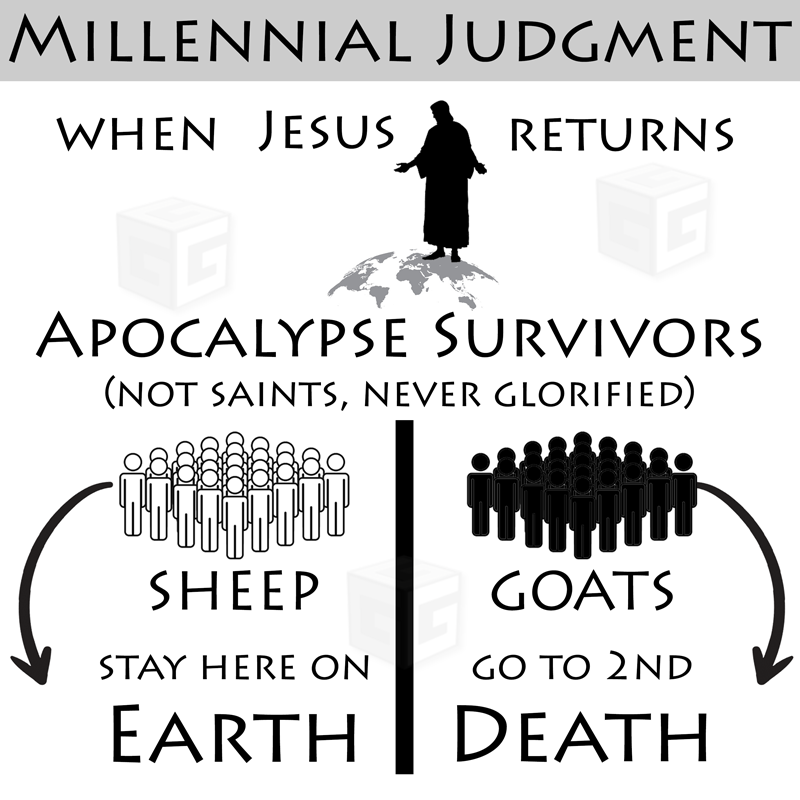
We know that this is after the Lord has taken His seat on the throne of Earth in Jerusalem. We also know from many passages in scripture that the previous seven-and-a-half years have seen the tribulation and God’s wrath (two distinct but sequential events). So, it’s very easy to see that these sheep and goats are survivors of the apocalyptic events that just preceded this judgment (see Matthew 24). These are not glorified people, but unglorified. And since glorification comes through faith, these are not believers—not one of them, whether a sheep or a goat. These, then, are mortal humans—the few survivors of the horrific times that just ended for them. “Throughout the earth the story is the same—only a remnant is left, like the stray olives left on the tree or the few grapes left on the vine after harvest.”(Isaiah 24:13, NLT)
They are called “The Nations”. The word for nations is the same as we use now—groups of people with a shared heritage and land. They were in the nations before being summoned to the judgment and they will continue to live as nations after it. The difference is that by then they will have been hand-picked by Christ to stay in His kingdom on Earth. They will be ruled by Jesus and His saints (Revelation 20).
Justification
And how does He choose who stays and who goes? It’s right there in the text. Whoever is kind to His brothers and sisters (saints) will be able to stay on Earth. Whoever is not kind to His brothers and sisters (saints) is sent away to eternal punishment. They don’t go to hell, they go directly to the Lake of Fire (or Burning Sulfur). And although hell is not forever (Revelation 20:14), the Lake of Fire is (Revelation 20:10). That makes the stakes as high as possible.
So these people are not judged by their faith, they are judged by their behavior. This is another very clear indication that these are not saints. Why? Because saints are saved by faith and repentance, not by their behavior (John 3:18; Ephesians 2:8-9; Romans 3:28; Galatians 2:16; John 3:16; Romans 10:9; etc.).
Not convinced? Let’s read it again.
Matthew 25:34 Then the King will say to those on His right, ‘Come, you who are blessed by My Father, inherit the kingdom prepared for you from the foundation of the world. 35 For I was hungry and you gave Me something to eat, I was thirsty and you gave Me something to drink, I was a stranger and you took Me in, 36 I was naked and you clothed Me, I was sick and you looked after Me, I was in prison and you visited Me.’
That has nothing to do with faith. It’s all about behavior. And again, the saints have already been established by then. I see Him sitting on His throne and pointing with His thumb over his shoulder at the saints standing behind Him when He says this, “Whatever you did for these, my brothers and sisters.”
And the same measure is used for those who are sent to eternal damnation—their behavior. Unfortunately for them, if they had displayed faith in Him then they would not be standing there for judgment (despite their bad behavior). They would be standing behind Him as saints, saved by faith. (I don’t know if the saints are actually standing there or not, I just use that as an illustration to help you see it.)
Are you seeing how this works out? If you aren’t there yet, that’s okay. I have more to share that will really drive this home for you. After all, if it’s the truth and is found in the Bible, then it will (usually) be in more than one place and have much support. And it does.
For now, the takeaway is that the separation of the sheep and goats is based on their behavior, not faith, and they are not saints. And then the sheep get to stay while the goats have got to go.
Next, we move on to some “loose ends” found in the scriptures that touch on this theme and actually reinforce the notion I have laid out for you. In the process, you might get a better picture of some of these sideline issues as well.
What Did I Do Here?
Before we move on, I want to ask you to stop and think this through with me.
What exactly did I just do here?
Did I invent some new theology? Did I redefine words? Twist meanings? Force a passage to say something it doesn’t?
No. Not at all.
All I did was take the passage exactly as it was given. I didn’t change anything. I didn’t overlay a system or bend it to fit a framework, doctrinal position, or creed. I just read it—and believed it. Not as allegory or parable, but as factual history that is yet to come.
And not just that passage. I looked at the full timeline. I didn’t isolate Matthew 25 and build a theory around it. I followed the flow of Scripture—from Jesus to Paul, from the prophets to Revelation. I let the Bible interpret itself.
And here’s what becomes obvious: by the time Jesus separates the sheep and the goats, the saints have already been glorified. That’s not speculation—that’s just following the order the Bible gives. So the people being judged in this scene can’t be the saints. It’s not possible. Look again at chapter 24, just before this (especially verses 30-31). He already gathered His “elect” from both heaven and Earth.
That’s not theological gymnastics. That’s just plain, immovable logic. So I followed it. I didn’t argue with the text. I let the text have the final word.
And here’s something else worth pointing out:
Jesus gave this teaching—the separation of the sheep and the goats—as the final section of His Olivet Discourse. That wasn’t random. The Olivet Discourse is the most complete end-times timeline we have in the whole Bible—the backbone that supports everything else. Yes, He gave a couple of parables in chapter 25—but this section isn’t one of them. He presents it as future fact—what He will actually do (narrative).
That matters.
No backflips. No borrowed terms from theological echo chambers. No clever system or reputation or career to protect. Just the straightforward meaning of what Jesus said.
And honestly? That’s the shocking part. Not that this view is radical—but that so few, if any, have ever taught it this way. For two thousand years, people have tried to force these words into their systems, wishes, and paradigms. I let the systems fall away and followed the Scripture instead.
So if this feels new, ask yourself: is it really new? Or have we just missed what’s been sitting in plain sight? Ask yourself, “Have I been following a teaching that makes no sense? Is that possible?”
I didn’t do anything unusual here. I gave Scripture permission to mean what it says and say what it means. That’s all. So, what do you think?
Did I remove the Gospel of Christ, as given by Paul and the other apostles? Not one jot or tittle. Did I give God the freedom to give grace to whomever He wishes, based on His own words? I believe I did.
If you need to wrestle with this, do it with humility, love, joy, and much prayer. Don’t check your brain at the door—use it. And let simple logic rule your mind. Let God’s love rule your heart.
Love needs truth. Truth needs love. Both need wisdom.
Chapter 2 Discussion and Reflection
Questions:
- Who is a saint?
- Who is a sheep?
- Who is a goat?
Answers:
- Someone saved by faith in what Jesus did on the cross. A believer.
- Someone not saved by faith in Jesus. A nonbeliever. But they get to live on in the Millennium.
- Someone not saved by faith, who did not treat people well. They are doomed to the Lake of Fire.
Reflection: How was this simple doctrine missed for so long? Is there anything about it that is not biblical? Which is the final authority for mankind: the Bible or the Church?
Note: “Biblical” means it matches the Bible, not necessarily the teaching of the Church.