
It’s time to talk about this, because it has gotten out of hand.
Disclaimer:
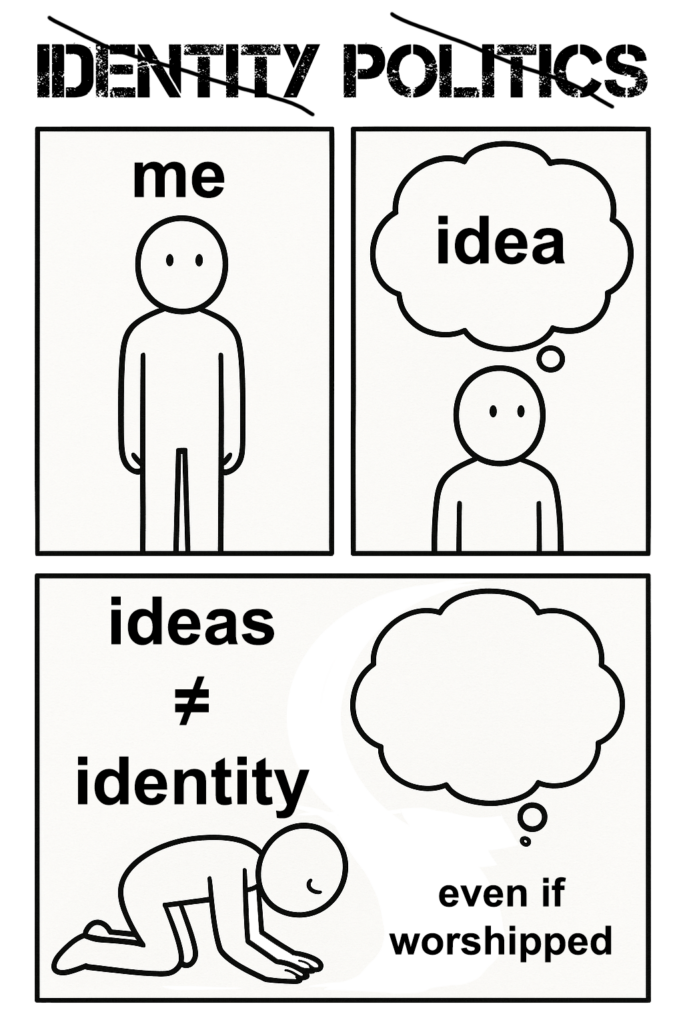
If anything here offends you, know this: I’m addressing actions and ideologies, not your worth as a person. I judge behavior and ideas, not identity. We’re all part of the same human family. Ideas ≠ identity. This means that you and your ideas are separate from each other. I am not my ideas and my ideas are not me. And I have no idea who you are.
Homophobia
I first heard about “homophobia” in the early 1990’s. Someone said that I was a homophobe for having a moral objection to same-gender sexual activity. That person assumed that I was hateful toward those who participate in what I consider to be morally offensive.
But wait.
Phobia is an irrational fear—not hatred. Who decided to change the meaning of this word? I never got that memo, I guess.
So my reply was “What do you mean? Phobia means fear. I don’t fear homosexuals.” Well, that reply was lost on deaf ears. Apparently, words don’t have meaning any longer. When he told me that he meant hatred, I told him that I don’t hate anyone for being a homosexual—I pity them. He didn’t like that answer any better. This was a discussion with a non-homosexual male at work.
The Cruelty
But we are going to go a bit deeper into this today. I’m going to show you a cruel angle to this topic that no one seems to be talking about.
While working in state fairs for a year or two, I learned that there are many people in the world with coulrophobia (the fear of clowns). And not just children. Adults can fear clowns too. And they do. And every clown I talked to about this fear of them is very sensitive to the reactions of people to their character, especially the kids.
What are the effects of phobias?
Phobia: a condition in which a person experiences an irrational or excessive fear of a specific object, situation, activity, or other people.
- Core feature: the fear is real to the person experiencing it, even if it seems disproportionate or illogical to others.
- Effects on the person:
- Emotional distress: persistent anxiety, dread, or panic.
- Physical symptoms: rapid heartbeat, sweating, nausea, shortness of breath, or fainting.
- Behavioral impact: avoidance of triggers, which can limit work, school, social activities, or other opportunities.
- Cognitive effects: intrusive thoughts, difficulty concentrating, heightened vigilance.
- Sleep and dreams: nightmares, vivid dreams about the fear, or sleep disturbances due to anxiety.
- Overall impact: phobias disrupt the person’s mind, body, and daily life, affecting relationships, functioning, and well-being.
Key takeaway: phobias are real conditions affecting real people, not moral judgments or political labels. Using the term to describe disagreement, critique, or moral opposition distorts reality and trivializes the real suffering of those who genuinely experience phobias.
But there is something deeper.
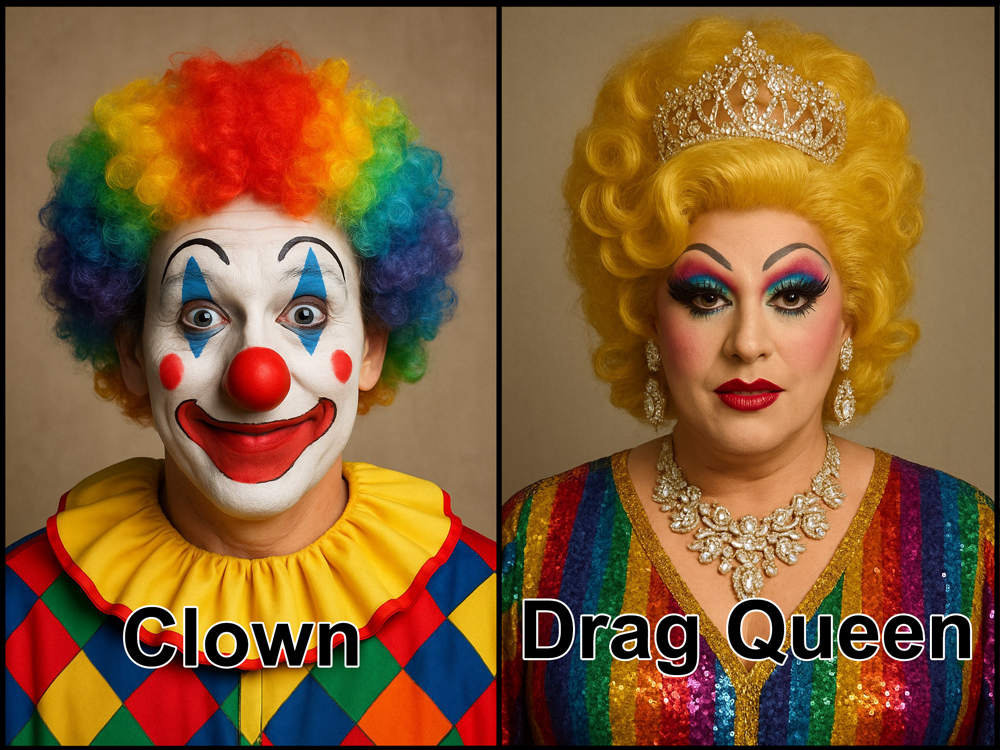
If a person is genuinely afraid of a clown—or a drag queen—how sensitive is the clown or queen to the effect they have on those with real fear?
Is it appropriate to shame, scold, or lecture the fearful ones, especially children?
Why is a drag queen permitted to express outrage that someone fears his appearance, but the person with the fear is labeled the problem?
If fear is real, why is only one kind of fear respected?
Who, then, is actually being unkind?
And let me be clear:
The cruelty is not in the costume—it’s in the harsh treatment of those who disagree or feel discomfort due to the outfit.
Not Just the Queens
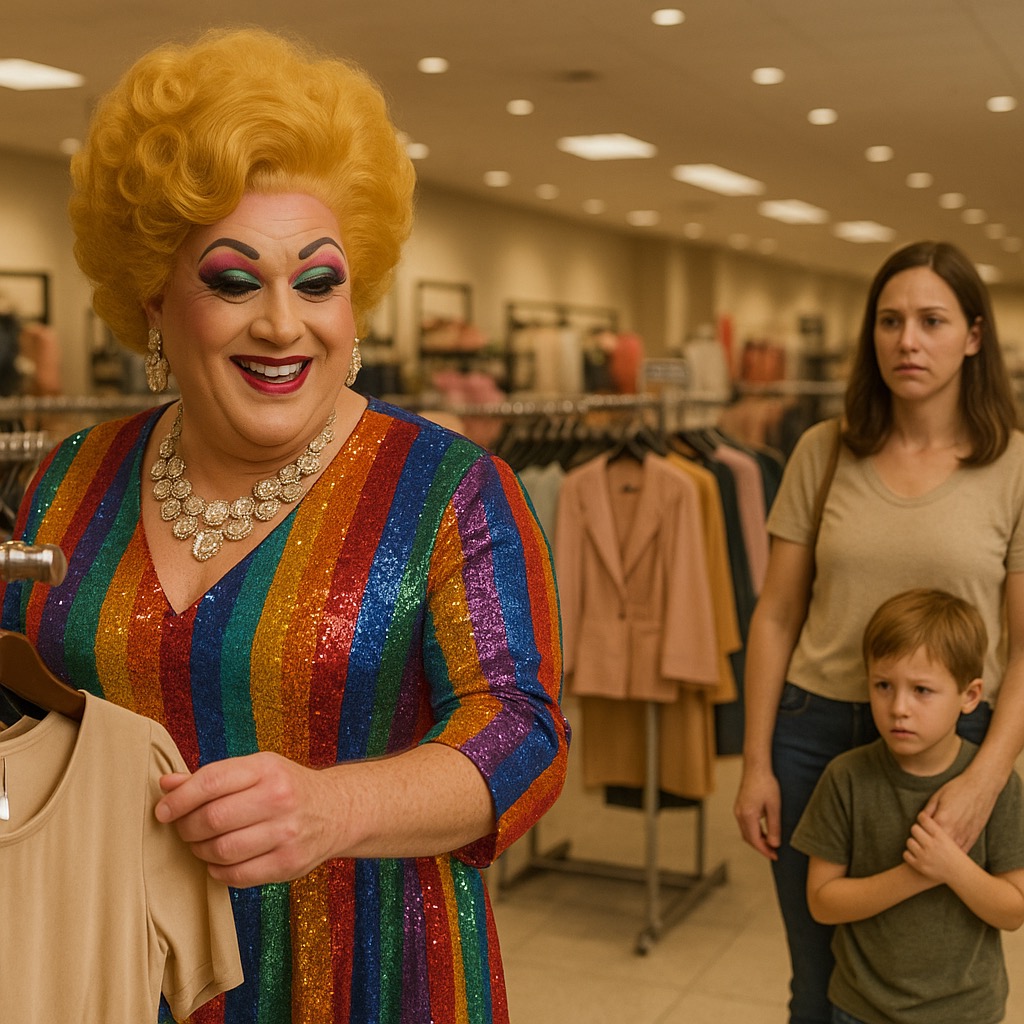
Have young boys been traumatized by unwanted sexual assaults or advances from adult males? All the time. And would that experience cause a deep fear of adult male sexual behavior—or of men who express same-sex sexual interest? Quite likely.
So if a man was sexually assaulted by another male at any point in his life, is it irrational for him to experience fear, discomfort, or avoidance around homosexual activity or homosexual advances? Of course not.
And if the fear is irrational by definition, can that be held against him? No. Phobia is not a moral failure.
In these cases—and there are many—how sensitive is it for a homosexual man to condemn, shame, or attack someone who is genuinely afraid because he was traumatized by a male in that context?
Trauma deserves compassion, not ridicule.
U.S. DOJ (Department of Justice) + RAINN (Rape, Abuse & Incest National Network):
- 1 in 6 boys is sexually abused before age 18.
- 60–90% of sexual abuse against boys is committed by adult males.
This means millions of men may carry legitimate fear, discomfort, or trauma related to male-on-male sexual behavior.
Labeling that fear as “homophobia” isn’t justice—it’s cruelty.
Islamophobia
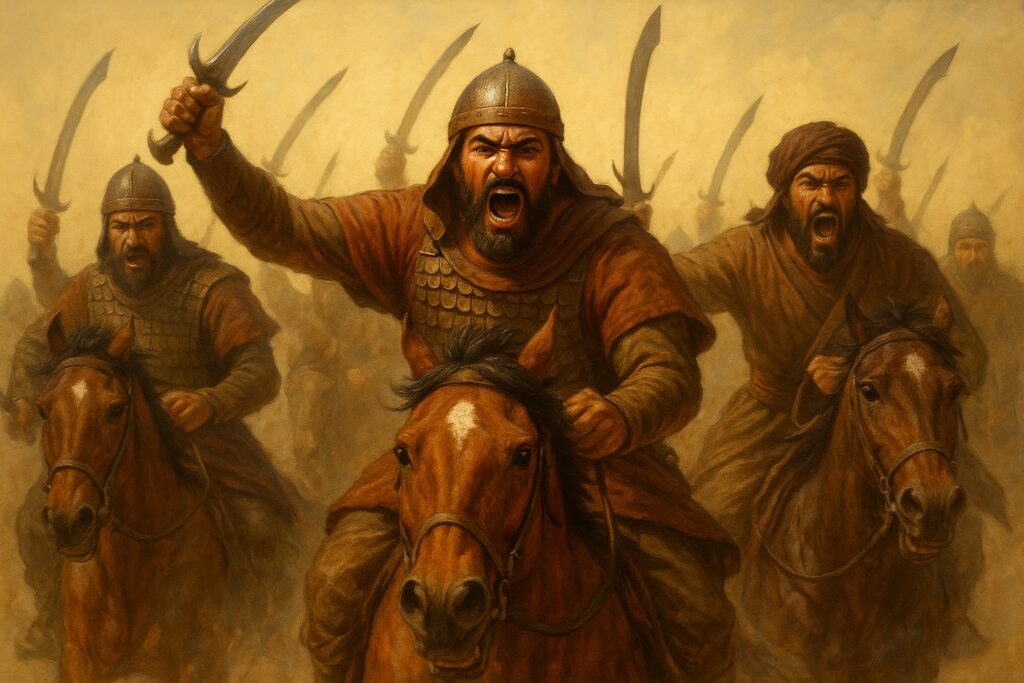
Same definition: Phobia is fear. Not all fear is irrational. Phobia is NOT hatred.
Islam is one of the three main Abrahamic, monotheistic religions.
This is where it gets very real, folks.
Can a person have an irrational fear toward those in Islam? Whether one likes it or not, yes, a person can have an overwhelming fear of those in Islam. But how and why? What is there to fear about a religion? It seems irrational (which a true phobia is). But is having a fear of Islam irrational for all people? Not in the least. In fact, there are millions of people who are legitimately afraid of those in Islam, called Muslims.
Islam as a Religion
According to Islam, 610 A.D. is when Muhammad received his first revelation from the angel Jibril while in a cave. From this event eventually came the religion of Islam.
But what is Islam? What is it like? What does it teach?
It isn’t all butterflies and pretty flowers. In fact, there are elements to it that are quite violent and harsh. Does this mean that all adherents of Islam are bad people in any way? No. There are very loving and warm people in the religion. But at the same time, the books they follow, the Qu’ran, the Sunnah, and the Hadith, can be twisted into certain beliefs and practices that are not kind at all.
Islamic Violence
History is rife with religious warfare: Christians killing Christians, Muslims killing Muslims, and Christians and Muslims killing each other (just to pick on the two big ones). In fact, I know of no major world religion that has not had some history of violent acts.
Also, there are many religions that can be oppressive toward their adherents or community. Christianity has been guilty of burning innocent people at the stake. Judaism has stoned their law breakers. And Islam is no exception. Sharia Law can be (usually is) quite oppressive. You don’t want to live under it, trust me. Especially if you have lived in the United States of America (the best nation on Earth).
Terrorism
Which of Islam’s Foundational Sources Are Used to Justify Violence?
Islam has four foundational teachings:
- The Qur’an
- The Sunnah (the example of Muhammad)
- The Hadith (written reports of Muhammad’s sayings and actions)
- Sharia (the legal system derived from the first three)
None of these sources inherently “incites violence,” but one category is used far more often by extremists than the others.
1. The Sunnah
The Sunnah contains the record of Muhammad’s actions, including his military campaigns. These historical events become legal precedent in Islamic jurisprudence. The Sunnah itself does not command Muslims today to wage constant war, but it is the basis for classical Islamic rules about warfare. Because of this, militant groups often point to episodes in the Sunnah to justify their actions, while ignoring context and traditional interpretation.
2. The Hadith
The Hadith are the texts most frequently misused by extremists.
They contain many peaceful teachings, but they also include narrations tied to specific battles, punishments, loyalties, and conflicts from Muhammad’s time. Extremist groups cherry-pick these wartime hadith, remove them from their historical settings, and present them as if they are standing commands for all Muslims today.
When extremists want a justification for violence, they almost always combine a Qur’anic verse taken out of context with a hadith to make it appear authoritative.
3. Sharia (Islamic Law)
Sharia itself does not “incite violence.” It is a legal framework that historically included sections on war, because Islam functioned as the law of empires. Classical Sharia contains rules about truces, treaties, prisoners, taxation, and wartime conduct. Modern extremists claim to follow Sharia, but what they practice is a distorted version that ignores the full legal tradition.
So which source is used most often today to justify violence?
Extremists rely most heavily on selected Hadith and portions of the Sunnah.
These contain historical wartime material that—when removed from context—become tools for radical ideology. The Qur’an itself contains far fewer war-related passages, and mainstream Islamic law strongly limits and contextualizes them.
The Reality?
Over the ages, Islam has been very violent and still is. They even behead some people still. They can seem unreasonable (as much as Baptists), brutish (like the Bedouins they spawned from), or arrogant (as much as any proper Jew -jk). Now, I am speaking generally and in good humor. I am not speaking out against any of those religions or their adherents. But there is nothing humorous about terrorism. And when it is done in the name of Allah, that will cause fear for those on the receiving end. After all, fear is the goal of terrorism, by definition.
This means that millions of people have a grounded, rational fear of those in Islam. And while this is mostly a regional issue, it is growing as those in the Middle East move into other areas, like Europe or the US, without assimilating into the new culture.
So when I hear those in Islam, who are not receiving all the perks and bennies of their new place, call others “Islamophobe” simply because they don’t like something about the other person, this becomes a problem. And it is a growing problem, as they move about the globe.
Sons of Ishmael
In Genesis 16:12, God speaks prophetically about Ishmael (Abraham’s first son), calling him “a wild donkey of a man” (or “a wild ass of a man” in older translations).
This phrase does not insult Ishmael; it describes a man who will live free, untamed, independent, and strong-willed, much like the wild desert onager (Asian donkey) of the ancient Near East. The next lines explain the meaning: he will live in tension with others, and others with him. It is a prophecy about conflict-filled independence, not personal worth.
Scripture presents Ishmael as the ancestor of many peoples of the Arabian Peninsula. From a biblical and historical standpoint, the tribes that later became associated with the Arab peoples trace their lineage to Ishmael, and Islam emerged within that same lineage in the 7th century. While not every Arab is an Ishmaelite and not every Muslim is Arab, Islam originated among the descendants of Ishmael, and his prophetic description echoes through the long history of conflict, independence, resilience, and tribal divisions in that region.
So God prophesied their behavior today. Yes, it still applies. And it’s no secret either. The Middle East has been a hotbed of violence for centuries. And this does apply to some in the Islamic faith.
Xenophobia
Fear of others from different cultures or ethnicities. That’s xenophobia. Of course, the phobia is strictly an irrational fear—it is not hatred. This is also tightly tied to Racism. I personally don’t believe in separate “races” of people. Is that supposed to mean different “species” of man? We are all one family, descended from Adam and Noah. The only Race is Human. Angels are a different race. But a “xenophobe” could fear a clan of the same “race”, or people of the same culture but of different ethnicity.
Is it rational? That depends. If someone has a legitimate reason for fearing them (due to war or other circumstance) then it is real. Ukrainians might fear Russians, for example. But whether the fear is rational or irrational, it should not be dismissed.
Am I encouraging racism or xenophobia? Not in the least—I dislike both. But we have the same issues with calling people xenophobic or racist as we do in the other topics covered above: It is mostly used as a slur against those who do not give you what you want or share your beliefs.
This must stop. Do not attack a person for their ideals, faith, or fear. Do not attack anyone for any reason. Just defend yourself against actual violence. If someone uses this kind of super-heated rhetoric against those who simply do not agree with them, then that can be an even larger issue than whatever they are attacking. We must, in a society, give people the benefit of the doubt. No man knows another’s heart or motives. Therefore, we must not attack others with allegations that cannot be proven. Instead, look only to their behavior. Do not judge people by WHO THEY ARE—JUDGE THEIR ACTIONS. Did you get that? Only judge a person’s actions, not who they are as a person. This is biblical (for those of you who follow it). And if we would all do just this one thing, most of our issues would melt away into a happy world.
Conclusion

Most of the issues we face along these lines have to do with self-centered people treating others badly. The main problem is not a person’s identity with a society, ethnicity, religion, or anything else. The main problem is people acting poorly for the wrong reasons.
Don’t call people things that are super-charged with emotion just for the effect (like “Nazi”). It accomplishes nothing but further divide or bring societal ruin. We in America are nearly there.
But it is not too late. We can stem this tide and turn it around by behaving civilly toward others, no matter how we are feeling at the time. Here’s how the Bible that I follow says it:
Treat others the way that YOU want them to treat you. (Luke 6:31)
Doing this will immediately and vastly improve your and everyone else’s world.
Be at peace with your brothers in the world—the human family. And quit judging people by their identity and judge them by their actions. And ideas are fair game for attack—but people are not.
For you and not against you.
Gary