

Contents
Introduction
Chapter 1: End Times Preview
Chapter 2: Sheep and Nations
Chapter 3: Loose Threads of Doctrine
Chapter 4: Return of the King
Chapter 5: The Millennial Life
Chapter 6: The New Creation
Chapter 1: End Times Preview
Since there are so many views on the End Times, I think it will help to at least show you where I land in this highly contentious and confusing area of biblical study. So this chapter is an introduction to the historic view that I am most closely aligned with. If you have another view, are not sure what your view is, or are staunchly loyal to a particular stand or teacher, then this might be helpful for you. Just try to not get upset if this is not what your pastor or favorite teacher teaches.
Main Views
When young people who are drawn to ministry enter into seminary, they are typically hit with a plethora of opposing views in eschatology (the part about the End Times). Many of them turn to one or another systematically pre-packaged model and stick with it, without really taking a deep-dive into the whole subject as given in the Bible. This is understandable, since they are being bombarded by so many other biblical topics in a short period of time. But the end result is a very structured population in the ministerial fields. They are herded into groups of theology that may or may not be compatible with each other. Unfortunately, this is an automatic division of the Church. And since each seminary graduate is potentially going to affect the outlook of many, many believers or seekers, the entire body of Christ is effectually fractured as a result. And when a topic, like this one, has an emotional impact on people, the wedge can be quite harsh and unloving.
I will try my best to not exacerbate this divide. But the divisions, factions, and feelings are real. So keeping this in mind, let’s take a high-altitude look at the main views of eschatology. If you find yourself getting even mildly upset, take a minute and ask the Lord for His peace to flow over your heart and soul. After we look at the various views, we will drill into a timeline of the one that I favor.
The first arena we fly over is regarding the timing of the Lord’s glorious return. Not every part of eschatology is important. For example, the timing of the return of Christ is less important that the fact of it. None of these doctrines on the return of our Lord is worth holding a grudge against a fellow believer with a different view. In other words, the fact of His return is actually nonnegotiable, while the timing of it is an opportunity for grace.
In all of these three main views, the reference point is the next age of Earth—the Millennium. They each are named and framed according to that era. This means that their names reflect that. So when you read the names of these, you are seeing a hint as to their connection to that epoch. For each, I’ll offer a short primer on where it came from, along with a few perceived strengths and weaknesses—just enough to orient you before moving on.
Premillennialism
Overview
Premillennialism teaches that Jesus will return before the Millennium begins. This view takes Scripture at face value and follows the plain sequence from Matthew 24 and Revelation 19–21 (for starters). The Lord physically returns, defeats His enemies, and establishes His kingdom on Earth for a thousand years. After that, there’s one final rebellion, followed by the judgment and the new creation.
But not all premillennial views are alike. Two very different camps exist within it: one follows the text; the other overrides and reinterprets it.
Historic Premillennialism
This view teaches that:
- Christ returns after the Tribulation (Matthew 24:29–31)
- The saints are resurrected and raptured at His return (1 Thessalonians 4:16–17)
- Those glorified saints then reign with Him for a thousand years (Revelation 20:4–6)
- Satan is bound, then released, then defeated permanently (Revelation 20:1–10)
- The final judgment and eternal state follow (Revelation 20:11–21:8)
This straightforward sequence requires no rearranging of the text. It aligns with the prophets, Jesus, and Paul—and was held by early church fathers like Justin Martyr and Irenaeus. It does not rely on invented systems or assumptions.
Supporting scriptures:
- Revelation 20:4–6 — Saints live and reign with Christ for a thousand years after His return
- Matthew 24:29–31 — Jesus returns immediately after the Tribulation and gathers His elect
- 1 Thessalonians 4:16–17 — The dead in Christ rise, the living are caught up together with them at the Lord’s return
- Zechariah 14:4, 9 — The Lord lands on the Mount of Olives and reigns as King
- Acts 1:11 — Jesus will return in the same way He left
- 2 Thessalonians 2:1–3 — The Day of the Lord will not come until the man of sin is revealed
Dispensational Premillennialism
A much newer view, Dispensationalism, splits the return of Christ into two events: an invisible rapture before the Tribulation, and a visible return after it. It also insists on a hard distinction between Israel and the Church.
Its assumptions include:
- A pre-Tribulation rapture, often read into 1 Thessalonians 4:17 without any stated timing
- The absence of the Church in Revelation after chapter 4—despite the presence of saints, witnesses, and the Bride
- A rigid Israel/Church division—contradicted by Ephesians 2:14–16 and Galatians 3:28
- A future gap between the 69th and 70th weeks of Daniel—entirely assumed (Daniel 9:27)—rather than the 2,000-year gap that has existed
One common claim is that because the word “church” (Greek ekklesia) doesn’t appear in Revelation 6–18, the Church must be gone. But that logic fails. The Church is referred to repeatedly—just in different terms: saints, overcomers, the woman, the offspring, “those who keep the commandments of God and the faith of Jesus” (Revelation 12:17, 14:12), and the Bride.
Also worth noting:
The word church is only used twice in the Gospels—and only in Matthew. It’s missing from many New Testament books altogether (e.g., 2 Timothy, Titus, 2 Peter, 1 John). So its absence in any one section of Scripture cannot be used to argue disappearance or irrelevance of the body of believers.
Problems with this view:
- No early church support—entirely modern in origin
- Assumptions override the text—gaps and categories are imposed, not found
- Breaks the return of Christ into two events with no clear biblical foundation
- Treats silence as proof and charts as Scripture
Summary
Historic Premillennialism follows a plain-meaning hermeneutic and honors the biblical sequence. Dispensationalism distorts that sequence with added frameworks and unbiblical assumptions. One draws doctrine from Scripture. The other draws Scripture into a system.
A Quick Sidebar on the Rapture
There are five main views on the timing of the rapture (when living saints meet Jesus in the air):
- Pretribulation—He will raise the saints before the 7-year tribulation.
- Midtribulation—He will raise the saints when the Great Tribulation starts.
- Prewrath—He will raise the saints just before God’s Wrath begins.
- Posttribulation—He will raise the saints after the tribulation.
- No Rapture—He will not raise the living saints at all into the sky.
Of these five, only one can be right—if any of them are. My own position is Posttribulation, though I place it in the middle of God’s Wrath, which immediately follows the tribulation. I arrive at this position through simple, straightforward reading of the Bible, not by aligning with any predefined system or label.
Postmillennialism
Overview
Postmillennialism teaches that Jesus will return after the Millennium. According to this view, the Church gradually brings about worldwide peace, justice, and Christian influence—culminating in a golden age before Christ returns. It gained traction in the 17th–19th centuries, particularly during times of colonial expansion and missionary success, when it seemed plausible that the world might be “Christianized.”
Hopeful Positives:
- Emphasizes the transformative power of the gospel
- Encourages active cultural engagement and long-term investment
- Offers a vision of hope instead of defeatism
Definite Negatives:
- Scripture repeatedly predicts escalating deception and wickedness, not global righteousness (2 Timothy 3:1–5, Matthew 24:9–12)
- Jesus describes His return as coming to a world like the days of Noah—not a peaceful golden age (Matthew 24:37–39)
- Revelation presents Christ as returning to destroy the beast and false prophet, not inherit a peaceful planet (Revelation 19:11–21)
- Historically, this view lessened after the World Wars, which shattered belief in human progress
Postmillennialism often ignores the warnings of apostasy, tribulation, and judgment in order to maintain its optimistic timeline. In doing so, it must minimize large portions of prophecy or reframe them as symbolic or past events (called, “preterism”).
Conclusion
The greatest flaw of Postmillennialism is its reliance on an allegorical or optimistic reinterpretation of prophecy. It doesn’t flow from a plain-meaning reading of the text, but rather from a theological hope layered onto it. Instead of taking Jesus’ own warnings about worldwide deception and judgment at face value, this view spiritualizes or sidelines those warnings to preserve its vision of steady human improvement. It sets aside the reality of how Jesus said He would return—in vengeance, not celebration.
Amillennialism
Overview
Amillennialism teaches that there is no literal thousand-year reign of Christ on Earth. Instead, the “Millennium” is symbolic of the present Church Age—Christ reigns from Heaven now, Satan is already bound, and the resurrection and judgment will occur in a single event at the end.
It became dominant in the 4th century under Augustine and has remained the default view in Roman Catholicism, much of Eastern Orthodoxy, and many Protestant traditions (especially Lutheran and Reformed branches).
Hopeful Positives:
- Sees Christ as already reigning—a strong theological anchor
- Affirms the unity of the people of God (no Israel/Church split)
- Avoids sensational speculation
Definite Negatives:
- Requires that Satan is currently “bound”—despite passages like 1 Peter 5:8, which warn believers that he “roams like a roaring lion”
- Must spiritualize Revelation 20—despite its placement after the return of Christ in Revelation 19
- Flattens the prophetic timeline, removing any real distinction between this age and the next
- Struggles to explain why Jesus would return to end a reign that’s already symbolic and finished
Where premillennialism sees prophecy as a chronological roadmap, amillennialism reinterprets much of it as metaphor or recurrence. While it avoids some excesses, it often does so by reducing the clarity and force of prophetic Scripture.
Conclusion
At its core, Amillennialism leans heavily on a symbolic hermeneutic, often treating clear, sequential passages as figurative or timeless. Rather than accepting Revelation 20 as a literal follow-up to Christ’s visible return in Revelation 19, it repositions the “Millennium” as a present reality—one that few believers would recognize in the world around them. This allegorical method not only breaks continuity within the book of Revelation but disconnects many Old Testament promises from their fulfillment in Christ’s future reign. The net result is a view that smooths over tensions in the text by redefining plain statements, which ultimately erodes the reader’s ability to trust what Scripture says at face value.
Biblical Warning to the Church About False Doctrine
2 Timothy 4:1 I solemnly urge you in the presence of God and Christ Jesus, who will someday judge the living and the dead when He comes to set up His Kingdom: 2 Preach the word of God. Be prepared, whether the time is favorable or not. Patiently correct, rebuke, and encourage your people with good teaching.
3 For a time is coming when people will no longer listen to sound and wholesome teaching. They will follow their own desires and will look for teachers who will tell them whatever their itching ears want to hear. 4 They will reject the truth and chase after myths.
5 But you should keep a clear mind in every situation. Don’t be afraid of suffering for the Lord. Work at telling others the Good News, and fully carry out the ministry God has given you. (NLT)
That time has clearly come. Whether it’s the overly hopeful outlook of Postmillennialism, the symbolic reinterpretation of Amillennialism, or the forecast-heavy sensationalism of modern Dispensationalism, each tends to cater to what people want to believe rather than what the Scriptures plainly teach. These systems often sideline direct warnings, redefine key terms, and replace God’s clear promises with theological extrapolations. The result is a fragmented Body of Christ, less equipped to discern what is unfolding around us. No wonder there is confusion in eschatology more than most areas of theology.
Not all who hold to these views do so maliciously. Many are simply repeating what they were taught. But regardless of intent, the outcome matters. Truth matters to God as much as Love. Love needs truth. Truth needs love. Both need wisdom.
Now that we’ve flown over the main views, let’s descend into the view that most closely reflects both the early Church’s understanding and the plain reading of Scripture: a traditional, historic Premillennial timeline.
Historic Premillennial Timeline
After carefully studying the End Times for over 30 years, I’ve arrived at a solid position on all its elements. I didn’t get there by following any one particular view, but by reading the Bible itself and slowly piecing together the parts using a plain-meaning interpretation. I let the Bible’s clear passages interpret the more vague ones. I prayed often and allowed both the Spirit and sound logic to guide my thinking.
It’s been a long journey—because there are so many moving parts. I can see how false notions have sprung up from hasty attempts to reach conclusions, or simply from repeating what old-so-and-so said without testing it.
But when we let the Bible speak and simply listen—without inserting our own fears, hopes, or agendas—this is what I believe we come away with. I hope it enlightens you. If you have any questions as to how I came to these conclusions, see my other End Times book, End Times Made Easy, for a deeper dive.
Ezekiel’s War
The very first thing to happen in the timeline is an invasion of Israel from the North, which includes several Islamic nations that surround Israel. This event is nearly imminent and could happen at almost any time. I say “nearly” imminent because there is only one prerequisite: Peace in Israel.
Ezekiel 38:8 A long time from now you will be called into action. In the distant future you will swoop down on the land of Israel, which will be enjoying peace after recovering from war and after its people have returned from many lands to the mountains of Israel. (NLT)
This, and the specific nations involved, rules out all other prospects as fulfilling this prophecy. October 7th wasn’t it. None of the recent wars were it. Israel MUST be at peace before Ezekiel’s War begins. And in my humble opinion, this will only come with regime change in Iran. And if Iran acts unilaterally (alone), then that will not be it either. If Israel attacks Iran to cripple them (as is happening as I write this) THAT will not be it. Here is what must take place for us to know that Ezekiel’s War has begun:
- A popular leader attacks Israel, who is from the Caucasus. The possible nations of his roots are: Russia, Georgia, Armenia, Azerbaijan, and Turkey. No other leader will do. No other heritage will count. He aligns himself with these specific nations (and only these nations) for the initial attack:
- Persia = Iran
- Cush = Ethiopia, Somalia, Sudan (as a region)
- Put = Libya, Algeria, Tunisia (as a region)
- Gomer = Turkey
- Beth-togarmah = Turkey
3. He is successful in claiming what he wants (unlike all other invaders).
4. The leaders will meet at a conference table. An agreement is reached and he pulls out to return home.
This begins the countdown of the 7-year tribulation period. 295 days after the conference table meeting, construction of the temple in Jerusalem will be completed. So when you see the third temple being built in Jerusalem, you can know with certainty that the tribulation has indeed begun. (There’ll be more on the timing later.)
Ezekiel’s War will be the main event of the End Times. It will last for about 7½ years and overshadow all other events. It begins with this specific invasion and ends with what we call “Armageddon”, a battle centered on the Valley of Megiddo, which is north of Jerusalem.
In Ezekiel 38 and 39, this war is neatly laid out for us. And when we take Daniel 11:21-45 as a parallel passage, we get even more details and a more complete timeline of the conflict. In both passages, the antichrist is the villain. In Ezekiel, he is called “Gog”, a man from a place called “Magog” (the Caucasus). He is the leader of the invasion and becomes the leader of the greater part of the whole world. (I am in doubt as to whether the USA will bend the knee to him or not. The more godly we are, the less likely it will be. But I’m sure you know how badly we flip-flop on this.)
Here are the main events that are encompassed by this war, in chronological order:
- The first half of the tribulation (which includes the building of the temple)
- The Great Tribulation (initiated with the capture and desecration of the temple)
- God’s Wrath (which includes these events: Christ’s return, the resurrection, the rapture)
- Armageddon (the final battle and rebellion of the war and this age)
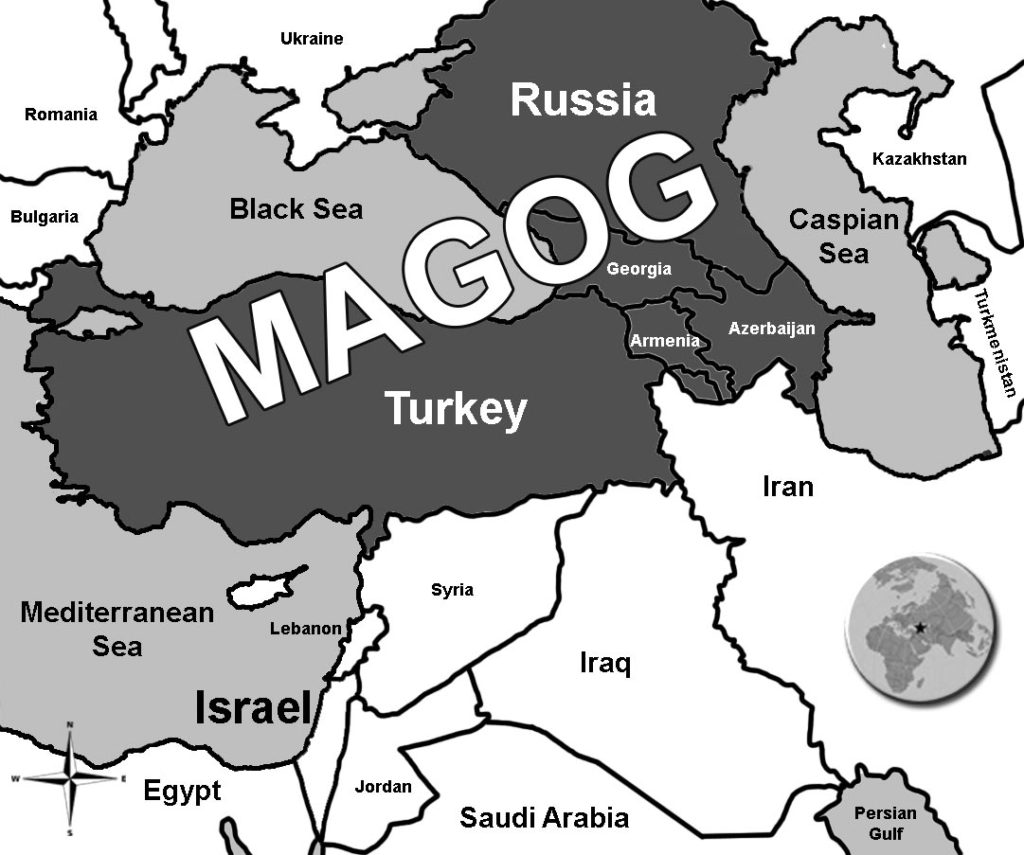
Why “Magog” Is Traditionally Identified with the Caucasus
1. Ancient Historical Consensus
Flavius Josephus (1st century AD) explicitly identifies Magog with the Scythians, who lived north of the Black Sea. He notes that the Greeks referred to this region as “Magogia,” reinforcing the biblical term’s use for that area.
Jerome (4th century AD), in both his Latin Vulgate commentary and Letter 77, locates Magog beyond the Caucasus, near the Caspian Sea, and refers to them as “Scythian nations… beyond the Caucasus and Lake Maeotis [Sea of Azov, north of the Black Sea].”
2. Biblical Geography and Tribal Names
Ezekiel 38 mentions adjoining tribes: Meshech, Tubal, Gomer, and Togarmah—tribal names consistently linked to ancient Anatolia and the Caucasus region in both scriptural and historical geography. The internal placement of Gog as “chief prince of Meshech and Tubal” makes little sense unless Magog itself is nearby, in the broader region to Israel’s north and northeast.
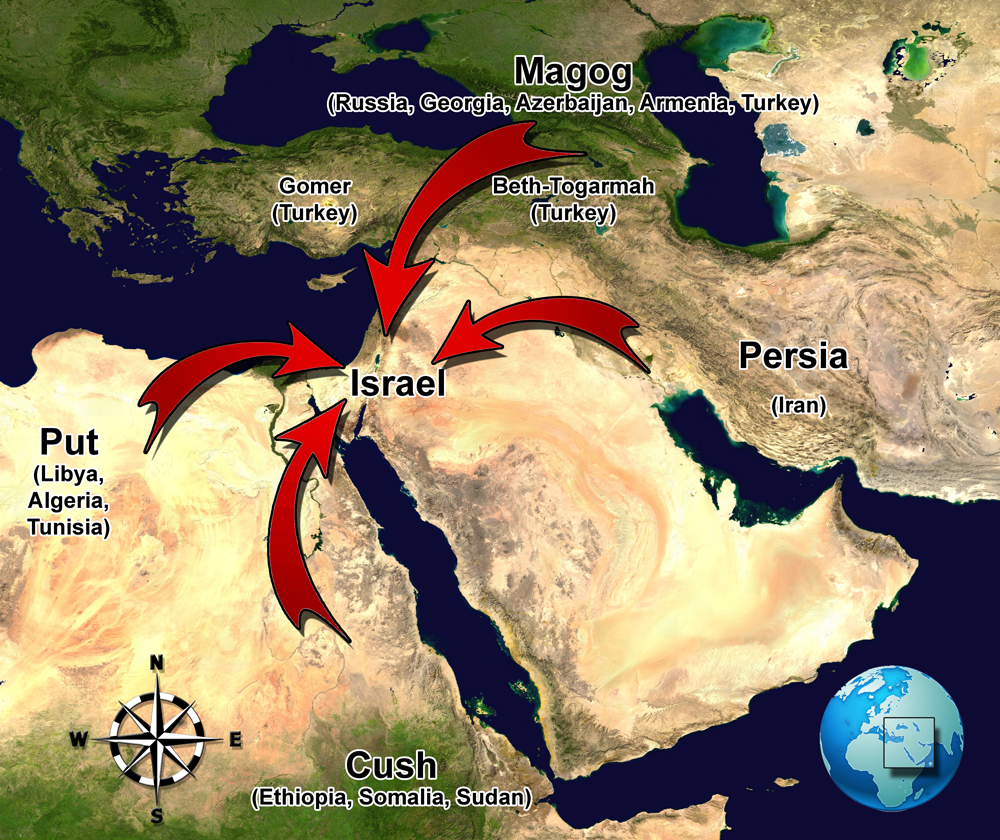
3. Classical and Archaeological Confirmation
Greek and Roman sources such as Herodotus and Pliny the Elder describe Scythian peoples living in the Pontic–Caspian steppe and the Caucasus. Josephus, Pliny, and others confirm that “Magogia” referred to this corridor in their records.
4. Later Church and Medieval Reinforcement
Writers such as Jordanes and Procopius, as well as medieval mapmakers, refer to the “Gates of Alexander” as being located in the Caucasus. This became a consistent tradition throughout early and medieval Christianity, identifying the region north of Israel and east of the Black Sea (to the Caspian) as the biblical Magog.
Summary
Collectively:
- Josephus gives the earliest direct link between Magog and the Scythians.
- Jerome explicitly places Magog north of the Caucasus.
- The biblical tribal context supports the Caucasus–Anatolia corridor.
- Classical and medieval sources reinforce this geographic identification.
This long-standing consensus—drawn from biblical text, ancient literature, and historical geography—makes the Caucasus the most traditional and textually defensible location for Magog, and by extension, Gog of Magog in Ezekiel’s prophecy.
Gog is a man, not a place
Ezekiel could not be any clearer in describing Gog as a man (male human).
Ezekiel 38:1 This is another message that came to me from the Lord: 2 “Son of man, turn and face Gog of the land of Magog, the prince who rules over the nations of Meshech and Tubal, and prophesy against him. 3 Give himthis message from the Sovereign Lord: Gog, I am your enemy! 4 I will turn you around and put hooks in your jaws to lead you out with your whole army—your horses and charioteers in full armor and a great horde armed with shields and swords. 5 Persia, Ethiopia, and Libya will join you, too, with all their weapons. 6 Gomer and all its armies will also join you, along with the armies of Beth-togarmah from the distant north, and many others. (NLT)
Anyone who says Gog is anything but a man is ignoring the plain language of the text.
Gog is Antichrist
There are too many direct links between Gog in Ezekiel and the Antichrist—both in Daniel 11 and in other passages—to ignore. Likewise, the parallels between Ezekiel 38–39 and Daniel 11 are too strong to place the timing anywhere else in history.
Ezekiel 38:7 “Get ready; be prepared! Keep all the armies around you mobilized, and take command of them. 8 A long time from now you will be called into action. In the distant future you will swoop down on the land of Israel, which will be enjoying peace after recovering from war and after its people have returned from many landsto the mountains of Israel. 9 You and all your allies—a vast and awesome army—will roll down on them like a storm and cover the land like a cloud. (NLT)
Ezekiel 38:18 But this is what the Sovereign Lord says: When Gog invades the land of Israel, my fury will boil over! 19 In my jealousy and blazing anger, I promise a mighty shaking in the land of Israel on that day. 20 All living things—the fish in the sea, the birds of the sky, the animals of the field, the small animals that scurry along the ground, and all the people on earth—will quake in terror at my presence. Mountains will be thrown down; cliffs will crumble; walls will fall to the earth. 21 I will summon the sword against you on all the hills of Israel, says the Sovereign Lord. Your men will turn their swords against each other. 22 I will punish you and your armies with disease and bloodshed; I will send torrential rain, hailstones, fire, and burning sulfur! 23 In this way, I will show my greatness and holiness, and I will make myself known to all the nations of the world. Then they will know that I am the Lord. (NLT)
2 Thessalonians 2:8 Then the man of lawlessness will be revealed, but the Lord Jesus will slay him with the breath of his mouth and destroy him by the splendor of his coming. (NLT)
Ezekiel 39:7 “In this way, I will make known my holy name among my people of Israel. I will not let anyone bring shame on it. And the nations, too, will know that I am the Lord, the Holy One of Israel. (NLT)
Timing:
- There is no other time when Israel has returned from many lands.
(Ezekiel 38:8, 11-12) - Israel is at peace before the invasion. This is a very rare condition.
(Ezekiel 38:14) - During God’s wrath and Jesus’ return
(Ezekiel 38:18-20, 2 Thessalonians 2:8) - After Gog’s invasion, Jesus will not allow His name to be shamed. If antichrist comes later, as some say, this is in conflict.
(Ezekiel 39:7) - In the Olivet Discourse, Jesus connects the invasion with the Abomination that Causes Desolation.
(Matthew 24:15, Daniel 11:31)
Connection:
- Both are from the North
(Ezekiel 38:15, 39:2, Daniel 11:28) - “Are you the one I was talking about long ago” This implies connection to the antichrist. (Ezekiel 38:17)
- Gog and antichrist are killed by Christ after His return
(Ezekiel 38:21-22, 39:4, 2 Thessalonians 2:8, Revelation 19:19-21) - How can Gog invade first and then antichrist when Ezekiel says that after the Gog invasion God will not allow anyone to bring shame on His name? Antichrist always tries to bring shame on the name of Jesus. (Ezekiel 39:7)
When we take the whole revelation of scripture into account, we see that there was no other time for this to happen, from the beginning of time until now. It is impossible for antichrist and Gog to be different men. There are more connections and proofs, but this is sufficient for this study.
The Third Temple
You might be wondering how I was able to say so confidently that the 3rd temple will be built in 295 days. Well, it took me a minute to figure it out. But I did it on my own, without anyone telling me. Here’s how I figured this out.
I started with a few verses in Daniel that intrigued me. Here they are:
Daniel 7:23 Then he said to me, “This fourth beast is the fourth world power that will rule the earth. It will be different from all the others. It will devour the whole world, trampling and crushing everything in its path. 24 Its ten horns are ten kings who will rule that empire. Then another king will arise, different from the other ten, who will subdue three of them. 25 He will defy the Most High and oppress the holy people of the Most High. He will try to change their sacred festivals and laws, and they will be placed under his control for a time, times, and half a time.
This passage is about the antichrist (the fourth beast). “Time, times, and half a time” is just a cryptic way of saying 3½ years (1+2+½). It’s also used in Revelation 12:14. And the calendar used in biblical prophecy uses a 360-day year, with each month being 30 days (you can read more about this in another book of mine, called The Broken Planet Model). So the period in question here is 1,260 days. 360 x 3 = 1,080. 360 ÷ 2 = 180. 1,080 + 180 = 1,260.
Daniel 8:13 Then I heard two holy ones talking to each other. One of them asked, “How long will the events of this vision last? How long will the rebellion that causes desecration stop the daily sacrifices? How long will the Temple and heaven’s army be trampled on?”
14 The other replied, “It will take 2,300 evenings and mornings; then the Temple will be made right again.” (NLT) (This is repeated in the same chapter in verses 23-26.)
In this passage, we see an interesting question being asked and answered. “How long will the temple…be trampled on (defiled)?” is the important question here. The answer is clear: 2,300 days. Put that number aside for a minute.
Daniel 9:26 “After this period of sixty-two sets of seven, the Anointed One will be killed, appearing to have accomplished nothing, and a ruler will arise whose armies will destroy the city and the Temple. The end will come with a flood, and war and its miseries are decreed from that time to the very end. 27 The ruler will make a treaty with the people for a period of one set of seven, but after half this time, he will put an end to the sacrifices and offerings. And as a climax to all his terrible deeds, he will set up a sacrilegious object that causes desecration, until the fate decreed for this defiler is finally poured out on him.” (NLT)
The ruler making a treaty for a period of one set of seven equals 7 prophetic years (2,520 days). That’s the total time of the tribulation. The Great Tribulation begins at the halfway point (1,260 days). The treaty he speaks of was most likely formed at the conference table in chapter 11, verse 27. This is why I say that the prophetic clock for the tribulation begins at that conference table moment. It is mentioned here in 9:27.
So, we take the 1,260-day mark and make it our starting point for all of our arithmetic we are about to set up. This is when the temple was defiled.
Daniel 12:11 “From the time the daily sacrifice is stopped and the sacrilegious object that causes desecration is set up to be worshiped, there will be 1,290 days. 12 And blessed are those who wait and remain until the end of the 1,335 days!” (NLT)
The 1,290 days is how long the object of desecration is left standing. The 1,335 is interesting. It is a point in time when those who wait until the end are blessed. (To me, the blessing would be glorification, which could arguably be when the “temple” is made right. I know that this would not refer to the building, but God is often mysterious. And saints are the new temple of the Holy Spirit. (See 1 Corinthians 3:16-17, for example.)
Now we take the numbers and look at them with some easy logic.
1,260—the length of time for either the first or the second half of the Tribulation.
1,290—the time that the statue stands (not the time we’re looking for).
1,335 —the time when the people are blessed.
2,300—the time until the temple is “made right”.
1,260 + 1,335 = 2,595. This tells us the extent of the time that the temple is defiled, which tells us how long it takes before being made right. To find out the time that it was built, we just subtract 2,300 from 2,595, which is not difficult. 2,595 – 2,300 = 295.
Here it is again with a better explanation: the tribulation starts on day 0 (at the conference table). 1,260 days later the temple is defiled (made wrong). That’s when the statue that defiles is set up, which will stand for 1,290 days. 1,335 days later is outside the tribulation period but the temple is still there, and this marks the day of blessing. The blessing includes the time that the temple is made right (glorification of the saints?). So when was the temple construction completed? Between day 0 and day 1,260, obviously. The exact day is guessed by subtracting 2,300 from 2,595.
Like I said, it took some time to figure this out. But now that I have it, I’m sticking with it. What do you think ? Does it make sense? It does to me.
Before we leave the temple, I’ll share one more thing about it.
Location
The 2nd temple site was not on what is now called “The Temple Mount”. Shocking, I know. If the Jews were not so stubborn, and paid attention to Josephus, Jesus, and a Roman named Tacitus, they would know that the temple was actually located just south of the current structure misnamed “Temple Mount”. In reality, that huge structure (that has many stones stacked upon each other—really big ones at that) was the foundation of the first century Roman Fort Antonia.
But we know from Jesus that not one temple stone would remain on top of another. And we know from Josephus that if he had not known where the temple was before its destruction, he would have never known. This means not one trace remained of it. And Tacitus wrote that the spring (Gihon) was located under the temple. There is not now and never was a spring located under the foundation for Fort Antonia. Here’s a picture to see what it looked like, courtesy of the late Dr. Ernest L. Martin.
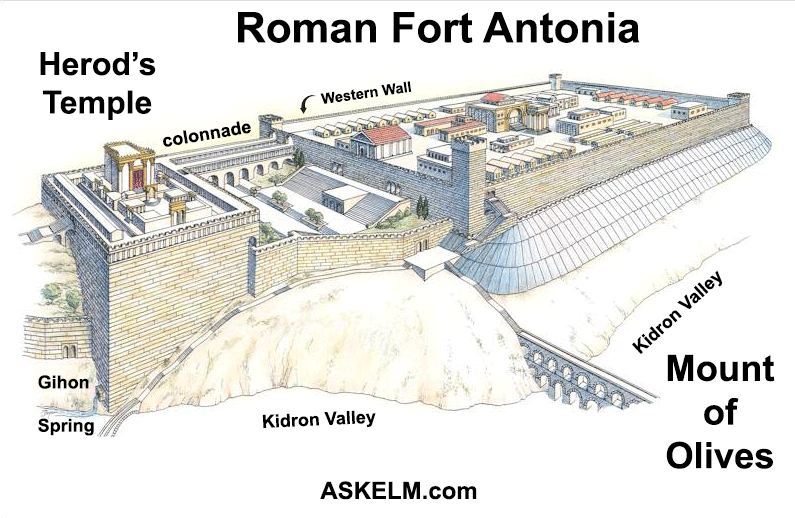
How interesting is that? If you want to see this again, it’s in the other book, End Times Made Easy. Or go to ASKELM.com.
The Abomination that Causes Desolation
As you just saw, at the 1,260-day point from the conference table meeting of Daniel 9:27, the temple is sacked and defiled by a statue and the antichrist himself. While the antichrist moves on to fight his war, the statue of him stands in the temple grounds for another 1,290 days.
The really interesting thing about this for me is that the mention of the Abomination is echoed by Jesus in His Olivet Discourse.
Matthew 24:15 “The day is coming when you will see what Daniel the prophet spoke about—the sacrilegious object that causes desecration standing in the Holy Place.” (Reader, pay attention!) 16 “Then those in Judea must flee to the hills. 17 A person out on the deck of a roof must not go down into the house to pack. 18 A person out in the field must not return even to get a coat. 19 How terrible it will be for pregnant women and for nursing mothers in those days. 20 And pray that your flight will not be in winter or on the Sabbath. 21 For there will be greater anguish than at any time since the world began. And it will never be so great again. 22 In fact, unless that time of calamity is shortened, not a single person will survive. But it will be shortened for the sake of God’s chosen ones. (NLT)
This is one of those important passages that helps to tie everything together. It’s like a marker that can be seen in Daniel and in the Gospels. It beautifully ties them together for us. And this statement of Jesus in verse 21 is where we get the term “Great Tribulation” (the words used in the King James Bible). This is how we know when and how the Great Tribulation begins.
The Great Tribulation
If you’ve been a bit lost on this, the word “tribulation” means trouble. It is translated as “anguish” below. It means that for the Church and the Jews, persecution will be worse than ever—even worse than the holocaust of WWII. Some 6 million Jews were exterminated by Hitler’s evil SS. This will be far worse than that. And this time, the Christians will be in the number too. All of this has been foretold by our Savior in the Olivet Discourse. He said that if that time had not been cut short for the sake of His elect, no one would survive.
God’s Wrath, The Return, The Resurrection, The Rapture
Unfortunately, many teachers think and teach that the tribulation and/or Great Tribulation are God’s wrath. This is not true. “How do you know that?” you may ask. Easy. Jesus said so.
Matthew 24:29 “Immediately after the anguish of those days,
the sun will be darkened,
the moon will give no light,
the stars will fall from the sky,
and the powers in the heavens will be shaken.
30 And then at last, the sign that the Son of Man is coming will appear in the heavens, and there will be deep mourning among all the peoples of the earth. And they will see the Son of Man coming on the clouds of heaven with power and great glory. 31 And he will send out his angels with the mighty blast of a trumpet, and they will gather his chosen ones from all over the world—from the farthest ends of the earth and heaven. (NLT)
When He says, “Immediately after the anguish of those days,” He means the tribulation. When He quotes the Old Testament prophets with the part about the sun, moon, stars, and powers, He is referring to His wrath. And then He shows how His wrath, second coming, the resurrection, and the rapture all happen at that time—after the tribulation. He says that “He will send out His angels with the mighty blast of a trumpet, and they will gather His chosen ones from all over the world—from the farthest ends of the earth and heaven.” And just like Paul and John told us, this all happens together on the same day: Return, resurrection, and rapture.
1 Corinthians 15:51 But let me reveal to you a wonderful secret. We will not all die, but we will all be transformed! 52 It will happen in a moment, in the blink of an eye, when the last trumpet is blown. For when the trumpet sounds, those who have died will be raised to live forever. And we who are living will also be transformed. 53 For our dying bodies must be transformed into bodies that will never die; our mortal bodies must be transformed into immortal bodies. (NLT)
Nothing about a pause of 7 years, 7 days, or even 7 minutes. But there’s more.
John 6:35 Jesus replied, “I am the bread of life. Whoever comes to Me will never be hungry again. Whoever believes in Me will never be thirsty. 36 But you haven’t believed in Me even though you have seen Me. 37 However, those the Father has given Me will come to Me, and I will never reject them. 38 For I have come down from heaven to do the will of God who sent Me, not to do My own will. 39 And this is the will of God, that I should not lose even one of all those he has given Me, but that I should raise them up at the last day. 40 For it is my Father’s will that all who see His Son and believe in Him should have eternal life. I will raise them up at the last day.”
How this is doubted and confused by so many teachers dumbfounds me.
Armageddon
As already mentioned, Armageddon is a battle, not a war. It is the final battle of Ezekiel’s War. It is called Armageddon, because the antichrist is camped out in the “Valley of Megiddo”. The name Armageddon comes from the Hebrew Har-Megiddo, meaning “Hill of Megiddo,” referring to the elevated site (Tel Megiddo) that overlooks the Valley of Jezreel, a historic battleground. John used this name in Revelation to signify the prophetic gathering place for the final global conflict. So the valley has two names. Officially, it’s called Jezreel, but John called it Armageddon, referring to the hill that borders it. See Revelation 16:16 for its use. There’s an image at the end of this chapter showing placement.
When we put together all of the teaching on this battle from the Bible, we get a pretty good picture of what will happen there. It’s basically the final stand of Satan and mankind against Jesus. It would be comical that they think they can fight Him, but it’s going to be really terrifying for those who assemble there. Antichrist and his entire army perish there. They finish each other off after being pelted by various means.
Ezekiel 38:21 I will summon the sword against you on all the hills of Israel, says the Sovereign Lord. Your men will turn their swords against each other. 22 I will punish you and your armies with disease and bloodshed; I will send torrential rain, hailstones, fire, and burning sulfur! 23 In this way, I will show my greatness and holiness, and I will make myself known to all the nations of the world. Then they will know that I am the Lord. (NLT)
Tanks, aircraft, artillery, drones, RPGs, AK-47s, over 200 million men, blah, blah, blah…they might as well be children with Nerf Swords. Jesus destroys them with the words of His mouth. Then and only then does He set foot on the Mount of Olives at Bethany, right where He ascended from.
Acts 1:7 He replied, “The Father alone has the authority to set those dates and times, and they are not for you to know. 8 But you will receive power when the Holy Spirit comes upon you. And you will be my witnesses, telling people about me everywhere—in Jerusalem, throughout Judea, in Samaria, and to the ends of the earth.”
9 After saying this, he was taken up into a cloud while they were watching, and they could no longer see him. 10 As they strained to see him rising into heaven, two white-robed men suddenly stood among them. 11 “Men of Galilee,” they said, “why are you standing here staring into heaven? Jesus has been taken from you into heaven, but someday he will return from heaven in the same way you saw him go!” (NLT)
And more explicitly, read Zechariah:
Zechariah 14:3 Then the Lord will go out to fight against those nations, as he has fought in times past. 4 On that day His feet will stand on the Mount of Olives, east of Jerusalem. And the Mount of Olives will split apart, making a wide valley running from east to west. Half the mountain will move toward the north and half toward the south. 5 You will flee through this valley, for it will reach across to Azal. Yes, you will flee as you did from the earthquake in the days of King Uzziah of Judah. Then the Lord my God will come, and all His holy ones with him. (NLT)
And this is when He begins to reign. All that is left is to have His Millennial Temple built and to bring His people home to live under His loving care.
Isaiah 60:1 “Arise, Jerusalem! Let your light shine for all to see.
For the glory of the Lord rises to shine on you.
2 Darkness as black as night covers all the nations of the earth,
but the glory of the Lord rises and appears over you.
3 All nations will come to your light;
mighty kings will come to see your radiance.
4 “Look and see, for everyone is coming home!
Your sons are coming from distant lands;
your little daughters will be carried home.
5 Your eyes will shine,
and your heart will thrill with joy,
for merchants from around the world will come to you.
They will bring you the wealth of many lands.
6 Vast caravans of camels will converge on you,
the camels of Midian and Ephah.
The people of Sheba will bring gold and frankincense
and will come worshiping the Lord.
7 The flocks of Kedar will be given to you,
and the rams of Nebaioth will be brought for my altars.
I will accept their offerings,
and I will make my Temple glorious.
8 “And what do I see flying like clouds to Israel,
like doves to their nests?
9 They are ships from the ends of the earth,
from lands that trust in me,
led by the great ships of Tarshish.
They are bringing the people of Israel home from far away,
carrying their silver and gold.
They will honor the Lord your God,
the Holy One of Israel,
for he has filled you with splendor.
10 “Foreigners will come to rebuild your towns,
and their kings will serve you.
For though I have destroyed you in my anger,
I will now have mercy on you through my grace.
11 Your gates will stay open day and night
to receive the wealth of many lands.
The kings of the world will be led as captives
in a victory procession.
12 For the nations that refuse to serve you
will be destroyed.
13 “The glory of Lebanon will be yours—
the forests of cypress, fir, and pine—
to beautify my sanctuary.
My Temple will be glorious!
14 The descendants of your tormentors
will come and bow before you.
Those who despised you
will kiss your feet.
They will call you the City of the Lord,
and Zion of the Holy One of Israel.
15 “Though you were once despised and hated,
with no one traveling through you,
I will make you beautiful forever,
a joy to all generations.
16 Powerful kings and mighty nations
will satisfy your every need,
as though you were a child
nursing at the breast of a queen.
You will know at last that I, the Lord,
am your Savior and your Redeemer,
the Mighty One of Israel.
17 I will exchange your bronze for gold,
your iron for silver,
your wood for bronze,
and your stones for iron.
I will make peace your leader
and righteousness your ruler.
18 Violence will disappear from your land;
the desolation and destruction of war will end.
Salvation will surround you like city walls,
and praise will be on the lips of all who enter there.
19 “No longer will you need the sun to shine by day,
nor the moon to give its light by night,
for the Lord your God will be your everlasting light,
and your God will be your glory.
20 Your sun will never set;
your moon will not go down.
For the Lord will be your everlasting light.
Your days of mourning will come to an end.
21 All your people will be righteous.
They will possess their land forever,
for I will plant them there with my own hands
in order to bring myself glory.
22 The smallest family will become a thousand people,
and the tiniest group will become a mighty nation.
At the right time, I, the Lord, will make it happen.”
Be blessed. Do not fear. God’s got this.
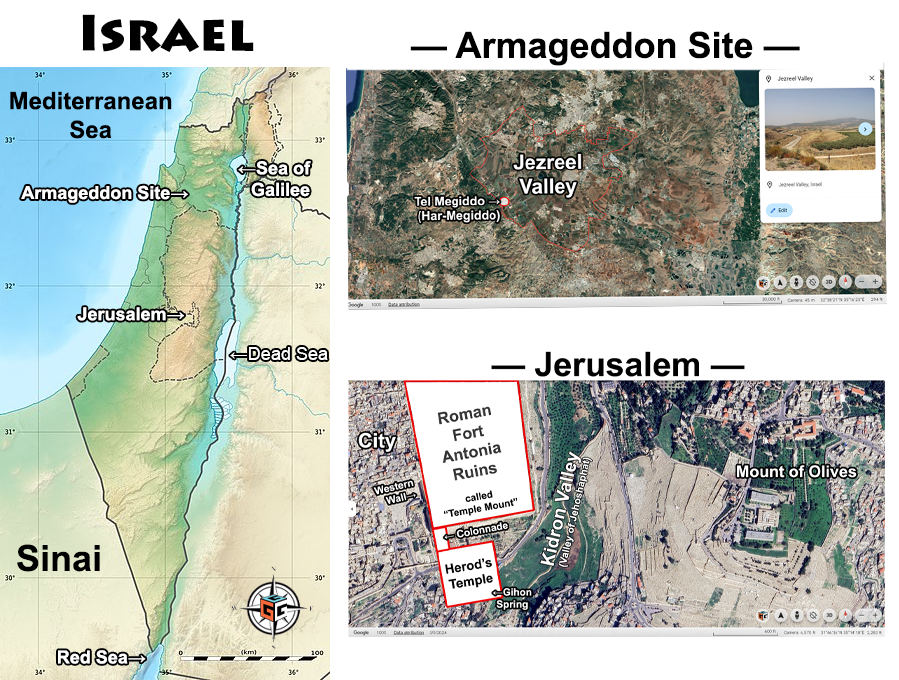
A Quick Timeline Overview
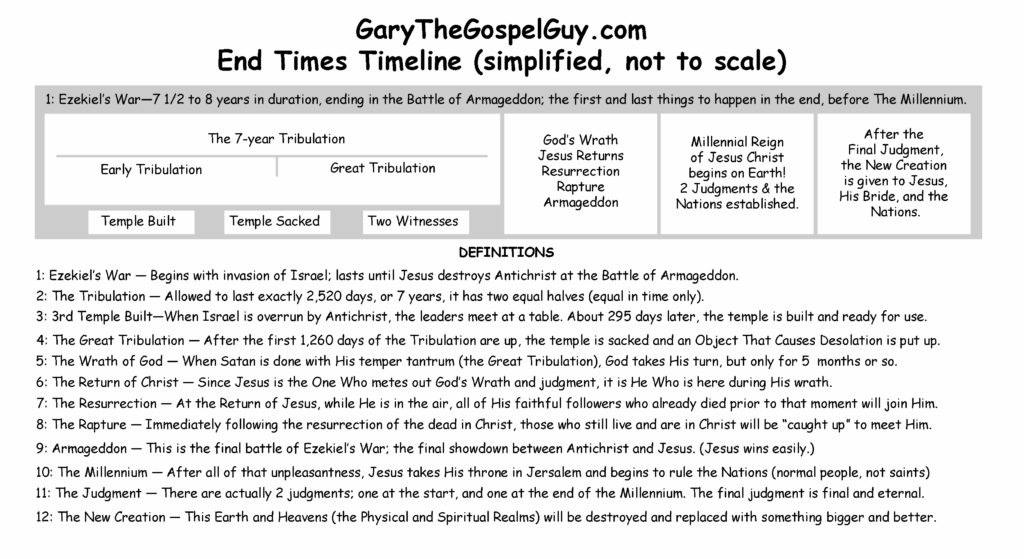
That was a lot to go over, so I think it might help to have a simpler overview or summary of the historic timeline. Since there are two equal halves of the tribulation with each half having 1,260 days, the count will restart for the beginning of the Great Tribulation. First will be the early tribulation followed by the Great Tribulation. So expect the count to restart at zero after the first 1,260 days.
Day 0 (tribulation): The Invasion of Israel
The count begins when the antichrist and the Israeli leader are sitting at a conference table, trying to deceive each other during the first Gog invasion. We find this event in two places in Daniel’s prophecy. Daniel 11, which is parallel to Ezekiel 38 & 39 and Daniel 9.
Daniel 11:27 Seeking nothing but each other’s harm, these kings will plot against each other at the conference table, attempting to deceive each other. But it will make no difference, for the end will come at the appointed time.
Daniel 9:26b “The end will come with a flood, and war and its miseries are decreed from that time to the very end. 27 The ruler will make a treaty with the people for a period of one set of seven, but after half this time, he will put an end to the sacrifices and offerings. And as a climax to all his terrible deeds, he will set up a sacrilegious object that causes desecration, until the fate decreed for this defiler is finally poured out on him.” (NLT)
It is because of Daniel 9 that we say that the tribulation will be a time of 7 years. This only begins when Israel is at peace, and only by specific nations. (Ezekiel 38:5, 8) These invading nations include the land that Gog rules, called “Magog” by Ezekiel (most likely Turkey, but could also be any of these other nations in the Caucasus: Russia, Georgia, Armenia, or Azerbaijan, joined by Iran (Persia), Ethiopia, Somalia, Sudan, as a region, called Cush, Libya, Algeria, Tunisia, as a region, called Put. (Ezekiel 38:5)
If those nations are not involved, it is not the beginning of the 7-year Tribulation. And as covered earlier, this event is touched on by Jesus in the Olivet Discourse.
Day 295: The Temple is Completed
As already explained, the temple will be built after this conference table meeting. Earlier, you saw how this is determined with the numbers provided by Daniel. This is a physical temple building that antichrist enters and defiles.
I believe that as soon as the temple construction is completed antichrist will again return to try to capture it. But He is thwarted by a powerful nation with a mighty navy. If the USA is in prophecy, this might be one place.
Daniel 11:29 “Then at the appointed time he will once again invade the south, but this time the result will be different. 30 For warships from western coastlands will scare him off, and he will withdraw and return home. But he will vent his anger against the people of the holy covenant and reward those who forsake the covenant.”
And if WWIII is to begin in these times, this might be the very time, since after this the warships are no longer a problem for the antichrist. My guess is that only WWIII could keep this mighty navy busy enough for him to sneak back in when they are either preoccupied elsewhere or their power is diminished. In addition to this, it is actually another many days (965, to be exact) before he can actually sack the temple in a second successful invasion. This tells me that he is really busy as well in the time between his second attempt and his successful second invasion.
And this takes us up to the 1,260-day mark, when the Great Tribulation begins. Antichrist’s second invasion.
Day 1,260: Great Tribulation Begins
Daniel 11:31 “His army will take over the Temple fortress, pollute the sanctuary, put a stop to the daily sacrifices, and set up the sacrilegious object that causes desecration. 32 He will flatter and win over those who have violated the covenant. But the people who know their God will be strong and will resist him.”
Here we see the beginning of the worse time of suffering on Earth (especially for Jews and Christians—people of the holy covenant that antichrist hates so much). And if these days were not cut short by God, then no one would survive. It is marked by this second invasion, as well as the setting up of a statue, called the Abomination (or Sacrilegious Object) that Causes Desolation (or Desecration). But for the sake of God’s “chosen ones” (either saints or sheep), they will be cut short.
Matthew 24:15 “The day is coming when you will see what Daniel the prophet spoke about—the sacrilegious object that causes desecration standing in the Holy Place.” (Reader, pay attention!) 16 “Then those in Judea must flee to the hills. 17 A person out on the deck of a roof must not go down into the house to pack. 18 A person out in the field must not return even to get a coat. 19 How terrible it will be for pregnant women and for nursing mothers in those days. 20 And pray that your flight will not be in winter or on the Sabbath. 21 For there will be greater anguish than at any time since the world began. And it will never be so great again. 22 In fact, unless that time of calamity is shortened, not a single person will survive. But it will be shortened for the sake of God’s chosen ones. (NLT)
We will now reset the clock to zero, showing the timing from this point on in a simpler manner, since it’s referenced from here on out by Daniel.
Day 0 (great trib): Satan Cast Down
Another important aspect of this pivotal day is that this is when Satan and his fallen angels are finally kicked out of the spirit realm and not allowed to return. We look at Revelation 12 for this detail.
Revelation 12:7 Then there was war in heaven. Michael and his angels fought against the dragon and his angels. 8 And the dragon lost the battle, and he and his angels were forced out of heaven. 9 This great dragon—the ancient serpent called the devil, or Satan, the one deceiving the whole world—was thrown down to the earth with all his angels.
10 Then I heard a loud voice shouting across the heavens,
“It has come at last—
salvation and power
and the Kingdom of our God,
and the authority of his Christ.
For the accuser of our brothers and sisters
has been thrown down to earth—
the one who accuses them
before our God day and night.
11 And they have defeated him by the blood of the Lamb
and by their testimony.
And they did not love their lives so much
that they were afraid to die.
12 Therefore, rejoice, O heavens!
And you who live in the heavens, rejoice!
But terror will come on the earth and the sea,
for the devil has come down to you in great anger,
knowing that he has little time.” (NLT)
We can glean a few points of interest from this important event:
- It could not have happened at any other time before the time of Christ’s first advent. This is shown by Satan being called “the accuser of our brothers”. (verse 10)
- Terror will come on the earth and sea when this happens, since the devil knows that he has little time left. (verse 12)
- This makes the Great Tribulation period Satan’s wrath (v.12), not God’s wrath. And this is reinforced by Jesus in the Olivet Discourse, where He says that after the Tribulation, acts of His wrath will commence. (Matthew 24:29-31, below)
So this is the beginning of Satan’s wrath and is not associated with God’s wrath (as many teachers falsely proclaim).
Day 1,260: End of Great Tribulation
Not only is this the end of the Great Tribulation, it is the beginning of God’s wrath.
Matthew 24:29 “Immediately after the anguish of those days, the sun will be darkened, the moon will give no light, the stars will fall from the sky, and the powers in the heavens will be shaken.
30 And then at last, the sign that the Son of Man is coming will appear in the heavens, and there will be deep mourning among all the peoples of the earth. And they will see the Son of Man coming on the clouds of heaven with power and great glory. 31 And he will send out his angels with the mighty blast of a trumpet, and they will gather his chosen ones from all over the world—from the farthest ends of the earth and heaven.” (NLT)
Notice how Jesus cleanly and subtly associates the timing of His wrath with the tribulation. “Immediately after the tribulation (anguish)…” and then goes right into His acts of wrath as discussed in many early prophets. This is neatly done by quoting scriptures that refer to “The Day of the Lord”, which begins with His wrath. (See Isaiah 24:23, Amos 5:18, Zephaniah 1:4-16, and Zechariah 14:6-7. And Peter echoes it in Acts 2:20 as well.)
This is why we cannot biblically associate the tribulation with God’s wrath.
Day 1,290: The Abomination Falls
1,290 days after the Great Tribulation begins, according to Daniel, the Abominable statue no longer stands. This takes place 30 days after the Great Tribulation is over.
Daniel 12:11 “From the time the daily sacrifice is stopped and the sacrilegious object that causes desecration is set up to be worshiped, there will be 1,290 days.”
What knocks it down? For this, let’s turn to Zechariah 14:
1 Watch, for the day of the Lord is coming when your possessions will be plundered right in front of you! 2 I will gather all the nations to fight against Jerusalem. The city will be taken, the houses looted, and the women raped. Half the population will be taken into captivity, and the rest will be left among the ruins of the city. (NLT)
See how he says, “the day of the Lord” (v. 1)?
Well, there are many things that happen in the era called the Day of the Lord. They are:
- His Wrath
- His Return
- His Glorification of the Saints
- His Millennial Rule
- His Separation of the Sheep and the Goats
- His Final Judgment
That’s a solid 1,000 years for this era called a “day”. But that’s alright. Peter told us that with the Lord, a day is as a thousand years (2 Peter 3:8). It fits. But it also means that we need to be careful about how we look at this very important time. For one thing, we don’t take all references to a “day” as a literal 24 hour period. Zechariah 14 is one of those passages. When he uses the word “day” don’t think that he is talking about a particular date, or sequence of days.
Let’s move on to Zechariah 14:2. The Lord gathers all the nations to fight against Israel. Interesting. This means that both the devil and God are working the events to happen that antichrist is involved in. This is going to be what is called “Armageddon” in the war we call Ezekiel’s War. It’s the final battle of that war. But that will be the final event before the Millennium begins. I’m still trying to get to the 1,290th day. But you can see how Zechariah 14 is not exactly a strict, chronological account.
Zechariah 14:3 Then the Lord will go out to fight against those nations, as He has fought in times past. 4 On that day His feet will stand on the Mount of Olives, east of Jerusalem. And the Mount of Olives will split apart, making a wide valley running from east to west. Half the mountain will move toward the north and half toward the south. 5 You will flee through this valley, for it will reach across to Azal. Yes, you will flee as you did from the earthquake in the days of King Uzziah of Judah. Then the Lord my God will come, and all His holy ones with him. (NLT)
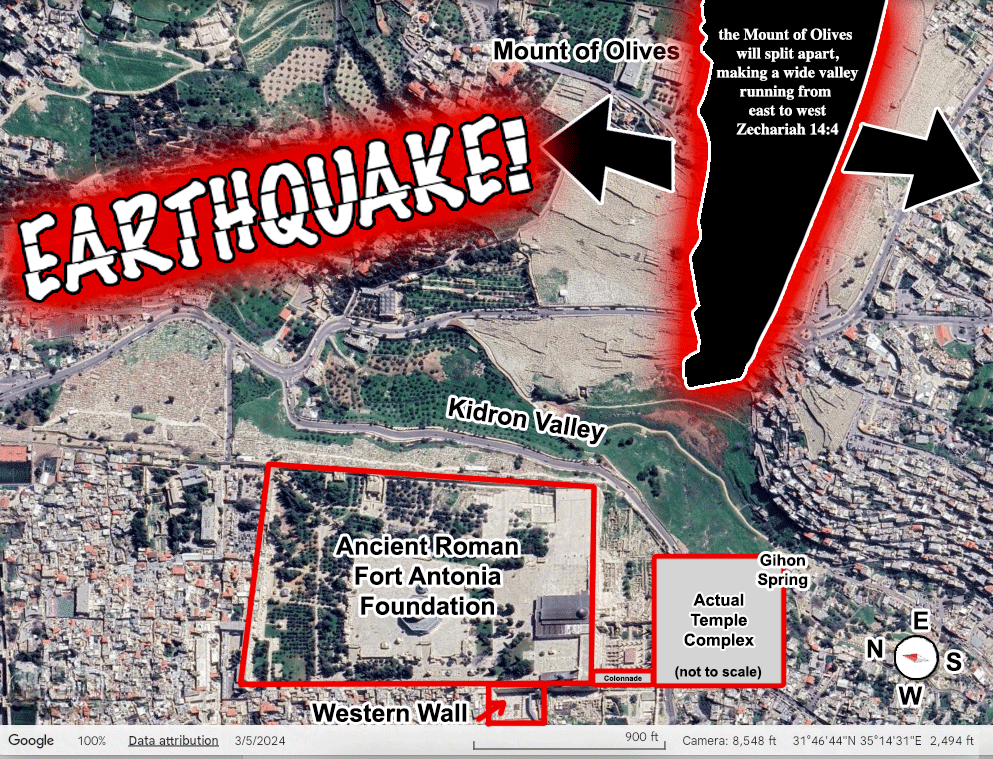
Okay, when Zechariah says “on that day” in verse 4, we need to understand that he is not speaking of the same calendar day that the other things he is talking about happening. He just means in that time (The Day of the Lord). If we do not allow this interpretation, then the End Times timeline unravels pretty quickly. And it doesn’t matter whose timeline you use. But even this superior timeline depends on this interpretation. How do we know this?
Look at the events that Zechariah unfolds:
- There is an invasion of all the nations, Armageddon
- Jerusalem falls
- Plunder when houses are looted, women raped
- Half the population is taken hostage or captive
- The other half remains (dead or alive) in the ruins
- The Lord goes out to fight for Israel
- He sets foot on the Mount of Olives
- The mount is split apart forming a valley (east/west)
- People will flee through the newly made valley
- The fleeing is likened to Uzziah’s earthquake
- All of the Lord’s holy ones will be with Him
Here’s the thing: Those events simply cannot be consecutive or chronological. To say so would be illogical in light of other verses and even within this passage.
And so this brings us to the 1,290th day.
On day 1,290 from the Abomination that Causes Desolation, the statue no longer will stand. Another event in this era (“day”) is the formation of a new valley.
Now, when God forms valleys, He usually uses natural forces to do so. I mean, He seems to like using things that He has made that operate within the laws established for those physical things. And so the best explanation for the valley’s formation is a natural event, not necessarily the feet of Jesus touching down on the dirt.
So that brings us to the great earthquake that happens during this era (the Day of the Lord). Many prophets mention this. Zechariah doesn’t. He just says that the people run through the valley to escape, but he likens it to an event involving an earlier quake. And he tells us that it is the Mount of Olives that is cracked wide open.
Here are some references for this quake:
- Ezekiel 38:19 In my jealousy and blazing anger, I promise a mighty shaking in the land of Israel on that day.
- Revelation 16:18 Then the thunder crashed and rolled, and lightning flashed. And a great earthquake struck—the worst since people were placed on the earth. (This is the same one that splits Jerusalem, called “Babylon”, into three parts.)
- Isaiah 29: 6 I, the Lord of Heaven’s Armies, will act for you with thunder and earthquake and great noise, with whirlwind and storm and consuming fire.
And what do you think would happen to the statue of antichrist in the temple when this huge earthquake hits? It falls down. On the 1,290th day.
I used to think that the valley through the Mount of Olives would happen as a result of Jesus touching down on it, but I no longer see it that way. This more naturalistic view of a quake being the reason makes more sense to me. I also see the quake as being what knocks the statue over now as well.
Day 1,335: A Blessing for Those Who Wait
Daniel 12:12 “And blessed are those who wait and remain until the end of the 1,335 days!”
I believe this to be none other than the glorification of the saints. After all, that would be the greatest blessing in the Bible, yes? And we can tell from other verses that the resurrection and rapture of the saints both occur along with the return of Jesus. See 1 Thessalonians 14:13-18 and Matthew 24:29-31 for two of the clearest accounts.
And when we do a little easy arithmetic, we can realize that this day is 75 days after the end of the Great Tribulation. 1335-1260=75. And looking at the locusts of God’s wrath (Revelation 9), we see that they have power to torture people for 150 days (5 months). That puts the resurrection and rapture right in the middle of God’s wrath. By the way, the locust attack is the only event of all of the events of His wrath that has a time given for its duration. So this is when I believe that the rapture happens—mid wrath. And I’ll put this up against anyone else’s timeline.
Day 1410-ish: The Return of the Lord
I cannot say with certainty what day exactly or what hour the Lord will set foot on the Mount of Olives. And this is in line with the prophecy of Jesus that says as much in His Olivet Discourse.
Matthew 24:36 “However, no one knows the day or hour when these things will happen, not even the angels in heaven or the Son himself. Only the Father knows.” (NLT)
Not all manuscripts agree that He included Himself in not knowing. But whether He did or not when He said that, I’m sure that He knows now. But one thing is certain; none of us know the day or hour when He will set foot on the ground at Bethany. But I believe it will be the very last event in these End Times of this age. It just makes the most sense to me.
Now, even though we cannot know the very date or time of day, Paul tells us that we will know approximately when these things will happen. And indeed, I have been able to figure it out, so it must be possible. Read how Paul puts it in his letter to those in Thessalonica:
1 Thessalonians 5:1 Now concerning how and when all this will happen, dear brothers and sisters, we don’t really need to write you. 2 For you know quite well that the day of the Lord’s return will come unexpectedly, like a thief in the night. 3 When people are saying, “Everything is peaceful and secure,” then disaster will fall on them as suddenly as a pregnant woman’s labor pains begin. And there will be no escape.
4 But you aren’t in the dark about these things, dear brothers and sisters, and you won’t be surprised when the day of the Lord comes like a thief. 5 For you are all children of the light and of the day; we don’t belong to darkness and night. 6 So be on your guard, not asleep like the others. Stay alert and be clearheaded. 7 Night is the time when people sleep and drinkers get drunk. 8 But let us who live in the light be clearheaded, protected by the armor of faith and love, and wearing as our helmet the confidence of our salvation.
9 For God chose to save us through our Lord Jesus Christ, not to pour out His anger on us. 10 Christ died for us so that, whether we are dead or alive when He returns, we can live with Him forever. 11 So encourage each other and build each other up, just as you are already doing. (NLT)
So Paul lets us know that those who are paying attention to the Lord and His Word will know pretty closely when all these things will come about. I mean, if I can figure it out, anyone should be able to.
Jesus echoed this sentiment when He told the parable of the mean servant, who was a partier and abuser.
Matthew 24:45 “A faithful, sensible servant is one to whom the master can give the responsibility of managing his other household servants and feeding them. 46 If the master returns and finds that the servant has done a good job, there will be a reward. 47 I tell you the truth, the master will put that servant in charge of all he owns. 48 But what if the servant is evil and thinks, ‘My master won’t be back for a while,’ 49 and he begins beating the other servants, partying, and getting drunk? 50 The master will return unannounced and unexpected, 51 and he will cut the servant to pieces and assign him a place with the hypocrites. In that place there will be weeping and gnashing of teeth. (NLT)
So both Paul and Jesus let us know who will know when the Lord returns, just not the exact hour or day.
I’ve seen where many teachers think that because Paul says in 1 Thessalonians 5:9 “For God chose to save us through our Lord Jesus Christ, not to pour out His anger on us” we will be raptured before His wrath (anger). But when taken in context of the big picture, we see that he is just referring to God’s eternal wrath, not the temporary wrath of the last days. And this is also supported by Paul’s next sentence: “Christ died for us so that, whether we are dead or alive when He returns, we can live with Him forever.” This shows that he was talking about salvation into sainthood, not just a rapture from the tribulation. And indeed, he mentions those who are still alive when Christ returns. That makes it clear that he is not showing a prewrath or pretribulational rapture.
The best, most biblical timing of the rapture is mid-wrath (which is after the Great Tribulation—”posttrib”), not any of the others. But this study is not about arguing the various ideas on the rapture. I have given you my interpretation and my biblical reasoning. You can do with it as you like.
Now that you’ve seen the historic premillennial timeline I follow, chapter two will present a radical way of seeing who will be in the Millennium—and who will not. It’s nothing like what you’ve likely heard from any teacher I know. Strap in your seatbelt. This is going to be a wild ride.
Historic Premillennial Timeline
Chapter 1 Discussion and Reflection
Questions:
- What Return of Christ doctrine is the author most closely aligned with?
• Premillennial
• Postmillennial
• Amillennial - What Rapture doctrine does the author agree with?
• Pretribulation
• Midtribulation
• Prewrath
• Posttribulation
• No Rapture - What are the two very different Premillennial doctrines called?
Answers:
- Premillennial—Jesus returns before the millennium.
- Posttribulation—The rapture occurs mid-way through God’s wrath, which is after the tribulation.
- Dispensational and Historic—The author most closely follows the Historic view (the oldest view).
Reflection: Why is eisegesis more dangerous than exegesis? (The author’s method is plain-meaning exegesis.)
Eisegesis—adding to, or changing, the text.
Exegesis—taking the text exactly as given. Note: Literalism is not plain-meaning, but plain-meaning can be literal (in addition to many other methods).