
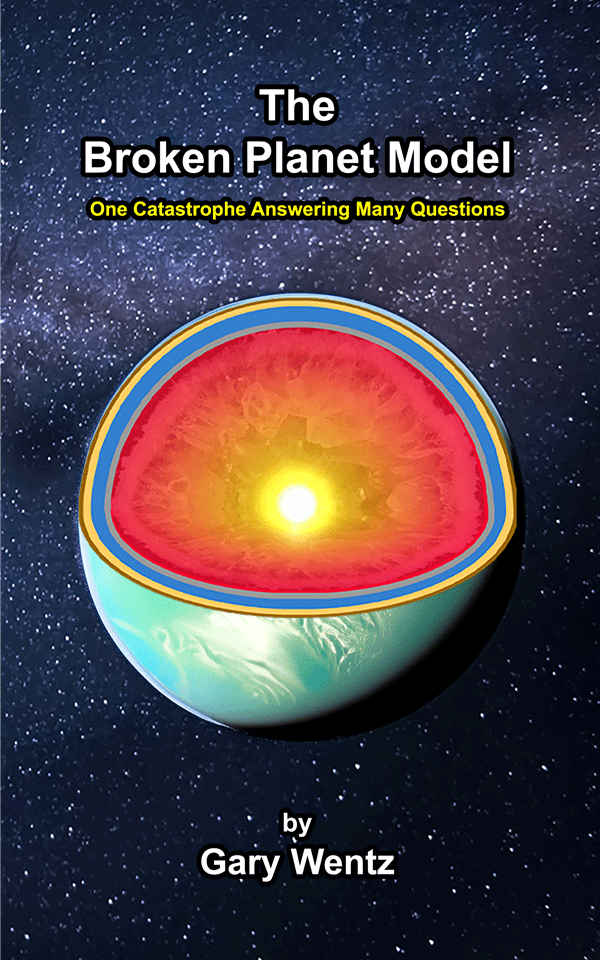
Contents:
Section I — INTRODUCTION & FOUNDATION
Section II — PRE-FLOOD STRUCTURE OF THE EARTH
Section III — CATASTROPHE – THE BROKEN PLANET
Section IV — SCIENTIFIC RAMIFICATIONS OF THE MODEL
Section V — SCIENTIFIC PREDICTIONS & FUTURE RESEARCH
Appendix A: Effects of the BPM Across All Disciplines
Appendix B: BPM Summary and Scientific Impact
Appendix C: Scientific Predictions of the Broken Planet Model (BPM)
Appendix A: Effects of the BPM Across All Disciplines
1. Astronomical / Rotational Effects
- Earth’s radius decreased by approximately 47.3 km (29.39 sm) due to the collapse of the Water Layer.
- Conservation of angular momentum caused Earth’s spin rate to increase, changing the year from 360 to 365.25 days.
- Pre-Flood Earth was likely a perfect sphere; post-Flood Earth shows equatorial bulge and distortion.
2. Geological Effects
- Tectonic Plates formed from the fractured Bedrock Layer during the global collapse.
- The Moho boundary structure collapsed completely, triggering instability across the crust. The Moho top plate now exists as fractured segments we call Tectonic Plates, though this distinction is often confused due to non-uniform global conditions.
- Sedimentary layers formed rapidly from compressed mud flows post-Flood.
- Mountain ranges were primarily formed by massive water-driven rearrangement of mud and lava during the collapse event—not by slow tectonic uplift. Volcanic mountains did form later from lava buildup.
- Continents, mountains, and canyons formed in place from violent movement and settling of mud and lava.
3. Hydrological Effects
- A 15-mile-thick (24 km) global Water Layer collapsed during the Flood. Only about 1/8 remained above the Mantle; the rest was likely drawn deep into the Mantle and Outer Core to replace extruded lava.
- Superheated water violently reshaped the surface, carrying and deploying mud and lava across the globe.
- Oceans represent the lowest areas of the post-collapse surface where mud, lava, and sediment settled—not preexisting cavities.
4. Atmospheric Effects
- Pre-Flood atmospheric pressure was likely 1.3–2.0 times higher than present.
- Oxygen levels estimated at 30–40%, enabling larger lifeforms and rapid growth.
- Collapse of pressure and shielding increased exposure to radiation post-Flood.
5. Biological / Fossil Record Effects
- Fossils formed by rapid burial of entire biomes in mud, followed by high compression as successive layers accumulated.
- Gigantism is explained primarily by the lack of radiation before the Flood, supported by high atmospheric pressure and oxygen levels.
- Stratified fossil layers reflect biomes stacked and buried in a single catastrophe.
- Mass extinction occurred rapidly and globally, not gradually.
6. Radiological Effects
- Flood triggered a one-time global radiation event that originated in the Mantle.
- Radioactive isotopes migrated upward and outward during the explosion.
- Modern radiometric decay rates are residual, not continuous or original.
- Assumptions of steady-state decay are invalid under BPM due to measuring only the residual trickle of radiation from solar, cosmic, and terrestrial sources—missing the initial dump of nearly all radiation during a single, inimitable, global event.
7. Chronological / Cultural Effects
- Original 360-day calendar preserved in ancient cultures (Babylonian, Mayan, Hebrew).
- Post-Flood year length change forced calendar corrections worldwide.
- Noah’s sons spread an unwittingly faulty 360-day calendar to the nations.
- Confusion in ancient chronology is consistent with BPM-based changes.
8. Magnetic / Electromagnetic Effects
- The divergence between True North and Magnetic North began as an immediate result of the Flood-triggering impact, which canted the Bedrock Layer and preserved its shifted alignment upon collapse — before any water had even escaped.
- This canting locked in a magnetic offset that persists today, unrelated to slow-flowing molten currents or gradual pole drift.
- The pre-Flood magnetosphere would have been stronger and more uniform, providing far greater protection from cosmic and solar radiation.
- So-called “magnetic reversals” and field anomalies in rock are more accurately explained as the result of chaotic movement, fracturing, warping, and flipping of already-magnetized materials (including sedimentary, amalgamated, and even Bedrock fragments) during the global Flood event — not slow pole flips over eons.
9. Meteorological / Climate Effects
- With post-Flood temperature and pressure dramatically altered, Earth’s climate shifted from stable, mist-fed biomes to turbulent, wind-driven, rain-dependent systems.
- The pre-Flood world maintained two distinct hydrological systems:
- A subterranean cycle, circulating between the Water Layer, the Water Table, and surficial water. The Water Table acted as a buffer, preserving the anaerobic seal of the Water Layer while allowing limited interaction with the surface.
- An atmospheric cycle, which was more uniform, gentle, and mist-based prior to the Flood.
- After the Flood, the destruction of the subterranean system and uneven redistribution of water across the surface led to deserts, snow zones, oceanic fronts, and violent weather patterns.
- Jet streams, monsoons, and polar vortices likely emerged as terrain-dependent and rotation-modulated effects, though any pre-Flood Coriolis influence is unknown.
- The Ice Age occurred mid-Flood, triggered by a super-saturated atmosphere and extreme global imbalance — a one-time, inimitable event. Its residual effects have lingered for over 4,300 years, but a recurring Ice Age is impossible post-Flood due to the permanent desert conditions of both poles.