
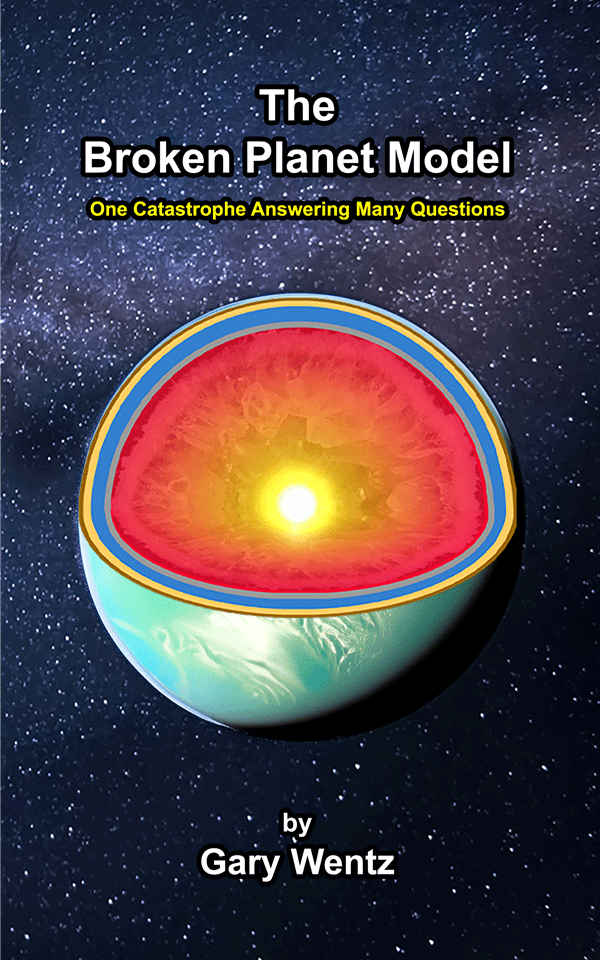
For web presentation, this work has been divided into its sections, with each section being a separate web post.
Contents:
Section I — INTRODUCTION & FOUNDATION
Section II — PRE-FLOOD STRUCTURE OF THE EARTH
Section III — CATASTROPHE – THE BROKEN PLANET
Section IV — SCIENTIFIC RAMIFICATIONS OF THE MODEL
Section V — SCIENTIFIC PREDICTIONS & FUTURE RESEARCH
Appendix A: Effects of the BPM Across All Disciplines
Appendix B: BPM Summary and Scientific Impact
Appendix C: Scientific Predictions of the Broken Planet Model (BPM)
Section I — INTRODUCTION & FOUNDATION
Purpose of This Work
To Present the Model and Its Source
The purpose of this thesis is to present a new Cosmology and Flood model to the world. This model is nothing like any other model on these topics, and delves deeper into the issues than any other has been able to do through mere observation. While all models largely discuss the same phenomena, until now none has the background that shows how certain characteristics of Earth actually came to be with the same cohesiveness and comprehensiveness that this model will present. For example, many models speak of Tectonic Plates and their function and effects, but none can present the origin of these plates with any clarity. This model will absolutely show how Tectonic Plates came into existence. But that is just one of the many questions of Geophysics and Geology that this model eloquently answers.
It is an expressed goal of this presentation to answer all of the top questions that continue to linger in the areas of Cosmology and Flood Geology. This will be done with logic, reason, and a level-headed look into the scientific discoveries that have been made over the centuries.
The Vision & Receipt of The Broken Planet Model (BPM)
Vision Prologue
This model, remarkably, did not come through the normal process of examination and hypothesis. Nor did it come about by direct observation of physical events and phenomena. If it did, then it would be even more remarkable than the truth—since no one can go back in time. But that will not make this truth any easier for some readers to believe.
The truth is very simple, but like the events it describes, it is not something that is variable or negotiable. In Cosmology, there is no scientific method available to mankind to prove one position over another. They are all based on beliefs that are unfalsifiable. All we can do is take what we are given and make our guesses. Throughout the short history of modern science, theories have come and gone like fog hiding a forest. Many have tried to obscure the truth but the truth will inevitably come out in the end. The trees will be seen.
But this model is different than the others in that it came about, not by observation, hypothesis, or logic, but by none other than direct revelation from a Supreme Being—namely, God. By “God”, I mean the God of the Bible, named therein as Yahweh, the Great I Am.
If this is too big of a pill for the reader to swallow, I can respect that. After all, it is an incredibly unusual claim to make in all seriousness. This is a criticism that I have been expecting from the day that I received this knowledge directly from the Creator. I do not shy away from such critique and indeed I embrace it. In fact, I would be less respectful of those who do not have any critical view toward such claims at all. So if this is you, then I applaud you. At the same time, I ask you to give me just enough attention to give this thesis a critical viewing.
You see, while the truth of the beginning has not been observed and recorded by men of science, there are still clues available to us that give more credence to some backstories, allowing them to make more sense than others. We discover this through logic and reasonable deduction brought out by what we do know. We allow common sense and observable laws that govern God’s creation to guide our thinking. And since this model is a revelation from God, it will be shown to be superior to all other models. I can say that, since I didn’t come up with it on my own. It is not a product of my intellect, knowledge, or education by men.
In this work, I will have a review at the end of each subsection to reinforce the main points presented. The goal of this feature is two-fold: 1) to help readers retain the concepts; and 2) to allow those who prefer to skim through it to do so easily. Here’s one for practice:
| Key Points: All cosmology and flood models are based on beliefs—there is no scientific method that can prove one over another—just logic and an honest look at the data.This model (The Broken Planet Model) is unique—it does not rely on hypothesis, observation, or speculation but was received through direct revelation. If I do speculate, it is on a side issue and not foundational to the model. The source of this model is God (Yahweh), the Sole Creator of the universe.Unlike other models, the BPM explains the true origin of tectonic plates and many other unanswered questions in geophysics and geology.The BPM is superior to all other models, not because of personal merit of the revelator, or messenger (me), but because it was revealed by God Himself.Skepticism is understandable and expected, but the model stands up to logical scrutiny and observational evidence.Truth is not negotiable or variable, it is absolute, and the BPM provides the most cohesive and comprehensive explanation of the Flood and Earth’s pre-Flood structure. |
The Vision
While being busy in my garage, my life was irrevocably invaded by an unexpected event. As I stood before my workbench, a holographic type of image appeared on the bench in front of me. I instantly recognized it as a spiritual vision being presented to me by my Lord. It was of a globe of the Earth, like one might have on their desk or table in the study. But this one had a cutaway view to expose the inner layers of the planet and was somewhat transparent.
As soon as I recognized what it was, which took about two or three seconds, the vision shifted and was no longer on the workbench but was much closer and larger in my view. In fact, it was all I could see. As to distance and perspective, what I saw resembled the view of holding a bowling ball up while readying for a roll down the lane. It was that close and clear.
In this second phase of the vision, I saw a representation of Earth’s Mantle, which could be said to resemble a brown bowling ball. It was just that smooth and intact. However, covering that sphere was a layer of water. This layer of water was clean and clear and was encased inside a thin rock sphere. This outer sphere did not look like it was of the same composition as the Mantle. On top of this outer sphere was soil, which was under the atmosphere. This phase of the vision was no longer in duration than a mere five seconds or so.
And that was the entirety of the vision that I received on February 12, 2023, in my garage. And while I did not fully understand at the time that I had seen the Mantle, Water Layer, Crust Bedrock, and Soil Layer, I knew that it was going to challenge everything that mankind has believed about This Broken Planet’s geology. I was instantly aware of the magnitude of this brief vision from God. I knew that it was from God because this was the second major vision I had received from Him by then. In the final second of the vision, as it faded away, I felt His hand upon my head with a touch that only He can give. He was letting me know in that touch that it was from Him and no one else.
| Key Points: The vision was received on February 12, 2023, while working in the garage.It began as a holographic image on the workbench, appearing as a cutaway view of Earth’s interior layers.The vision then shifted, becoming larger and filling my entire field of view.Earth’s Mantle appeared as a smooth, intact, brown sphere, resembling a bowling ball.A clear Water Layer was encased inside a thin rock sphere, separate from the Mantle.Above this rock sphere was soil and the atmosphere, completing the Pre-Flood Earth’s structure.The vision lasted only about 8 seconds, but its impact was immediate and profound.It was instantly recognized as a divine revelation from God, confirming a radically different geological model.In the final moment of the vision, God’s hand touched my head, a confirmation that this revelation came directly from Him. |
Further Revelation Through Study
I fully expect that I have just lost a percentage of readers. But then I also know that many of you are still reading. Good for you! This thesis is going to look at this model in a mostly scientific light, so if you are sensitive to such unwavering declarations of spiritual contact, fear not. That was the only part that might be uncomfortable for some who view this presentation.
But the Lord did not leave me to my own devices at that point. For the rest of the year, He was with me when I began to dive into geophysics like never before. I felt a need to know enough to communicate what I had clearly seen. I needed to learn, for example, that it was the Mantle that looked like a bowling ball. I needed to know that no one else has declared knowing about a Water Layer that existed between the Crust Bedrock (the hollow sphere containing the water) and the Mantle. I needed to learn that no one before this had declared the Mantle to have been intact and smooth before the Flood of the Bible.
But teach me, He did. In the following months of 2023, I learned a great deal about how this planet was arranged and how each part functioned. As you go through this presentation with me, I invite you to do so open-mindedly, with a spirit of discovery while being grounded to solid principles of physics, logic, and reason. This is not going to be a rehash of the principles you learned in geology class or have seen in documentaries. In fact, this is going to invite you to see things in a completely different manner altogether. All of the data is the same; all that needs to change is the manner in which we look at that data. In other words, I am inviting you to consider a complete change in your paradigm that surrounds the Earth Sciences. If you feel that you are ready, then read on, my fellow explorer, read on. We are about to take science to new heights and new depths, as we explore the world beneath our feet and the Creator Who is over our heads.
| Key Points: The vision was only the starting point—the rest of the model was developed through study and logical analysis.The Lord guided the learning process, leading to a deeper understanding of geophysics throughout 2023.The vision revealed truths unknown to modern science, including:The Mantle was smooth and intact before the Flood.A Water Layer existed between the Crust Bedrock and the Mantle.The Crust Bedrock was a hollow sphere that contained water.The following study confirmed the vision’s accuracy, reinforcing its scientific implications.This presentation challenges conventional geophysics, offering a completely new paradigm for Earth Sciences.The data remains the same, but its interpretation must change to align with the truth of Earth’s original design.Readers are invited to explore with an open mind, applying physics, logic, and reason to uncover a greater understanding. |
BPM’s Superiority to Other Models
Since this model did not come from me and my intellect, I can feel freer to tout its strengths more than if it originated within my own mind. So, with this clarification, I will now discuss how this model is superior to the alternatives with a very broad brush, so to speak.
Scientifically
With full acknowledgement that this may well be the most contentious arena for acceptance or rejection of this ground-breaking model, please know that I am not attempting to be polemic against anyone in any way in this thesis (see my other book, This Broken Planet, for a more polemic tone). Nor am I intending to be what some may term as “preachy” about a particular view or worldview that may be at odds with the paradigm of those in the scientific community. While there is undoubtedly contention between cosmologies that may be either “secular” or “religious”, it should be recognized that these kinds of distinctions are not in themselves scientific. In other words, a religious worldview has the ability to be just as scientific as a secular worldview. So, when I say that I am going to attempt to show this model’s superiority in the scientific vein, I am meaning that it is actually superior in the truest sense of what we call “science” (unlike some science-based views that are not scientific).
Rather than hash out these distinctions in these opening remarks of the thesis, I’ll pretty much leave it there for now. Just know that when I use terminology or commentary that may seem to be at odds with a particular view, it is not against people who hold the opposite view. Rather, it is merely to acknowledge that some theories or backstories offered are simply superior to others—not that the people involved on one side or the other are superior to the others of the opposite view in any way. I hope that this becomes quite clear to the reader in the most crystal manner as we progress.
In the mainstream scientific community today, it should be recognized that views which are rejected solely on these grounds—that they are ancient and religious—are also based on perceptions rooted in a past that did not have our scientific acumen (and data) of the modern age. In other words, ancient philosophies and antique philosophies are both firmly rooted in the past. How far that root extends into the past really has no bearing upon the legitimacy of the paradigm. But when speaking of scientific evidence for a theory or view, it should be noted that scientific knowledge changes on a regular schedule. And since the introduction of the most mainstream views of the scientific community, much has come to light that shows just how wrong some of the earlier views may have been, due to not having the whole picture. For example, Darwin did not have the fossil record that we do now when he formed his hypotheses.
Ironically, the perceptions we humans have, regarding things that cannot be directly observed, noted, and properly examined through repetition, can change for many reasons that have nothing at all to do with the data. If we are being honest with ourselves, and the data, we should realize that all of cosmology is a matter of belief, regardless of the position one comes down on. And this is why the model you are about to learn is a matter of backstory, first and foremost. And my assertion will always be that this backstory fits better with the most scientific data than any of the others. And it isn’t personal.
Theologically
In the field of theology, faith, and religion, there are differences of belief and mood as well. Some attempt to be as scientific as they can be, while others automatically reject anything that could be considered as “secular”, or grounded in a scientific vein. Perhaps this is due to a feeling that they are being dismissed by some in the scientific community—regardless of the intentions of those being accused of such dismissal. This is not to say that such behavior does not occur; it does. But I am saying that not all who are in that community are so dismissive. For all I know, they may be in the minority. But still, everyone in both camps should do all they can within their own camp to mitigate such activity and opinion. And I must acknowledge that there have been and are many who bully from the pews and pulpits. This angst must end, in my view, on both sides.
In fact, I could state quite honestly that one of my overarching goals in this presentation is to soften some of the rhetoric and hostility that has been fomenting for some time now—from both sides. As the son of a scientist (my dad) and of a religious devotee (my mom), I feel that I am in a position to see things from both perspectives quite objectively and honestly.
But the theological camp (in which I am firmly entrenched) has their cosmologies as well. And just because they may have what I consider to be a better backstory, it does not give them license to play loose with the facts. As a Young Earth Creationist, there are many theories and positions that have intrigued me. Some are fine attempts at being both scientific and theological, as difficult as that line has been to hold. But in all fairness, I must state that none of them is both scientifically sound and theologically based, whether secular or theological.
For example, the model called Catastrophic Plate Tectonics (CPT) is very scientifically rooted and attempts to show that position quite well. It is arguably the favorite view today for those in the Christian scientific community (a rather small faction). However, it is not as complete or comprehensive as its proponents may be willing to admit. Neither is it as biblically coherent and agreeable as they would like. I’ll not present my reasoning yet for this assertion, but know that it is going to come out in this paper. The other views of Young Earth Creationism (YEC) also flounder at some point or another, either in science or biblical agreement.
My model is actually going to show full agreement with both the backstory of the Bible and with the empirical evidence and data of the science world. All without twisting or softening or mangling either side to make it fit squarely within both. In other words, you may have your science, and faith in God too. This may actually be a first for humanity. Yes, it’s that good. (Again, not tooting my own horn. This model did not initiate with me—it came from God.)
Logically
This is actually a harder point to make than the other two (scientific and theological superiority). Logic is a fundamental trait within all people, regardless of their bents or stripes. In order to effectively support this claim, my work here (and logic) will have to be spot-on in every single claim it makes. It will have to be nearly perfect in its assertions and conclusions.
Regardless of position, any paradigm has logic attached to it. Admittedly, some positions are better grounded in reality and physics than others. But logic is a thing that is not so easy to pin down on people, like holding mercury under a gloved finger on a plate. Still, I am definitely asserting that this model is indeed superior in the use of logic than those that come before it.
Now, was their logic flawed based on what they knew when using said logic? Probably not. I mean, I can show how Darwin’s logic didn’t give him the result that he was reaching for, but at the time that he came up with it, it fit his paradigm quite well. So, in this regard, logic is going to be seen as contextual. In other words, the more knowledge we have on a subject, the better our logic can serve us. And that is probably the crux of this statement and thesis. I have been given a completely different backstory to geophysics and Flood geology than what anyone else has ever had to use for their logical conclusions. So, it isn’t so much that the logic is superior, but that the topic can be better understood when new information comes to light.
And that’s what this model is—a new way of seeing things from a completely different background or backstory. And this will definitely affect our ability to apply our use of logic to the situation. This, in short, will naturally give the model a superior means of applying logic to the topics at hand. It isn’t that my own logic is superior to anyone else’s, it’s that I have a backstory that was given to me that lends us the ability to use superior logic. And since the particular details of the model happen to fit precisely with the known data which is the most up-to-date that we have to work with, that gives the logic used more credence as well.
| Key Points: Scientific SuperiorityThis model is not based on personal intellect—its strengths can be freely emphasized.It is not intended as a polemic against individuals but as a presentation of a superior framework.Scientific paradigms should not be judged by their age—both ancient and modern theories can be flawed or accurate.Cosmology is ultimately based on belief—no model can be directly tested through repeated observation.This model provides a superior backstory, fitting the best available scientific data without contradictions or inconsistencies.Theological SuperiorityScience and faith are not mutually exclusive—a model can be both theologically and scientifically sound.The conflict between science and theology is often exaggerated, with dismissiveness present in both camps.Young Earth Creationist models (e.g., CPT) attempt to be scientific, but they fall short in either science or biblical coherence, or both.This model aligns fully with both biblical history and empirical science, without forcing either to fit a preconceived framework.For the first time, a model offers a seamless integration of science and theology, without compromising either side.Logical SuperiorityLogic is fundamental to all models, but better logic comes from having a more complete and accurate backstory.Older models were not necessarily illogical, but they were based on incomplete information.This model provides new foundational knowledge, allowing for a more precise application of logic.It is not that the logic itself is superior, but that the revealed backstory enables a more accurate logical framework.The details of this model fit precisely with the most up-to-date data, making its logical conclusions stronger than previous models. |
Current Geological & Cosmological Paradigms
Secular Uniformitarianism (The Problem)
Not to beat up on uniformitarianism or those who apply it, but there are problems inherent in this approach to the world we live on.
Firstly, it assumes that nothing catastrophic ever occurred in the past that could have fundamentally reshaped the planet. Where does this idea come from?
In the 18th Century, a lawyer, now touted as the “Father of Modern Geology”, named James Hutton, laid the foundation for this paradigm. In a public proclamation, Hutton claimed this:
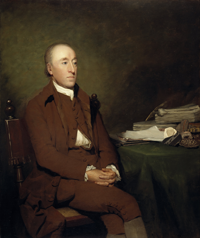
“The past history of our globe must be explained by what can be seen to be happening now. No powers are to be employed that are not natural to the globe, no action to be admitted except those of which we know the principle.” (Transactions of the Royal Society of Edinburgh. Book published by Royal Society of Edinburgh, “Theory of the Earth”, 1785.)
This statement can arguably be cited as foundational to the doctrine and paradigm of uniformitarianism—“The theory that all geologic phenomena may be explained as the result of existing forces having operated uniformly from the origin of the earth to the present time.” (Definition from The American Heritage Dictionary of the English Language, 5th Edition.)
If the reader is in doubt as to the crux of this statement, it means that both creation and catastrophic events must be eliminated from our thinking. According to Hutton, this is due to both creation and the Great Flood as not being repeatable—they are not something that can be seen as happening in the world today. After all, the scientific method calls for repeatability. And in essence, neither creation nor catastrophes of a transformational nature can be taken seriously by many in the scientific community. Is this fair? No. Is it logical? Not in my opinion (we will be visiting this assertion when we get there). Is it the way it has been for over two centuries now? Very much so. In fact, the scientific majority view still holds to this notion, doctrine, or paradigm.
So, how do we distance ourselves from this restrictive worldview? We will explore another backstory that neither Hutton nor any of his disciples, since the Enlightenment, had access to when we look at my model. We will consider if it is logical, scientific, and sound enough to replace Hutton’s ideas. And we will see if what I am proposing aligns closely enough with present-day empirical evidence to justify discarding Hutton’s conclusions.
It is not my intention to accomplish this task in this section. It will come later when we look at the model in-depth. But when that time comes, we will be served well by reevaluating Hutton’s claims in light of this new background that no one else has had access to up until now.
Notice that I am not attacking anyone’s intelligence or motives; only the ideas that came from a false narrative, by not having all of the evidence in-hand to make such a judgment call. I will absolutely give the reader enough material on the new backstory to make such a decision. And to not reconsider that assumption ingrained by Hutton and his disciples would be unfortunate in its effects on reason and logic after this model is seen for what it is—perfect.
| Key Points: The Problem with Secular UniformitarianismUniformitarianism assumes that no past catastrophes fundamentally reshaped the planet.James Hutton, the “Father of Modern Geology,” introduced this paradigm in the 18th century.Hutton’s foundational statement (1785) asserts that Earth’s history must be explained only by observable, natural forces.This led to the doctrine of uniformitarianism, which denies creation and catastrophic events due to their lack of repeatability.The scientific method emphasizes repeatability, making mainstream science dismissive of one-time events like creation or the Flood.Despite over two centuries of dominance, this paradigm is neither fair nor entirely logical.Reevaluating Hutton’s ClaimsHutton and his followers lacked the full picture, as they did not have access to the new backstory revealed in this model.This model challenges Hutton’s conclusions, offering a logical, scientific alternative based on a more complete understanding.The task of dismantling uniformitarianism will come later, when the model is examined in depth.The goal is not to attack individuals but to expose flaws in the false narrative created by incomplete evidence.Readers will be given sufficient material to reconsider uniformitarian assumptions, once they see the new model in its full scope.Failure to reconsider Hutton’s paradigm in light of this new model would be a missed opportunity for logic and reason to prevail. |
Biblical Creationism (The Solution)
The modern creationist movement came about as a response to the problematic theories of Deep Time (which puts forth the idea that Earth is billions of years old) and Evolution (the idea that kinds of animals and other life forms can change into other kinds). Exactly why those theories are problematic will be shown throughout the presentation of the details as we progress.
Dr. Henry Madison Morris (October 6, 1918 – February 25, 2006), a hydrologist, is considered to be the father of this movement in the modern age. In 1961, Dr. Morris and Dr. John Clement Whitcomb, Jr. (June 22, 1924 – February 5, 2020), Old Testament Theologian, coauthored The Genesis Flood (Published by Baker Book House, Grand Rapids, MI, 1961-1974). Together, they started the movement that accepted the Flood of Genesis as literal fact and showed it to be a worldwide phenomenon of catastrophic proportions. They were instrumental in helping the world take the book of Genesis (from the Bible) seriously and literally—factually.
This is not to say that the creation account was never taken literally before. It is simply a fact that the scientific community had made huge strides since the Enlightenment in getting people to largely disregard the Bible as being factual at all. They had successfully replaced the Bible’s creation narrative with their own uniformitarian narrative, which removes the creation account entirely. And since the scientific community was so successful at changing the historical narrative, Morris and Whitcomb found it imperative to demonstrate the scientific realities of how the Flood was likely an actual event as given in the narrative of the holy scriptures. They combined hydrological science and Old Testament theology to do this.
I personally read their book, The Genesis Flood, written the year I was born, and found it to be very enlightening. I highly recommend it to all readers who are interested in creationism and the Earth Sciences. It has indeed been foundational to the creationist movement of today.
Current Models & Shortfalls
There have been many creationist models that have come up out of this movement in response to the models of the secular movement. I will briefly show the top three and discuss why they have been popular.
Water Vapor Canopy Theory (VCT)
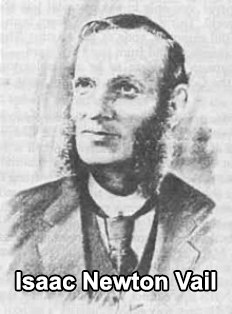
One theory that was later popularized by Morris and Whitcomb in The Genesis Flood but actually predates their work is the Water Vapor Canopy Theory, or simply “Canopy Theory.” This theory was originally presented by American Quaker, Isaac Newton Vail (1840 – January 26, 1912), in his book The Earth’s Aqueous Ring: or The Deluge and its Cause (1874, F. S. Hickman Publishers, West Chester, PA).
Vail proposed that early Earth was surrounded by a series of rings in what he called the Annular Theory. The Canopy Theory, a later extension of this model, focused on the final stage when the last remnants of these rings formed a vapor canopy before collapsing in the biblical Flood.
Vail’s Annular Theory and Canopy Theory are not separate theories but rather two interconnected aspects of a single model describing Earth’s ancient atmospheric and hydrological system. The Annular Theory serves as the broader framework, while the Canopy Theory refines the model by addressing how the last phase of the annular system affected Earth’s climate and contributed to the Flood.
Vail’s Annular Theory, including the Canopy Theory, was ultimately rejected due to conflicts with known laws of physics, atmospheric science, and geology. While it was an interesting attempt to explain the biblical Flood, it lacks mechanistic feasibility and empirical support. Modern flood geology and creationist models have mostly abandoned Vail’s ideas in favor of alternative explanations.
Hydroplate Theory (HPT)
The Hydroplate Theory was developed by Walter T. Brown, an American engineer and young Earth creationist. He introduced his theory in a book called In the Beginning: Compelling Evidence for Creation and the Flood (published by the Center for Scientific Creation, Phoenix, AZ, 1980). The book has since undergone multiple revisions, with notable editions released in 1986, 1995, 2001, and 2008.
Walt Brown’s Hydroplate Theory proposes that before the Flood, vast subterranean water chambers existed beneath Earth’s crust. A rupture in the crust caused this water to burst out with immense force, flooding the Earth and triggering massive geological upheavals. This event formed mountains, ocean basins, the Grand Canyon, and even asteroids and comets. Brown rejects plate tectonics and mainstream geology, arguing instead that the Flood reshaped Earth’s surface in a single cataclysmic event. This model may be the closest to the one being presented in this work, but with some major differences.
Catastrophic Plate Tectonics Model (CPT)
While technically a creationist model, Catastrophic Plate Tectonics (CPT) is built on a collegiate foundation rather than a purely biblical one. Does it align with the biblical narrative? Partially, but not entirely. Instead of reconstructing events from a first-principles biblical perspective, CPT superimposes a modern geological framework onto the Flood account. It assumes tectonic plate movement was the driving mechanism of the Flood and relies on a Pangaea-like Pre-Flood supercontinent that later fragmented. This thesis will demonstrate why that narrative is fundamentally flawed and present a superior, biblically and scientifically consistent alternative.
CPT was developed by Dr. John Baumgardner in the early 1980s and has since been embraced by nearly all the major figures in the creationist movement, promoted as THE model to follow. However, it has critical flaws—especially those of a biblical nature.
Personally, I respect John Baumgardner and many of his closest associates. For example, Dr. Steve Austin’s work on Mt. St. Helens (1980) demonstrates how canyons can form rapidly, apart from slow erosion. He also showed how fossilized trees were deposited in a catastrophic, flood-like manner in Yosemite and other locations. Many of their discoveries have reinforced the faith of thousands, proving that biblical truth aligns with scientific observation.
But defeating mainstream assertions does not automatically make their own model perfect. While their work has been valuable, it does not mean that all of their interpretations are air-tight or beyond scrutiny. All of us are fallible, limited in our understanding of the full picture. The key difference? At least they are willing to be challenged and stand on the validity of Scripture.
I wholeheartedly applaud Dr. Baumgardner and his associates. I do so with genuine admiration and deep appreciation for their tough stance for creation over the decades, as they have fought tirelessly against a godless paradigm. I am grateful to have them on the team.
| Key Points: Biblical Creationism as the SolutionThe modern creationist movement arose in response to Deep Time and Evolution, which contradict the biblical account and empirical evidence.Dr. Henry Morris and Dr. John Whitcomb launched the modern movement in 1961 with The Genesis Flood, demonstrating the plausibility of a worldwide catastrophe.The scientific community had largely dismissed Genesis as historical fact, replacing it with a uniformitarian narrative.Morris and Whitcomb combined hydrological science and theology to restore credibility to the biblical account of the Flood.Current Creationist Models & Their ShortfallsWater Vapor Canopy Theory (VCT)Originally proposed by Isaac Newton Vail (1874) as the Annular Theory, later refined into the Canopy Theory.Suggested that Earth was once surrounded by a vapor canopy, which collapsed, causing the Flood.Ultimately rejected due to conflicts with atmospheric science, physics, and geology—it lacked empirical feasibility.Hydroplate Theory (HPT)Developed by Walter T. Brown (1980) in In the Beginning: Compelling Evidence for Creation and the Flood.Proposes that vast subterranean water chambers existed beneath the crust, which ruptured and flooded the Earth.Explains many geological formations through a single catastrophic event, rejecting plate tectonics.HPT is closest to this model in some respects, but with significant differences.Catastrophic Plate Tectonics (CPT)Developed by Dr. John Baumgardner (1980s) as a creationist alternative to mainstream geology.Assumes a Pre-Flood continent and rapid plate movements as the driving mechanism of the Flood.Superimposes secular geological frameworks onto the Flood narrative, rather than reconstructing events from biblical principles.Though widely accepted among creationists, CPT has critical biblical inconsistencies that will be addressed in this thesis.Acknowledging the Contributions of Creation ScientistsDr. Steve Austin’s work on Mt. St. Helens proved that canyons can form rapidly, reinforcing flood geology.Many of their discoveries have strengthened faith, showing that the Bible aligns with scientific evidence.However, refuting secular geology does not mean their models are flawless—all models must be scrutinized.Creationists like Baumgardner and his associates deserve respect, as they fight against a godless paradigm while standing on biblical truth. |
Methodology: Agreement with Data, Not the Narrative
As of this writing, in the year 2025, we have collected more information about the planet, solar system, and cosmos than ever before. We have built tools that extend our reach beyond what was once thought possible, surpassing even the wildest imaginations of past generations. While we may not have reached the peak of scientific discovery, we are far higher up the hill than our great-grandparents could have believed. Never before in history have we possessed such remarkable technology to probe the depths of the Earth, the vastness of the heavens, and the fundamental forces that govern existence.
With seismic imaging, we read waves sent through the Earth, capturing their echoes with sensitive instruments and modeling their patterns using powerful computers. These tools allow us to uncover hidden structures deep within the planet without ever drilling into them. We can hypothesize that the Inner Core is composed of Nickel and Lead and recognize that these metals, when set in motion, generate electrical currents. We now understand nuclear forces more deeply than ever, measuring the intensity of radioactive power and manipulating these forces to push the boundaries of human capability.
With satellites and space probes, we have explored the distant planets of our Solar System and even ventured beyond its borders. Powerful space telescopes and long-lived probes have returned stunning images of tiny, distant Pluto; the gas giants Jupiter, Saturn, Uranus, and Neptune; and galaxies billions of light-years away. The discovery of exoplanets, gravitational waves, and black holes has transformed our perception of the universe, opening a window into a reality so vast that it defies comprehension. We have set foot on the Moon, landed probes on Venus and Mars, and captured detailed images of the Sun that no human could safely witness firsthand. Soon, we will plant flags on new worlds, standing upon the soil of planets once seen only as wandering stars in the night sky.
We have also peeled back the layers of the microscopic world, venturing into the realm of atoms, quarks, and quantum mechanics. We have manipulated atoms and uncovered the raw power embedded in the infinitesimal building blocks of matter and energy. We have mapped our own DNA, as well as that of other living creatures, revealing a complexity and elegance so profound that it defies naturalistic explanation. The deeper we look, the clearer it becomes: life is not an accident but an intricately designed masterpiece. We now know that more information is packed into a single atom than in an entire library of human literature. When these subatomic particles come together in perfect mathematical precision to form the structures of life, the brilliance of the design is undeniable. We can now see with our own eyes just how fearfully and wonderfully we are made. And in those moments, the veil is lifted, if only for an instant, to reveal an intellect behind creation that far surpasses our own.
But while these tools have granted us extraordinary access to knowledge, the way this knowledge is interpreted is often hijacked by false narratives. The issue is not the raw data itself, nor the astounding complexity of creation, but our own tendency to impose secular philosophies upon the evidence, warping its true meaning. For all our technological progress, human interpretation remains fallible, often steered by preexisting assumptions and ideological commitments. This is especially true in geology, cosmology, and biology, where scientific data is frequently filtered through a lens that denies the true history of Earth and humanity.
We have fallen victim to a deception woven by forces beyond our comprehension—a narrative that stretches out time into meaningless eons, that condenses the brilliance of creation into lifeless matter, and that lures us away from reality into an artificial fantasy.
It is here that we must draw the line between observation and assumption, between discovery and distortion. True science—in its purest, most uncorrupted form—is the pursuit of God, the One who spoke the cosmos into being and fashioned the Earth as a masterpiece of divine engineering. But when scientific inquiry is chained to secular or even demonic dogma, it ceases to be a tool for truth and instead becomes a mechanism for illusion—designed to shift our focus away from the Creator and onto ourselves, our desires, and our own malleable hearts, minds, and souls.
| Key Points: Unprecedented Scientific AdvancementAs of 2025, humanity has gathered more data about Earth and the cosmos than ever before.Technology has expanded our reach, surpassing even the wildest imaginations of past generations.Seismic imaging allows us to explore Earth’s hidden structures without drilling into them.Advances in nuclear physics and electromagnetism help us understand the forces governing creation.Space exploration has revealed the vastness of the universe, from exoplanets to gravitational waves and black holes.Microscopic discoveries in quantum mechanics and genetics expose an intricately designed reality.Science Confirms Design, Not RandomnessDNA mapping and atomic structure reveal great complexity, pointing to intentional design.The deeper we look, the more we see evidence of divine craftsmanship.Creation is not an accident but a meticulously designed masterpiece.The Hijacking of Data by False NarrativesScientific discoveries are often misinterpreted, filtered through ideological lenses.Data itself is neutral, but assumptions and biases distort its true meaning.Geology, cosmology, and biology are especially prone to being shaped by false narratives.The mainstream scientific paradigm stretches time into meaningless eons, reducing creation to lifeless matter.This deception is not merely intellectual—it is spiritual, a strategy to obscure reality and mislead humanity.True Science Pursues Truth, Not IllusionTrue science is a pursuit of God, revealing the wisdom of the Creator.When science is twisted by secular or even demonic dogma, it becomes an illusion, leading people away from truth.Modern scientific inquiry, when free from false presuppositions, affirms the divine engineering of creation. |
Consensus is Not Knowledge
In modern times, scientific consensus has been elevated to a position of unquestionable authority, as though the agreement of a majority establishes truth. The phrase “scientists agree” is often used as a rhetorical shield, discouraging any challenge to prevailing ideas. But consensus is not knowledge. It is not discovery, nor is it truth. It is merely agreement—an agreement that is often shaped by social, political, and philosophical biases rather than by raw evidence. After all, those men in lab smocks are still men. And not one of them is omniscient (all-knowing).
History is filled with examples of consensus being dead wrong. At one time, the scientific consensus held that the Sun revolved around the Earth. The greatest minds of the day rejected heliocentrism (the idea that everything revolves around the Sun), not because the evidence was weak, but because the established authorities refused to consider it (in favor of the false idea that everything revolves around the Earth, called geocentricism). Similarly, the consensus once mocked the idea that microscopic organisms could cause disease, yet today, germ theory is foundational to medical science. The consensus has shifted, crumbled, and reformed countless times, proving that majority opinion does not dictate reality.
Yet, despite these historical failures, modern institutions insist that consensus is synonymous with fact. This is especially true in fields like geology, cosmology, and biology, where questioning the accepted narrative is treated as heresy. Deep time, evolution, and uniformitarianism are not upheld because of undeniable evidence but because the scientific establishment enforces them as dogma. Dissenters are not debated; they are silenced.
Real knowledge is not determined by a show of hands, nor does it depend on whether it is accepted by the intellectual elite. Knowledge should be built on observable, repeatable, and testable reality—on what is actually true, regardless of whether it is popular.
The consensus may deny a global Flood, but the scars on the Earth, the seashells on mountain tops, and the bones in the dirt and rock tell a different story. It may insist that life arose by random chance, but the precision of DNA defies such absurdity. It may stretch time into billions of years, but catastrophic geological processes contradict that assumption.
The truth does not require human agreement to be true. It stands on its own, independent of institutions, peer reviews, and academic acceptance. In the end, scientific consensus is just the opinion of the few forced upon the many—but reality belongs to God alone. It may very well be time to abandon the fables.
I invite the reader to embrace the irony—those who have been calling truth fantasy and fantasy truth have fallen into a trap set for them, baited with the cheese of self-importance.
| Key Points: Consensus is Not TruthScientific consensus is often mistaken for fact, but it is merely agreement—not knowledge.The phrase “scientists agree” is used as a rhetorical shield, discouraging challenges to prevailing ideas.Majority opinion does not determine reality, as history has repeatedly shown.Historical Failures of Scientific ConsensusThe consensus once held that the Sun revolved around the Earth, rejecting heliocentrism despite strong evidence.Germ theory was once mocked, even though microscopic organisms clearly cause disease.Consensus has shifted and crumbled countless times, proving that accepted views are not always correct.Modern Consensus as DogmaFields like geology, cosmology, and biology treat dissent as heresy, rather than engaging in debate.Deep time, evolution, and uniformitarianism are enforced, not because of undeniable evidence, but because they serve a dominant narrative.Dissenters are silenced, not refuted, showing that the establishment prioritizes ideology over truth.Real Knowledge is Built on Reality, Not PopularityTruth should be based on observable, repeatable, and testable data—not on whether it is widely accepted.The Earth bears scars of a global Flood, contradicting uniformitarian assumptions.DNA’s precision defies the randomness required by evolutionary theory.Geological evidence supports catastrophe over vast ages, challenging deep-time narratives.Reality does not depend on human agreement—truth belongs to God, not institutions.The Ironic Trap of False AuthorityThose who call truth fantasy and fantasy truth have fallen into their own deception.Modern scientific dogma is baited with self-importance, luring many into accepting fables over reality.It is time to abandon these fables and seek truth that stands apart from consensus. |
Interpretation is Not Truth; Data is (when properly collected)
Modern science prides itself on the pursuit of knowledge, but knowledge depends on accuracy, integrity, and honesty in handling data. The raw numbers, the measurements, and the physical evidence—the data itself—are neutral. However, data is only as reliable as those who collect, interpret, and report it. And history has shown that when the pursuit of truth conflicts with the pursuit of consensus, truth often takes a backseat.
Honest data collection should seek to uncover what is, not reinforce what is expected. Yet, too often, scientific findings are not simply observed but molded—shaped to fit neatly into the prevailing model. Some researchers, whether knowingly or unknowingly, filter results through the lens of institutional dogma, ensuring that only acceptable conclusions survive the scrutiny of peer review and public presentation. Raw data may be objective, but its interpretation is not exactly free from agenda.
Take, for example, the issue of radiometric dating. The decay rates of radioactive elements are measurable and real—but the assumptions behind dating methods introduce variables that are neither testable nor repeatable. When dates contradict expectations, they are often discarded as “anomalies,” while those that align with the standard model are published without question.
Or consider fossil discoveries that disrupt evolutionary timelines. When soft tissues were found in dinosaur fossils—something that should be impossible if they were truly millions of years old—the reaction was not one of scientific curiosity but of damage control. Instead of asking “What does this evidence reveal?”, the response was “How can we make this fit into what we already believe?”
This is not to suggest that all scientists are dishonest or that all data is deliberately manipulated. Many researchers are genuinely seeking answers, and their work has contributed to incredible discoveries. But in a system where careers, funding, and reputations depend on conformity to the mainstream consensus, inconvenient evidence is often reshaped, ignored, or explained away to preserve the consensus view.
| Key Points: Data is Neutral; Interpretation is NotScientific data, when properly collected, is objective—it consists of raw measurements and physical evidence.However, interpretation is subject to bias, as history has shown that consensus often overrides truth.Honest science should uncover reality, not merely reinforce predetermined expectations.The Issue of Scientific BiasResearchers often mold findings to fit prevailing models, knowingly or unknowingly.Institutional dogma filters results, ensuring that only acceptable conclusions are widely accepted.Peer review and funding structures discourage deviation from the mainstream narrative.Examples of Misinterpreted or Suppressed DataRadiometric dating relies on real decay rates, but the assumptions behind the method introduce untestable variables.Dates that contradict expectations are dismissed as anomalies, while those that fit the model are published without question.Soft tissues in dinosaur fossils should be impossible if they were millions of years old, yet they were met with damage control instead of open inquiry.Instead of asking “What does the evidence reveal?”, mainstream science often asks, “How can this fit our existing beliefs?”The Systemic Pressure to ConformNot all scientists are dishonest, and many are genuinely seeking truth.However, careers, funding, and reputations are tied to upholding mainstream consensus.Inconvenient evidence is often reshaped, ignored, or dismissed, not because it is false, but because it threatens the dominant narrative. |
Truth is Found in the Evidence, Not in the Agenda
When data is properly collected and openly (honestly) examined, it should point to one reality—not multiple conflicting interpretations. The truth is not found in how many scientists agree with a conclusion, nor in the weight of an institution’s endorsement. It is found in what the evidence actually reveals—free from artificial constraints.
As we examine the true history of the Earth, we must approach the evidence with open eyes and unshackled minds. The past does not need reinvention—it needs revealing.
Physics’ Laws of Thermodynamics
The Laws of Thermodynamics govern the movement, conversion, and limitations of energy throughout creation. These are not human-made constructs but fixed, observable realities. They define how heat flows, how power is generated, and how systems sustain themselves—or break down over time. Without these principles, the universe would be chaotic, unpredictable, and ultimately lifeless. Yet, the universe is neither chaotic nor lifeless. It is ordered and structured with unwavering precision.
Science has only discovered these laws—it did not create them. The laws of thermodynamics were embedded into nature by the Creator, who set them in motion to sustain the systems that make life possible. Yet, despite their foundational role in science, many modern theories—including deep time and evolution—require violations of these very laws to support their conclusions. The contradiction is glaring, but few are willing to acknowledge it.
Heat Transfer = Power
The transfer of heat and energy is one of the primary forces driving the natural world. From the warming of the Earth by the Sun to the simplest chemical reactions, the movement of heat allows work to be performed. This principle is what fuels weather systems, makes engines run, and enables life itself. Heat naturally flows from areas of higher energy to lower energy, and this predictable movement is what allows us to harness energy for mechanical work.
This understanding has led to some of the greatest inventions of modern civilization. The steam engine revolutionized transportation and industry, refrigeration allowed for food preservation on a massive scale, and internal combustion engines enabled modern vehicles to become a global necessity. One of the most transformative applications of energy transfer is the electrical grid, now spanning the planet. Through the application of these fundamental laws, we have developed a system that delivers power to homes, businesses, and entire cities at the flip of a switch. Electricity has enabled mass communication, global commerce, and life-saving medical technologies. None of this would be possible without the structured, predictable laws of thermodynamics in place.
Yet, even as energy is harnessed, it is also lost. No system is perfectly efficient, and over time, energy becomes less usable as it disperses. The Second Law of Thermodynamics states that all systems move toward entropy—gradual decline and disorder. Evolutionary models, however, require the exact opposite: increasing complexity and order without external guidance. While energy can certainly build and sustain complex systems, it does not do so blindly. The world around us operates under constraints, boundaries that evolutionists ignore in favor of speculative explanations.
Nuclear Power
At the core of many of the universe’s energy systems lies nuclear power—the process of releasing enormous amounts of energy from atomic interactions. While humans have only recently begun harnessing nuclear energy, God implemented these principles from the very beginning.
The Sun is a massive nuclear furnace, sustaining life on Earth through the process of nuclear fusion. At its core, hydrogen atoms fuse into helium, releasing staggering amounts of energy, radiating heat and light outward in a mostly controlled manner. The fine balance between gravitational force and energy output prevents it from either collapsing inward or expanding wildly. This process is precise, constant, and utterly essential for sustaining life on Earth. Photosynthesis depends on the Sun’s energy, as does Earth’s climate stability. The Sun’s output is neither random nor chaotic but finely tuned to provide the exact conditions necessary for life.
Deep within the Earth, the Inner Core functions as a nuclear heat source, playing a vital role in maintaining the planet’s magnetic field and contributing to internal energy cycles. Many mainstream models attempt to reduce Earth’s internal heat to mere radioactive decay, but this explanation is insufficient. The core’s continued energy output suggests an intentional, self-sustaining system, not merely residual heat from planetary formation. Without the heat and electromagnetic shielding provided by the core, life would not survive on the surface. The same nuclear principles that power the Sun also function deep within the Earth, ensuring that the planet remains dynamic, structured, and habitable.
When Science Ignores Its Own Laws
The laws of thermodynamics are not just scientific principles; they are a direct challenge to secular models that attempt to explain existence apart from the Creator. Evolution and deep time require a system in which energy and complexity increase without intelligent intervention. However, the First Law of Thermodynamics states that energy cannot be created or destroyed, only transferred—until it is no longer useful for work. Evolutionary models require the spontaneous generation of energy, defying the very foundation of physics. The Second Law of Thermodynamics states that systems naturally move from order to disorder (entropy), yet evolution demands that simple systems gradually build themselves into more sophisticated ones. These are contradictions that cannot be resolved within the constraints of known physics.
The structure of life itself further reinforces this reality. The deeper we study biological systems, the more we uncover irreducible complexity—systems composed of multiple interacting parts, all of which are required for the whole to function. A living cell does not operate in fragments; it is an integrated network where removing any single part results in complete failure. The same applies to large-scale biological processes. The nervous system, circulatory system, and immune system do not evolve independently over time—they must exist together from the beginning for life to function.
If the universe were truly a random accident, these laws would not exist in the first place. And yet, they govern all things with precision. Thermodynamics does not point to chaos—it points to God. It confirms that the universe was engineered with laws that sustain, uphold, and govern its existence. Energy does not move aimlessly. Power does not generate itself. Complexity does not arise from disorder. Science does not contradict the Creator—it confirms Him.
With these foundations laid, we will soon turn to the Broken Planet Model. We will do so without assuming that the processes we observe today have always been at work in the past. Instead, we will allow the vision to speak for itself, unrestricted by modern biases yet firmly harmonious with the known, and consider an alternative framework that fully accounts for the evidence—both scientific and biblical. What if the true history of this planet is far simpler—and far more profound—than anything previously imagined?
| Key Points: For any model to be valid, it must adhere to the known, universal laws of science. These are not theories or assumptions—they are fundamental principles observed and confirmed in every aspect of reality.All theories must agree with the known laws of science: Law of Gravity – Mass attracts mass, with a force proportional to their masses and inversely proportional to the square of their distance.First Law of Thermodynamics (Conservation of Energy) – Energy cannot be created or destroyed, only transferred or transformed.Second Law of Thermodynamics (Entropy) – All systems naturally move toward disorder unless acted upon by an external force.Third Law of Thermodynamics (Absolute Zero) – As temperature approaches absolute zero, entropy approaches a minimum value.Newton’s Laws of Motion – Objects in motion stay in motion unless acted upon by a force; force equals mass times acceleration; every action has an equal and opposite reaction.Law of Conservation of Mass-Energy – Matter and energy cannot be spontaneously generated or eliminated—only converted between forms.Coulomb’s Law – Charged particles attract or repel with a force proportional to their charge and inversely proportional to distance.General Relativity – Gravity is the warping of spacetime by mass, affecting time and motion on a cosmic scale.Law of Biogenesis – Life only comes from pre-existing life; it does not spontaneously generate.Wave-Particle Duality – Light and matter exhibit both wave-like and particle-like behavior, depending on how they are observed. |
Biblical Cosmology
Now let us turn to what the Bible says about the creation—the origin of the cosmos. We will look at the first chapter of the Holy Bible, from Genesis, chapter one, where the account of the creation is given.
The biblical Hebrew account is narration in a somewhat poetic form, but it is not Hebraic poetry. And while it is somewhat ambiguous and abbreviated, it still is an accurate telling of how the world was made, even if not how we would like to read it (I, for one, would like more detail). And although it is largely from a human third-person perspective, it is from the One Who made this cosmos. It is revealed truth from the One Who knows how and when it was done because He is the One Who did it. And since He is the Author of both life and the story (given through men), it is not theory, speculation, or mythology (since these are human constructs). Being revealed truth is what sets it apart from any other cosmology known to man.
In this thesis, we will take it as it is given through a contemporary English translation and apply some modern understanding to the narrative in order to fully capture the meaning of the text. This will help us to fully grasp the narrative with our scientifically grounded minds—or at least see it in a different light.
The method here will be to show the text in the New Living Translation—which is not fully literal; not fully interpretive—and then present a new take on the text in my own words. I think that the NLT strikes a good balance overall in its attempt to take the ancient script and present it to the modern mind in a way that captures the essence of it in an eloquent manner. I will then take it one step further and show how we may have framed the narrative today with what we know about the creation in a scientific mode. I am not rewriting the Bible; only showing it to you in a different way for clarity from another perspective. Let us do this with a spirit of curiosity and discovery, from an open mind.
NLT Bible:
1 In the beginning God created the heavens and the earth. 2 The earth was formless and empty, and darkness covered the deep waters. And the Spirit of God was hovering over the surface of the waters.
3 Then God said, “Let there be light,” and there was light. 4 And God saw that the light was good. Then he separated the light from the darkness. 5 God called the light “day” and the darkness “night.” And evening passed and morning came, marking the first day.
My take on it:
1 When God first created the physical universe, 2 the Earth was without life and was not yet in its final form. It was dark and covered with water. And the Spirit of God was upon it; right on the surface of the water.
3 Then God said, “Let there be physical light,” and light appeared everywhere. 4 God liked the light, calling it “good”. He made the light so that it could be separated, stopped, or broken by physical objects, making it impossible to go through solid matter. 5 God called the light “day” and the darkness “night”, making shadows where the light could not go. This He did in the first 24 hours; establishing the length of day and marking the first day as evening passed and morning came.
NLT Bible:
6 Then God said, “Let there be a space between the waters, to separate the waters of the heavens from the waters of the earth.” 7 And that is what happened. God made this space to separate the waters of the earth from the waters of the heavens. 8 God called the space “sky.” And evening passed and morning came, marking the second day.
My take on it:
6 Then God said, “Let there be more space between the water molecules, to distinguish the moisture in the air from the moisture in liquid form.” 7 And that is what happened. God made this atmosphere to distinguish the liquid water from the gaseous water. 8 God called the moist atmosphere “sky”. Evening turned to morning, making the second day.
NLT Bible:
9 Then God said, “Let the waters beneath the sky flow together into one place, so dry ground may appear.” And that is what happened. 10 God called the dry ground “land” and the waters “seas.” And God saw that it was good. 11 Then God said, “Let the land sprout with vegetation—every sort of seed-bearing plant, and trees that grow seed-bearing fruit. These seeds will then produce the kinds of plants and trees from which they came.” And that is what happened. 12 The land produced vegetation—all sorts of seed-bearing plants, and trees with seed-bearing fruit. Their seeds produced plants and trees of the same kind. And God saw that it was good.
13 And evening passed and morning came, marking the third day.
My take on it is informed by Peter’s commentary in his second letter (“They [Scoffers] deliberately forget that God made the heavens by the word of his command, and he brought the earth out from the water and surrounded it with water.” From 2 Peter 3:5, NLT):
My take on it:
9 Then God said, “Make the liquid water so that it will gather together and combine into one mass when it touches itself, and then bring out the dry ground from under it.” And that is what Adonai did. 10 God called the dry ground “land” and the waters “seas”. God liked it and called it “good”.
11 Then God said, “Let the land sprout with vegetation of all kinds, bearing seeds with its life in them (DNA) to produce more vegetation after the plant’s kind and its fruit.” And that’s what Adonai did; He made plants with seeds that replicate the kind they came from. 12 The land produced vegetation with much variety and splendor. Each variety made seeds that replicate and reproduce the kinds of plants they fall from onto the ground to take root and grow up into the same plant as they fell from. 13 And evening passed and morning came, marking the third day.
NLT Bible:
14 Then God said, “Let lights appear in the sky to separate the day from the night. Let them be signs to mark the seasons, days, and years. 15 Let these lights in the sky shine down on the earth.” And that is what happened. 16 God made two great lights—the larger one to govern the day, and the smaller one to govern the night. He also made the stars. 17 God set these lights in the sky to light the earth, 18 to govern the day and night, and to separate the light from the darkness. And God saw that it was good.
19 And evening passed and morning came, marking the fourth day.
My take on it:
14 Then God said, “Let the light only come from sources of light in the new universe. Put huge sources of light far and near to the Earth for the people to use as a way to mark the passing of time and seasons. 15 Make sure that the lights reach the Earth so that people can see them.” And that’s what Adonai did. 16 He made two great sources of light close to the Earth that appear to be the same size from it. One rules the day, the other rules the night. The big bright one is farther away and the dimmer one that reflects the other’s light is much smaller and closer to Earth. He also made the stars farther off. 17 God put these lights in the sky to light the Earth all the time; 18 one to dominate the day, and the others to dominate the night. This established the sources of light that we see from Earth. Light and dark have now become separate and distinct from each other. God liked it and called it “good”.
19 Now even His creatures can mark time using this method. This was the fourth day.
NLT Bible:
20 Then God said, “Let the waters swarm with fish and other life. Let the skies be filled with birds of every kind.” 21 So God created great sea creatures and every living thing that scurries and swarms in the water, and every sort of bird—each producing offspring of the same kind. And God saw that it was good. 22 Then God blessed them, saying, “Be fruitful and multiply. Let the fish fill the seas, and let the birds multiply on the earth.”
23 And evening passed and morning came, marking the fifth day.
My take on it:
20 Then God told Adonai, “Fill the seas and other waters on the surface with lifeforms that live in the water. And make all kinds of flying animals to soar through the atmosphere on wings.” 21 So Adonai put sea creatures of all kinds in the waters to swim, scurry, and move within it. He also made all kinds of animals that can take flight in midair. These animals in the water and the air can produce offspring of their own kind. God liked what He saw 22 and blessed the animals, saying to them, “Be fruitful and make lots of babies to nurture and grow into more like you. Birds and fish and other such animals, fill the seas, skies, and land around the world.”
23 Evening passed and morning came, marking the fifth day on Earth.
NLT Bible:
24 Then God said, “Let the earth produce every sort of animal, each producing offspring of the same kind—livestock, small animals that scurry along the ground, and wild animals.” And that is what happened. 25 God made all sorts of wild animals, livestock, and small animals, each able to produce offspring of the same kind. And God saw that it was good.
My take on it:
Then Father told Adonai, “Produce from the earth all kinds of land animals, each producing offspring of the same kind as the parents—livestock, small animals that scurry along the ground, and wild animals of all sorts.” And that is what Adonai did. 25 Adonai made all kinds of wild animals, livestock, and tiny animals, such as insects. Every kind of animal can reproduce more of its kind through the processes established for its kind. God liked it and called it “good”.
NLT Bible:
26 Then God said, “Let us make human beings in our image, to be like us. They will reign over the fish in the sea, the birds in the sky, the livestock, all the wild animals on the earth, and the small animals that scurry along the ground.”
27 So God created human beings in his own image. In the image of God he created them; male and female he created them.
28 Then God blessed them and said, “Be fruitful and multiply. Fill the earth and govern it. Reign over the fish in the sea, the birds in the sky, and all the animals that scurry along the ground.”
My take on it:
26 Then Father told Adonai, “Now, let’s make human beings in our own image, to be like us, so that they will rule over the earth and other animals with them in the world. They will be greater than all of the other creatures on Earth; the fish, the birds, the other animals, both great and small, whether wild or domestic.”
27 So Adonai created human beings in His own image. He made them just like Adonai; only they are male and female.
28 Then God blessed them and told them, “Be fruitful and have lots of babies. Fill the Earth and rule over it. Rule over the fish in the seas and the birds that fly in the sky, and all of the other animals as well—even those little ones that scurry on the ground under your feet.”
29 Then God said to Adam, “Look! I have given you every seed-bearing plant throughout the earth and all the fruit trees for your food. 30 And I have given every green plant as food for all the wild animals, the birds in the sky, and the small animals that scurry along the ground—everything that has life.” And that is what happened.
31 Then God looked over all he had made, and he saw that it was very good! And evening passed and morning came, marking the sixth day.
Commentary on the Text
To whom is God speaking when He speaks the creation into being? When He says “Let ‘us’…”, who are the others or other to whom He is speaking? The answer is given much later in the Bible. But before going there, let me show you that the word used for God is “Elohim”, which is a Hebrew word for God in the plural form. When taken in the context of the entire revelation of scripture, we know that there is clearly only one God shown to exist. This is accomplished in many places, but one clear passage would be in Isaiah 44:6-8.
6 This is what the Lord says—Israel’s King and Redeemer, the Lord of Heaven’s Armies:
“I am the First and the Last;
there is no other God.
7 Who is like me?
Let him step forward and prove to you his power.
Let him do as I have done since ancient times
when I established a people and explained its future.
8 Do not tremble; do not be afraid.
Did I not proclaim my purposes for you long ago?
You are my witnesses—is there any other God?
No! There is no other Rock—not one!” (Isaiah 44:6-8, NLT)
Don’t think of ‘Rock’ as being a mineral deposit; think of it as a foundation. He is our Foundation to place all of our knowledge, hope, and faith upon. This is in opposition to placing our faith on theory, myth, or supposition.
So if there is only one God, then why the plurality? How does that make sense? Well, the world knows, through reading the Bible, that God has revealed Himself to us in three different Persons, with each being different or distinct from the others while remaining as a unified Whole. While this shows that He is not entirely like us, we can take Him at His word when He says that we were made in His image. Obviously, this creative Being is far more advanced than us in His abilities and character (speaking time, space, and matter into existence, for example), while still being relatable on some level as well.
He tells us to call Him Father, for example—a way in which we can (may) relate to Him. He also has shown us one of His Persons as being a Son to the Father Person. We now know this Person of the Triune Godhead to be named Yeshua (Hebrew), or Jesus (Greek). He is called the Messiah (Hebrew) or Christ (Greek), which means Anointed One, in the context of being Savior or Deliverer. This is one way we may relate to Him.
Besides being the Christ or Messiah, Jesus is also called Adonai in Hebrew. This word simply means “Lord” for us. So when you see Adonai being used in the Bible, it is likely speaking of Jesus (either in His bodily form or His preincarnate, spiritual form). Although, the Third Person of this Godhead is also called Adonai, since He is shown to be equal with God. In fact, all three Persons can be called Lord or Adonai. For me, personally, I call both Jesus and Holy Spirit “Adonai”, while calling the Father “Father”. That’s just my own thing. But this is why I say “Then Father told Adonai…” in the text above.
And why am I showing Jesus and the Holy Spirit as being involved in the creation? It is very simply because that is what the New Testament teaches us.
1 Long ago God spoke many times and in many ways to our ancestors through the prophets.2 And now in these final days, he has spoken to us through his Son. God promised everything to the Son as an inheritance, and through the Son he created the universe. 3 The Son radiates God’s own glory and expresses the very character of God, and he sustains everything by the mighty power of his command. When he had cleansed us from our sins, he sat down in the place of honor at the right hand of the majestic God in heaven. 4 This shows that the Son is far greater than the angels, just as the name God gave him is greater than their names. (Letter to the Hebrews, chapter 1:1-4, NLT, emphasis added)
And we also see in the very text of Genesis that the Holy Spirit was included in the creation when it says that “the Spirit of God was hovering over the surface of the waters”.
I hope that this explanation clears up for the reader why I presented the text as I did. I also hope that this little exercise of showing the biblical text in a different light has been helpful for you in seeing that the Bible is not as backward as some might think. It is just given using ancient vernacular, rather than words that would not have made any sense for the greater majority of humanity. And if the reader is so religious and therefore upset in my undertaking this exercise, then I can only say “take a deep breath and know that you are not all that”. There are many ways to understand God’s reality, and I have not violated His revelation one iota. It still stands unharmed and undiluted. So breathe in through the nose, and out through the mouth for a few minutes. It will pass. Then pray to Him Who made This Broken Planet and get His opinion on it. I know that I did. And He seems fine with it.
For the rest of us, can we now see how true biblical cosmology goes far beyond any ideas of big bangs or aliens spreading their seed or whatever else is out there? Only this narrative from the Bible covers the actual beginning of all things, and in a way that is not a violation of what we know to be true from scientific research. Alternatively, the big bang idea does not cover where the energy and matter came from, and the idea of alien life simply placing their spawn here on Earth says nothing of where they came from. This means that these ideas are not truly cosmological—explaining the beginning. And if you have any other nifty ideas about cosmology, see how they might stack up as well. God has given us the true cosmology of life and the universe—the true beginning. What we do with that knowledge is given to us as well. After all, He is a God of truth and freedom.
Throughout this work, I will give the readers a method for facilitating group discussions. This is what makes it Group Study Friendly. This feature will be at the end of each section. So now take the test to see what you have learned about this presentation.
Section I Group Discussion Questions
1. How is the Broken Planet Model (BPM) different from all other models?
- It came from God
- It answers all of the major questions about cosmology and the Flood
- It fits perfectly with what we know about the world beneath our feet
- All of the above
2. Why is scientific consensus not the same as truth?
- Consensus is just an agreement, not proof
- Science has been wrong many times in history
- True knowledge is based on evidence, not popular opinion
- All of the above
3. What is the biggest problem with other Young Earth Creationist models?
- They rely on mainstream geological assumptions
- They fail to fully align with both Scripture and science
- They don’t explain tectonic plate creation
- All of the above
4. How do the Laws of Thermodynamics disprove evolution and deep time?
- Energy cannot create itself (First Law)
- Order doesn’t increase over time naturally (Second Law)
- Life doesn’t come from non-life (Law of Biogenesis)
- All of the above
5. What would happen if the BPM were widely accepted?
- It would overturn deep-time assumptions
- It would confirm the Bible’s historical accuracy
- It would completely reshape geology and cosmology
- All of the above
Answers:
1. D. All of the above.
BPM is the only model that fully explains the origin of tectonic plates, the Pre-Flood Water Layer, and the Flood’s catastrophic power, all while perfectly aligning with Scripture and observable data.
2. D. All of the above.
Scientific consensus isn’t fact—it’s just a majority opinion. History proves that popular science can be completely wrong (geocentrism, spontaneous generation, etc.), while truth stands apart from popular belief.
3. D. All of the above.
Most creationist models borrow from secular geology, making them incomplete or compromised. BPM doesn’t assume a Pre-Flood Pangaea, tectonic drift, or long ages—it presents an entirely new foundation.
4. D. All of the above.
Evolution and deep time break scientific laws—energy can’t appear from nowhere, disorder doesn’t create order, and life doesn’t spring from non-life. BPM aligns with these laws; evolution doesn’t.
5. D. All of the above.
Accepting BPM would overturn deep-time myths, expose evolution as fiction, confirm the Bible, and reshape modern science. It would redefine how we view Earth’s past and our future.
Reflection:
The Broken Planet Model is unlike anything before it. While other models borrow from mainstream assumptions, BPM starts from absolute truth—revelation from God Himself. This model solves the last unanswered questions of geology and cosmology while exposing the flaws of deep time and evolution. If BPM were widely embraced, it would shatter the scientific establishment and force a complete rewrite of Earth’s history. The real question is: Will people accept the truth, or continue clinging to a lie?